One Hour With Mountain Gorillas in Bwindi — The Sixty Minutes That Change Everything
One hour with mountain gorillas in Bwindi is the single most requested wildlife experience in East Africa — and for very good reason. Deep inside Uganda's ancient Bwindi Impenetrable Forest, you will stand a few metres from a wild gorilla family, watch a silverback at rest, and hear the soft vocalisations of a species that shares 98.4% of your DNA.
Nothing prepares you for it. This guide does its best.
Why One Hour? Understanding the Time Limit
The one-hour time cap exists to protect mountain gorillas from the stress of prolonged human contact. Because gorillas share approximately 98.4% of human DNA, even a common cold can prove fatal to them.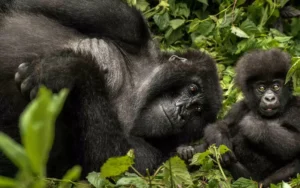
The Uganda Wildlife Authority enforces this limit strictly across all gorilla trekking Uganda parks — Bwindi Impenetrable National Park and Mgahinga Gorilla National Park. When your guide signals the hour is complete, you return to the trail regardless of what the gorillas are doing.
The limit creates something unexpected: urgency. Knowing you have exactly sixty minutes makes every interaction more present, more attentive and more deeply felt. You are not browsing. You are witnessing.
The Morning Before Your Hour Begins
One hour with mountain gorillas in Bwindi does not begin when you find them. It begins at park headquarters, between 7:00 and 8:00 AM, for the mandatory morning briefing.
Rangers assign your group to a specific gorilla family and trekking sector. Bwindi has four sectors — Buhoma, Ruhija, Rushaga and Nkuringo — each offering a different experience of the forest.
Your guide explains the rules: maintain at least seven metres from the gorillas, no flash photography, no eating or drinking near the gorillas, and turn away if you need to cough. These are conservation safeguards, not suggestions. They are enforced by trained rangers who accompany every group.
After the briefing, your group enters the forest. The trek to find your gorilla family can last anywhere from thirty minutes to seven hours, depending entirely on where the gorillas moved overnight.
The Trek: Earning the Encounter
Gorilla trekking Bwindi terrain is genuinely demanding. The forest sits at altitudes between 1,160 and 2,607 metres above sea level. You will navigate steep volcanic slopes, thick undergrowth and muddy trails that test your boots and your legs.
This is why hiring a porter is one of the best decisions you can make. For around USD 15 to 20, a local porter carries your daypack and steadies you on difficult sections. Every experienced trekker recommends it.
The forest itself rewards the effort. Bwindi Impenetrable Forest is one of Africa's most ancient ecosystems — unchanged for 25,000 years, holding over 200 tree species, 350 bird species and 120 mammals. The air is cool, damp and alive with sound.
By the time your trackers radio ahead to say the gorillas have been found, you have already had an extraordinary morning. What comes next is something else entirely.
First Contact: The Moment Everything Changes
Before your group reaches the gorillas, a team of trackers has been in the forest since before dawn. They follow the signs left overnight — broken branches, feeding debris, fresh nests — and radio your guide when the family is located.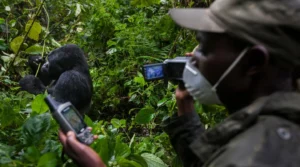
Your guide signals for silence. You move in single file. And then, without announcement, the gorillas are simply there.
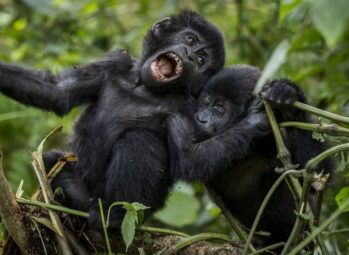
The first thing most people notice is not the size — though the size is staggering — but the ordinariness of what the gorillas are doing. A mother nurses her infant. Juveniles wrestle in a shaft of light. An adult female strips a branch of leaves with calm efficiency.
The silverback sits slightly apart, resting with the quiet authority of an animal that has nothing to prove. A mature male weighs over 180 kilograms. He looks at your group, assesses you and looks away. Your guide gives the signal. The hour begins.
What Gorillas Do During Your Visit
The encounter itself is not a performance. The gorillas do exactly as they please. What you witness depends entirely on what the family was already doing when your trackers found them.
Feeding is the most commonly observed behaviour. Gorillas consume up to 30 kilograms of vegetation daily — leaves, stems, bamboo shoots and fruit. Watch how methodically they work: selecting a branch, bending it toward the mouth, stripping it clean in one smooth pull. See also what Gorillas Eat
Grooming reveals the social structure of the family. A mother works through her infant's hair with total focus. Subordinate females groom the silverback as a gesture of social bonding. What looks like simple hygiene is a continuous, complex negotiation of relationships.
Play among juveniles is almost always the highlight. Young gorillas between two and eight years are fearless and physically bold. They tumble, chase, hang from branches and occasionally approach your group boundary out of curiosity. Their expressions are unmistakably expressive.
Vocalisation adds a dimension no photograph conveys. During rest periods, gorillas make low rolling belch vocalisations that pass through the group like a wave of contentment. It means, essentially, "all is well." Occasionally the silverback chest-beats — that famous percussion carrying through the forest. It is communicative, not aggressive. But experienced up close, it is extraordinary.
The Rules You Must Follow
The seven-metre distance rule is the most important. This minimum separation exists entirely to protect gorillas from human pathogens. If a gorilla approaches closer, remain still and let your ranger manage the situation.
No flash photography. Natural forest light produces extraordinary photographs. Use it.
Wear a mask when close to the gorillas. The 2026 protocol strictly enforces mask-wearing near gorilla families to prevent respiratory disease transmission. Bring a surgical mask and wear it properly.
Illness means staying behind. If you are unwell on trek day, you must not proceed. If you cannot trek due to illness, 50% of the gorilla permit Uganda fee may be refunded. Do not push through symptoms — a common cold can kill a gorilla.
The one-hour limit is absolute. No extensions are possible under any circumstances.
The Gorilla Permit Uganda: What You Are Paying For
A gorilla permit Uganda costs USD 800 per person in 2026 for foreign non-residents. A discounted rate of USD 600 applies during the low season — April, May and November.
Your gorilla permit Uganda includes one hour with the mountain gorillas, an experienced park guide, armed ranger security and park entrance fees. It does not cover accommodation, meals, transport or porter fees.
20% of every permit fee goes directly to local communities surrounding the park — funding schools, clinics and conservation jobs. This is the economic model that has driven the mountain gorilla population from fewer than 300 individuals in the 1980s to over 1,000 today.
As of March 2026, full payment is required immediately to secure a permit. The previous seven-day hold system has been discontinued. Book three to six months in advance for peak season — June to August and December to February.
The Four Sectors of Bwindi Impenetrable Forest
Bwindi Impenetrable Forest National Park covers 480 square kilometres across four trekking sectors. Your choice of sector shapes your entire experience.
Buhoma is the most accessible and established sector — the classic first-time entry point, with excellent lodge infrastructure and gentler terrain. Home to the Mubare family, the first ever habituated in Bwindi.
Ruhija sits at the highest altitude, offering cooler air, extraordinary birding and a genuinely remote feeling. The terrain is demanding. The experience is deeply rewarding for seasoned safari travellers.
Rushaga has the most habituated gorilla trekking Bwindi families in the park — giving you the highest probability of a smooth, successful trek day. It is also the only sector offering the Gorilla Habituation Experience.
Nkuringo offers the most dramatic landscapes in Bwindi, with sweeping views into the Democratic Republic of Congo. The treks here are the most physically challenging. The reward is an encounter that feels earned in every sense.
Want More Than One Hour? The Gorilla Habituation Experience
For those who want to go deeper, Uganda offers the Gorilla Habituation Experience (GHE) exclusively in Bwindi's Rushaga sector. It costs USD 1,500 per person and allows up to four hours alongside a semi-habituated gorilla family.
Only four visitors are allowed per day — making it one of the most exclusive wildlife encounters available anywhere in Africa. You join the research and ranger team, observing the gorillas through a full cycle of feeding, resting and moving.
One hour with mountain gorillas in Bwindi changes people. Four hours transforms them.
After the Hour: Walking Back Out
When your guide signals the end of the hour, the group turns and begins the trek back. This walk has a particular quality — a quiet that is different from silence.
People process the experience mostly without words. Some replay specific moments: the infant's face, the silverback's stillness, the sound of juveniles tumbling through undergrowth three metres away. Others simply walk and let the forest carry them out.
By the time you reach the trailhead, something has shifted. The world outside feels the same. Your relationship to it feels subtly different — as if you have been briefly reminded of something important that ordinary life tends to obscure.
Many travellers describe the encounter as the single most emotional wildlife experience of their lives. Not because anything dramatic happened, but because nothing needed to. The gorillas simply lived their day. You were present. That was enough.
Surveys of safari travellers consistently rank gorilla trekking Bwindi above game drives in the Serengeti, above whale watching and above Antarctic expeditions in terms of lasting emotional impact. The reason is proximity — not physical proximity alone, but something closer to recognition. Looking into a gorilla's eyes, you sense that something is looking back.
That is what one hour with mountain gorillas in Bwindi does. It is brief, irreplaceable and it stays with you for the rest of your life.
Best Time for One Hour With Mountain Gorillas in Bwindi
Gorilla trekking Bwindi is available year-round, and mountain gorillas can be visited in every month of the year. However, the timing of your visit affects the trekking conditions significantly.
The dry seasons — June to September and December to February — are the most popular periods. Trails are firmer, the forest is less muddy and visibility through the undergrowth is better. These are peak months, and gorilla permits sell out three to six months in advance.
The low season months of April, May and November bring afternoon rains that make trails slippery. However, the forest is at its most lush, the park is quieter and UWA currently offers gorilla permits at the discounted rate of USD 600 — saving USD 200 per person. Many experienced travellers consider low season the better choice.
Temperature in Bwindi averages around 11°C in the morning and 23°C in the afternoon year-round. Dress in layers and always carry a rain jacket regardless of the season.
How to Get to Bwindi Impenetrable Forest
Bwindi Impenetrable Forest sits in the far south-western corner of Uganda, near the borders with Rwanda and the Democratic Republic of Congo. Getting there requires planning, but the journey is part of the experience.
By road from Entebbe or Kampala: The drive takes approximately 8 to 10 hours via Mbarara or Kabale. Roads have improved significantly in recent years, and the scenery through south-western Uganda is spectacular — terraced hillsides, crater lakes and the rising highlands of the Albertine Rift.
By charter flight: A one-hour charter flight or scheduled aerolink flight from Entebbe connects to Kihihi airstrip (for Buhoma and Ruhija sectors) or Kisoro airstrip (for Rushaga and Nkuringo). This is the fastest option and dramatically reduces travel time.
From Rwanda: Many visitors combine gorilla trekking Uganda with Rwanda and cross into Bwindi via the Cyanika or Katuna border crossings — just a short drive from Volcanoes National Park. The East Africa Tourist Visa at USD 100 covers Uganda, Rwanda and Kenya.
Book Your Gorilla Trek With Tulambule Uganda Safaris
At Tulambule Uganda Safaris, we have been organising gorilla trekking Uganda safaris since 2014. We secure your gorilla permit Uganda, match you to the right sector for your fitness level, arrange accommodation and build your complete itinerary from Entebbe or Kigali.
Your hour in the forest is waiting. Contact us today to check permit availability for your travel dates and receive a personalised quote. Let us take you to the gorillas.
Affordable 3-Day Gorilla Trekking Uganda Safari tour
3 Days Fly-In Gorilla Safari Uganda!
5 Days Uganda Safari Gorillas, Chimps, Wildlife & Culture
12 Days Uganda Safari, Big Five, Chimps, Gorillas and Culture