Travellers who want to track gorillas in Uganda now have a much simpler way to get there. Uganda Airlines operates direct flights between London Gatwick and Entebbe International Airport, cutting out the layovers that used to make this trip a two day affair from the UK.
This guide covers what you need to know to track gorillas in Uganda, from getting there to what happens once you are standing in front of a wild mountain gorilla family.
It also looks at where to stay, how much to budget, and which parks pair well with a trek if you want to build a longer trip around it.
Why Uganda Is One of the Best Places to Track Gorillas
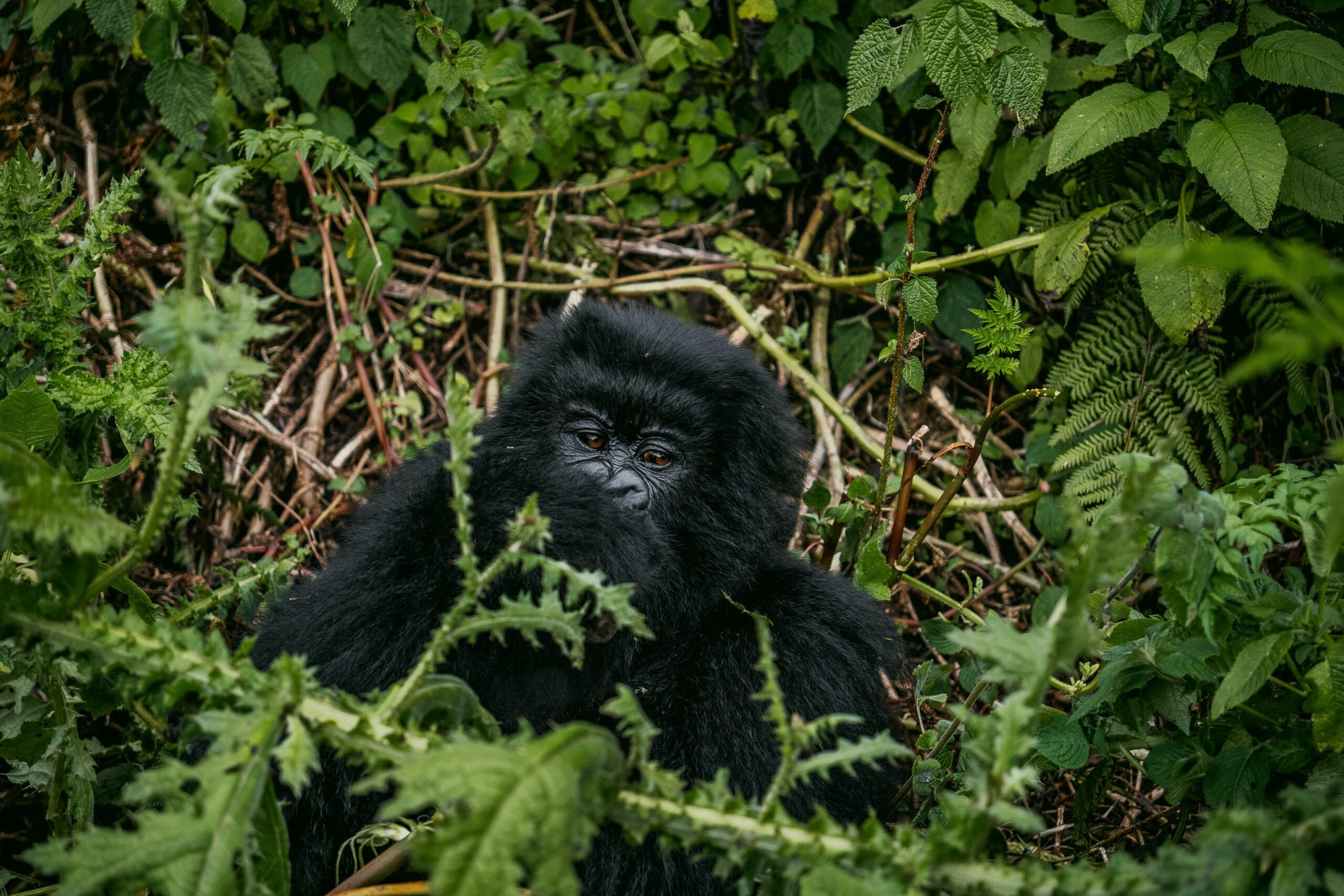
Uganda is home to nearly half of the world's remaining mountain gorillas. Most of them live in Bwindi Impenetrable National Park, a UNESCO World Heritage Site recognised for its exceptional biodiversity.
Smaller numbers also live in Mgahinga Gorilla National Park, near the Rwanda and DR Congo borders.
Unlike some other wildlife encounters, gorilla trekking is not a drive-by sighting. It is an active, physical experience that puts you on foot in the gorillas' own territory, following trackers who often set out hours before dawn to locate the family first.
Trekking here means guided hikes through dense, ancient rainforest to reach habituated gorilla families. Watching them forage, interact, and protect their young at close range is genuinely one of the most powerful wildlife encounters left on the planet.
For a full breakdown of permits, pricing, and park logistics, our complete gorilla trekking guide covers everything in detail.
What Actually Happens on a Gorilla Trek
A gorilla trek starts early, usually with a briefing at the park headquarters around 7:30am. Rangers assign each group of up to eight visitors to a specific gorilla family, based on that family's last known location.
Group sizes are capped deliberately, since smaller groups mean less noise and disturbance once you reach the gorillas themselves.
From there, it is a guided hike through dense forest, sometimes on a clear trail and sometimes cutting through undergrowth with the help of a machete-wielding guide. Trackers who went ahead at dawn radio back updates on the family's position, so the route can shift as you go.
Once you reach the gorillas, you get one hour with them. That hour is tightly regulated, and for good reason.
A maximum group size, a minimum viewing distance, and a strict no-flash rule all exist to protect the gorillas from stress and disease transmission, since mountain gorillas share enough DNA with humans to catch many of our illnesses.
Even so, one hour spent a few metres from a silverback and his family tends to feel like far more than sixty minutes.
Getting There: Direct Flights Make It Easier to Track Gorillas in Uganda
Since May 2025, Uganda Airlines has flown nonstop between London Gatwick and Entebbe four times a week, using a modern Airbus A330-800neo with business, premium economy, and economy cabins. That means UK travellers no longer need a layover in the Gulf or elsewhere in Europe to reach Uganda.
Entebbe International Airport is Uganda's main gateway, sitting on the shores of Lake Victoria. From there, it is roughly a five to six hour drive to Bwindi, or a short domestic flight if you would rather save the road time for game drives elsewhere.
Travellers outside the UK still have solid options. Airlines including Ethiopian Airlines, Qatar Airways, Kenya Airways, and Emirates all connect major global hubs to Entebbe with a single stop, typically through Addis Ababa, Doha, Nairobi, or Dubai.
For US and Canadian travellers especially, connecting through one of these hubs is often just as fast as routing through London, sometimes even faster depending on the specific city of departure. The direct Gatwick service mainly benefits UK based travellers and anyone already passing through Europe.
This shorter, simpler routing matters more than it sounds. Less time in transit means more energy for the trek itself, which is physically demanding and easier to enjoy when you are not still recovering from a rough journey.
Best Time to Track Gorillas in Uganda
Uganda's equatorial climate keeps temperatures fairly stable year round, generally between 20°C and 30°C. That said, timing still affects how comfortable the trek itself will be.
- Dry seasons (June to August, December to February). Trails are firmer and easier to navigate, which makes the hike itself less strenuous.
- Wet seasons (March to May, September to November). Trails get muddier and the trek is more physically demanding. However, this period brings fewer crowds and lush, vivid green forest for photography.
No matter when you go, Uganda's climate rarely rules out a trek entirely. It mostly comes down to how much mud you are willing to deal with.
Gorilla Trekking Permits and Preparation
Permits for Uganda's gorilla parks are limited and sell out well in advance, especially during the dry season. Booking early is not optional if you want a specific date or park.
A few essentials make the difference between an enjoyable trek and a miserable one:
- Sturdy, broken in hiking boots. This is not the trip to test out new footwear.
- Waterproof clothing. Even in the dry season, rainforest weather changes fast.
- Gardening gloves. Useful for gripping vegetation on steep sections of the trail.
- Insect repellent. Standard for any forest trek in this part of Uganda.
- A camera with a reasonable zoom. Flash photography is not allowed near the gorillas, so a lens that performs in low light helps.
Regular walking or light cardio training in the weeks before your trip also helps considerably, especially if your normal routine does not involve much hiking. Treks can last anywhere from one to eight hours round trip, depending on where the gorilla family happens to be that day.
Altitude in some sectors adds an extra layer of difficulty worth preparing for as well.
How Gorilla Tourism Supports Conservation in Uganda
Choosing to track gorillas in Uganda is not just an adventure. It is also one of the more direct ways a traveller can fund conservation.
Permit fees go straight toward anti poaching patrols, habitat protection, and park management carried out by the Uganda Wildlife Authority. This funding is a major reason Uganda's mountain gorilla population has grown steadily over the past two decades, rising from just a few hundred individuals to well over a thousand today.
That growth stands out at a time when so many other great ape populations are shrinking.
The benefits reach beyond the forest boundary too. Revenue from trekking supports healthcare, education, and infrastructure projects in communities living around Bwindi and Mgahinga.
In practice, this means a well run trek benefits the gorillas, the guides, and the villages nearby all at once.
Bwindi or Mgahinga: Which Park Should You Choose?
Most visitors track gorillas in Uganda through Bwindi, and there is a simple reason why. Bwindi holds around 20 habituated gorilla families spread across four trekking sectors, so it offers far more permit availability, route flexibility, and choice of accommodation style than Mgahinga.
Mgahinga Gorilla National Park, further south near the Rwanda and DR Congo borders, usually has just one habituated family. It is a smaller, quieter option, and it pairs well with a trip that also covers golden monkey tracking in the same park.
For most first time visitors, Bwindi is the more practical choice simply because of permit availability. Mgahinga suits travellers who have already trekked before and want a lower key, less crowded add-on.
Gorilla Habituation Experience: A Longer Alternative
Beyond the standard one hour trek, Bwindi also offers a gorilla habituation experience in its Rushaga sector. This lets a small group of visitors spend up to four hours with a gorilla family that is still being acclimatised to human presence, alongside researchers and trackers.
It costs more than a standard permit and requires a higher level of fitness, since the families involved are often deeper in the forest. In exchange, it offers a far more immersive, less rushed encounter.
Only two habituation permits are issued per day in Rushaga, which makes this option considerably harder to book than a standard trek and worth planning months in advance.
Beyond Gorilla Trekking: Other Things to Do in Uganda
Most travellers who come to track gorillas in Uganda end up building a longer trip around it, and the country makes that easy.
The Rwenzori Mountains, often called the Mountains of the Moon, offer snow capped peaks just a few hours from Bwindi, with hiking routes ranging from short day walks to multi day summit attempts.
Murchison Falls, where the Nile forces through a narrow gorge, adds dramatic scenery and strong lion sightings to the itinerary, particularly across its northern Buligi sector.
Queen Elizabeth National Park offers classic game drives and the famous tree climbing lions of Ishasha, while Kibale Forest is one of the best places in Africa for chimpanzee tracking.
Lake Bunyonyi, one of Africa's deepest lakes, rounds things out with a slower, more reflective stop between parks. Its terraced hillsides make for one of the more peaceful overnight stays on a Uganda itinerary.
Combining any of these with a gorilla trek turns a single bucket list hike into a full picture of what Uganda actually offers, from misty mountain forest to the open savanna of the Nile delta.
What Does It Cost to Track Gorillas in Uganda?
Gorilla trekking permits in Uganda are priced differently for foreign non-residents, foreign residents, and East African citizens. Prices are set directly by the Uganda Wildlife Authority rather than by individual operators, and the gorilla habituation experience costs more than a standard permit.
Beyond the permit itself, your overall budget also depends on accommodation choice, transport between Entebbe and Bwindi, and how many other parks you combine with the trek.
For exact, current permit pricing and full cost breakdowns, our complete gorilla trekking guide is kept up to date with the latest figures.
Where to Stay Near Bwindi
Accommodation near Bwindi ranges from simple guesthouses to high end luxury lodges, spread across the park's four main trekking sectors: Buhoma, Ruhija, Rushaga, and Nkuringo.
Buhoma is the most established and accessible sector, with the widest range of lodges and the shortest drive from the main road. This also makes it the easiest sector for combining gorilla trekking with a wider Uganda itinerary.
Ruhija sits at higher altitude and suits travellers combining gorilla trekking with birdwatching, since it borders one of Uganda's richest birding areas.
Rushaga and Nkuringo, in the south, offer access to more remote gorilla families and tend to have fewer crowds, though the drive in takes longer. These southern sectors are also where the gorilla habituation experience is based.
Where you stay should generally follow which sector your permit is assigned to, since driving between sectors on trek morning eats into rest time before an already demanding hike.
A good operator will match your lodge to your permit sector rather than the other way around, and will confirm that pairing well before you fly.
Practical Tips Before You Track Gorillas in Uganda
A few habits separate a smooth trip from a stressful one.
- Book permits early. Especially for dry season dates, permits can sell out months ahead.
- Pack for the forest, not the savanna. Waterproof layers matter more here than they do on a standard game drive.
- Follow the guides' instructions closely. Distance rules exist to protect both you and the gorillas, and a good guide will never compromise on them.
- Build in a buffer day. Weather or park access can occasionally shift trek dates, so avoid scheduling an international flight the same afternoon as your trek. A single spare day near Bwindi also gives you room to rest before the drive back to Entebbe.
Frequently Asked Questions About Tracking Gorillas in Uganda
How do I get to Uganda to track gorillas? Uganda Airlines now flies direct from London Gatwick to Entebbe four times a week, removing the need for a layover from the UK. From Entebbe, it is roughly a five to six hour drive or a short domestic flight to Bwindi.
What is the best time to track gorillas in Uganda? The dry seasons, from June to August and December to February, offer firmer trails and an easier hike. The wet seasons bring fewer crowds and greener scenery, at the cost of muddier trails.
How fit do I need to be to track gorillas? Treks can run from one to eight hours depending on where the gorilla family is that day. Regular walking or light cardio training beforehand makes a real difference.
Do gorilla trekking fees actually help conservation? Yes. Permit revenue funds anti poaching patrols and habitat protection through the Uganda Wildlife Authority, and also supports healthcare, education, and infrastructure in communities around the parks.
Can children track gorillas in Uganda? The Uganda Wildlife Authority sets a minimum age of 15 for gorilla trekking. This is a safety measure, both for the child and for the gorillas, since young children can struggle with the noise discipline the trek requires.
Is it safe to track gorillas in Uganda? Yes, when done through a licensed operator with certified ranger guides. Rangers carry out daily health and safety checks on both the trails and the gorilla families themselves.
Strict distance rules protect visitors and gorillas alike, so following your guide's instructions is the single most important safety habit on the trek.
How long does the actual trek take? Anywhere from one to eight hours round trip, depending on where the assigned gorilla family happens to be that day. Rangers and trackers set out ahead of the main group to locate the family first.
Can I combine gorilla trekking with a Uganda safari in one trip? Yes, and most visitors do exactly that. A common pattern pairs a few days trekking in Bwindi with game drives in Queen Elizabeth or Murchison Falls.
Both parks are a manageable drive from the gorilla sectors and add the classic big game sightings a gorilla-only trip would miss.
Continue Planning Your Trip
Ready to track gorillas in Uganda for yourself? Read our complete gorilla trekking guide for permit and pricing detail, explore our safari itineraries, or build your own custom safari around Bwindi and beyond today.
Have questions first, or want help matching a permit sector to the right lodge? Get in touch with our team and we will help you plan the right trip from start to finish.