Walking safaris in Lake Mburo National Park offer the rarest thrill in Uganda—experiencing the wild entirely on foot, and this guide reveals exactly why it must top your bucket list.
Walking Safaris in Lake Mburo National Park – The one and ONLY Park in Uganda for This
There is a particular sound that defines the African wilderness. It is not the roar of a lion or the trumpet of an elephant, as the documentaries would have you believe. It is the silence.
The profound, heavy, electric silence that descends when a herd of buffalo stops chewing to stare directly at you. In that moment, there is no engine humming beneath your seat, no roof casting a shadow over your head, and no glass window separating you from 800 kilograms of raw muscle and hide.
You are simply standing on the red, dusty earth, holding your breath.
This is the reality of a walking safari in Lake Mburo National Park. Across the vast, sprawling savannahs of East Africa, this experience is often reserved for the ultra-luxury camps of Kenya or the private concessions of Tanzania. But here, tucked away in the western corridor of Uganda, lies a national park that breaks every rule.
Walking safaris in Lake Mburo National Park are not merely an optional add-on to a standard game drive; they are the park’s crowning glory. It is the singular, definitive location in the Pearl of Africa where the Uganda Wildlife Authority permits tourists to dismount their vehicles and traverse the bush on two feet.
For the discerning traveler who craves authenticity over convenience, who wants to feel the heartbeat of Africa rather than just observe it from a distance, Lake Mburo is the ultimate destination. This will guide you through every facet of this exclusive Ugandan adventure, from the wildlife you will encounter to the trails you will tread, ensuring you understand exactly why this park holds a unique, untouchable status in Uganda’s tourism portfolio.
Why Lake Mburo Stands Alone as Uganda’s Only Walking Safari Destination
To truly appreciate the rarity of walking safaris in Lake Mburo National Park, one must first understand the geographical and ecological dynamics of Uganda.
The country is home to over ten distinct national parks, each a masterpiece of biodiversity. Murchison Falls boasts the powerful Nile and massive elephant herds. Queen Elizabeth is famous for its tree-climbing lions and sprawling savannah. Bwindi is the impenetrable fortress of the mountain gorilla.
Yet, none of these iconic parks allow you to walk freely through the bush.
Why?
The answer lies in predator density and terrain. Parks like Murchison and Queen Elizabeth harbor large populations of lions, leopards, and hyenas that roam in unpredictable packs.
While these predators are magnificent to view from a vehicle, allowing tourists to walk among them would be a recipe for disaster. Similarly, the dense, mountainous forests of the west are plagued by volatile weather and thick undergrowth, making foot travel dangerous and logistically impossible.
Lake Mburo, however, is different. It is a remarkably safe, open, and manageable ecosystem. At just 370 square kilometers, it is Uganda’s smallest savannah park. Its topography is a mosaic of rolling hills, seasonal swamps, and acacia woodlands. Crucially, Lake Mburo lacks the apex predator density found elsewhere. There are no lions. Elephants are absent.
This ecological quirk creates a perfectly controlled environment for pedestrian exploration. The wildlife here is predominantly plains game—herbivores that are accustomed to the sight of humans moving slowly and respectfully.
When you book walking safaris in Lake Mburo National Park, you are stepping into a sanctuary where the primary threat is getting your boots muddy, not facing a charging predator.
Furthermore, the Uganda Wildlife Authority rigorously regulates these walks. No one is allowed to traverse the park without an armed ranger. These rangers are not just guards; they are master naturalists trained in tracking, behavior reading, and emergency response.
They know the temperament of the local buffalo herds and the migration patterns of the eland.
In essence, Lake Mburo is the Ugandan government's designated playground for the pedestrian adventurer. It is the only place in the nation where the law, the ecology, and the infrastructure align to offer this rare, privileged perspective. To miss out on this when visiting Uganda is akin to visiting the Sistine Chapel and refusing to look up.
The Gentle Giants and Plains Game You’ll Meet on Foot
The magic of walking safaris in Lake Mburo National Park is magnified by the incredible diversity of wildlife you encounter at eye-level. When you are seated in a vehicle, animals often regard you as a single, large, uninteresting mechanical object.
However, when you are on foot, you become distinctly human. The animals react with genuine, instinctual curiosity and wariness, providing photographic moments that are impossible to replicate from a truck.
The Burchell’s Zebra
Perhaps the most iconic resident of Lake Mburo is the Burchell’s zebra. Lake Mburo boasts the largest population of zebras of any Ugandan park. 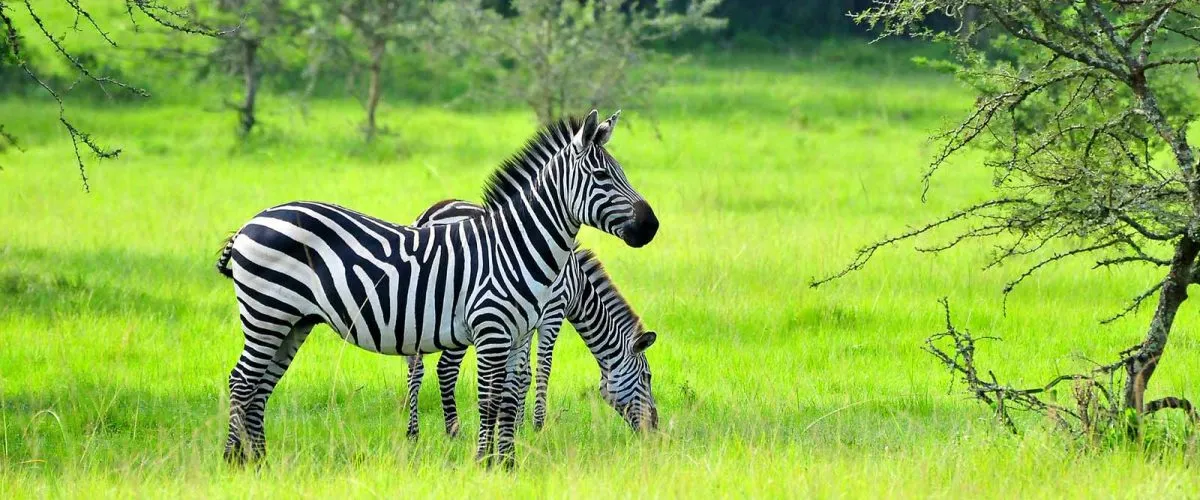
On walking safaris in Lake Mburo National Park, you will encounter these striking, monochrome equids grazing placidly against the backdrop of the park’s granite outcrops. On foot, you can clearly hear their unique barking calls and the rhythmic swishing of their tails swatting tsetse flies.
They are usually quite tolerant of human presence, allowing you to observe their intricate social hierarchies—the dominant stallions herding their mares—from a respectful but thrillingly close distance.
The Majestic Eland and Defassa Waterbuck
Walking safaris in Lake Mburo National Park allow you to appreciate sheer scale. The eland, the world’s largest antelope, stands taller than a man at the shoulder.
When you encounter a bull eland on foot, its sheer bulk and the dewlap swinging beneath its throat are awe-inspiring. Equally impressive is the Defassa waterbuck, distinguished by the white, toilet-seat-shaped ring on its rump.
These animals are highly adapted to the damp fringes of the lake and the seasonal swamps. Walking in these areas means wading through marshy ground, inhaling the earthy scent of wet mud and watching these graceful creatures bound away with surprising agility.
The Cape Buffalo – Respect from a Distance
While Lake Mburo lacks lions, it is home to the notoriously unpredictable Cape buffalo. These are the "Black Death" of the African bush, responsible for more hunter fatalities than any other animal. Your ranger will guide you expertly around the buffalo herds, ensuring you maintain a safe distance.
Observing a buffalo from the safety of the ground, feeling the vibration of their heavy hooves as they shift their weight, instills a level of respect that the armored safety of a car simply cannot convey. You learn to read their body language—the flick of an ear, the curl of a lip—which is an education in African survival.
The Topi and Impala
The open grasslands are also home to the fleet-footed topi and impala. Walking gives you the edge here. Without the noise of an engine, you can get remarkably close to these acrobatic antelopes. You’ll hear the sharp, alarm-call snorts of the impala, warning the herd of your presence—a sound that becomes the ambient soundtrack of your adventure.
The Hippo and Crocodile
As you approach the shores of Lake Mburo and its connecting swamp systems, the tenor of the walk changes. You will likely halt at a safe overlook to observe pods of hippos submerging and surfacing with a great expulsion of air. On foot, the smell of the hippo latrines and the grunting, guttural chorus of the pod is visceral and overpowering.
Similarly, you will spot the eyes of Nile crocodiles just breaking the water’s surface, a chilling reminder that while you are safe on land, the water belongs to them.
Exploring the Diverse Trails of the Park
A key reason why walking safaris in Lake Mburo National Park never get monotonous is the sheer variety of trails. The park’s geography allows for distinct "micro-habitats," each offering a different sensory experience.
The Salt Lick Trail
Perhaps the most rewarding route for wildlife viewing is the trail leading to the salt lick. Animals are drawn to the mineral-rich soils found at various points around the lake.
During the dry season, this is a magnet for herbivores. Walking this trail, you will find yourself surrounded by a confluence of species—zebras jostling with waterbucks, while warthogs kneel to dig for roots.
The ranger will use the terrain to position you downwind, ensuring the animals are unaware of your presence for as long as possible.
The Rubanga Forest Walk
A complete change of scenery awaits in the Rubanga Forest. This is a narrow strip of dry, tropical forest featuring massive, gnarled fig trees and dense thicket. Walking here is a shady, cool respite from the savannah heat. The acoustics change entirely; the open plains' silence gives way to the raucous calls of forest birds.
This trail is exceptional for spotting the elusive bushbuck, which dart through the undergrowth, and the stunningly beautiful African green pigeon.
The Kazuma Lookout Trail
For those wanting a cardiovascular challenge combined with panoramic vistas, the Kazuma Trail ascends the eastern escarpment. The walk is steep, requiring a moderate level of fitness, but the reward at the summit is breathtaking.
You gain a bird’s-eye view of the entire park, the shimmering lake, and the distant blue hills of the greater Ankole region. It is an ideal spot for a packed breakfast or a sundowner, watching the shadows lengthen over the savannah you just traversed.
The Swamp Fringe Walk
The seasonal papyrus swamps are a different beast entirely. Walking along the fringe of the swamp, your ranger will stop frequently to point out the endemic papyrus gonolek, a striking red-and-black bird that is notoriously difficult to photograph.
The ground is spongy, the air is humid, and the giant kingfishers dive like torpedoes into the murky water. It is a reminder that Lake Mburo is not just a savannah park; it is a wetland wonder.
The Twilight Experience – Night Walking Safaris in Lake Mburo National Park
Just when you think walking safaris in Lake Mburo National Park have peaked, the sun dips below the horizon, and a completely new world awakens. Most parks close their gates at dusk. Lake Mburo, however, offers the extraordinary privilege of a night walking safari.
This is not a stroll under the stars; it is a sensory raid into the nocturnal realm. Equipped with high-powered spotlights, your ranger will lead you into the darkness.
The first thing you notice is the temperature drop and the amplified sounds—the chirping of crickets, the cough of a leopard (which inhabit the park but are rarely seen), and the distant rumble of hippos leaving the water to graze.
The Nocturnal Predators
The spotlight scans the grasslands, catching the red glow of hyena eyes. Lake Mburo has a healthy population of spotted hyenas, and on a night walk, you might hear their eerie, maniacal laughter echoing across the hills. While they are predators, they are generally shy of humans, allowing for safe and riveting observation as they scavenge or hunt small duikers.
Hippos on the Lawn
The most heart-stopping aspect of the night walk is encountering hippos grazing on the terrestrial grasslands. Hippos do not swim at night; they walk miles to find fresh grass.
With no water to retreat into, they are intensely defensive. However, your ranger carries a high-caliber rifle not for hunting, but for firing warning shots into the air to deter a charge.
Standing in the pitch black, listening to the heavy, rhythmic chopping of a hippo’s jaw as it grazes, is an adrenaline dump that few travel experiences can match. It is a raw, unfiltered interaction with the untamed.
When to Embark on Walking Safaris in Lake Mburo National Park
Timing is everything. While walking safaris in Lake Mburo National Park are available year-round, the quality of your experience depends heavily on the season.
The Dry Season Peak (June – August & December – February)
This is the prime time for walking. The vegetation is sparse, giving you clear lines of sight across the savannah. Animals congregate around the few remaining permanent water sources, making them highly predictable and easy to locate. The trails are firm, and the risk of encountering deep mud is minimal.
However, note that this is peak tourism season in Uganda, so you will want to book your permits early. The mornings are crisp, and the visibility is unmatched.
The "Green" Season (March – May & September – November)
Walking in the rainy season is a vastly different, though equally rewarding, challenge. The park explodes into life. The dry, dusty acacias don vibrant green foliage. The migratory birds arrive in huge numbers, making this the premier time for birders. Expect breathtaking, dramatic skies and sudden, refreshing downpours. The main caveat is the mud. Trails become slippery, and some routes to the salt licks may be inaccessible. Furthermore, the taller grass reduces visibility, making wildlife encounters more sudden—and more thrilling. If you choose this time, robust, waterproof boots are non-negotiable.
Essential Preparation for Your Walking Safari
Unlike a game drive, where you can wear shorts and flip-flops, participating in walking safaris in Lake Mburo National Park requires thoughtful preparation. Your safety and comfort are directly correlated to the gear you bring.
The Gear List
-
Footwear: This is the most critical item. Invest in high-ankle, waterproof hiking boots that are already broken in. Blisters are the enemy of the walking safari.
-
Clothing: Wear long, breathable trousers (khaki, olive, or beige). Colors matter; avoid blue and black (which attract tsetse flies) and white (which is too visible). Long sleeves are essential for protecting against the sun and thorny branches.
-
Layers: The temperature fluctuates wildly. The morning walk can start at a chilly 10°C (50°F), but by 10 AM, it can easily hit 30°C (86°F). A lightweight, quick-dry jacket that can be tied around your waist is a lifesaver.
-
Accessories: A wide-brimmed sunhat, polarized sunglasses, and a high-SPF sunscreen are mandatory. Bring the smallest possible daypack to carry your camera and water.
Physical Fitness and Hydration
A typical walking safari covers 3 to 6 kilometers (2 to 4 miles), often off-trail. While this is moderate, the terrain can be uneven, and the altitude (the park sits at 1,220 meters) can tire the unaccustomed. Ensure you are reasonably mobile. Your ranger will set a pace suitable for the group, but you should carry at least 2 liters of water per person to avoid dehydration under the equatorial sun.
Communication and Protocol
Before the walk, your ranger will give a detailed safety briefing. Listen intently. The golden rules of walking safaris are:
-
Stay in a tight group, walking single file.
-
Do not run (running triggers a predator's chase instinct).
-
Keep your voice to a low murmur; the bush transmits sound incredibly well.
-
Always follow the guide's hand signals immediately—if he stops, you stop; if he crouches, you crouch.
Beyond the Wildlife – The Landscape and Culture
The Acacia Woodlands
Walking allows you to appreciate the botanical giants of the area. The rolling hills are peppered with magnificent acacia trees. The ranger will point out the symbiotic relationship between the acacia and the ants that live within their spines. You will learn which herbs are used by the local communities for medicinal purposes, offering a deeper cultural context to your trek.
The Bahima Homesteads
From the high vantage points, you will spot scattered "manyattas" (traditional homesteads) outside the park boundaries. The sight of a cowherd in his vibrant robe, moving silently with his cattle through the morning mist, is a poignant reminder that this landscape is not just a zoo—it is a working, living cultural heritage that has persisted for millennia.
Walking vs. Driving – The Psychological Shift
There is a profound psychological difference between viewing wildlife from a vehicle and viewing it on foot. In a car, you are a spectator. The experience is framed by a metal rectangle, like watching a nature documentary with the volume turned up.
When you step out for walking safaris in Lake Mburo National Park, you become a participant. The air smells different—heavy with dust, dung, and wild sage. You feel the gradient of the hills in your calves. You notice the tiny things: the intricate patterns of a beetle’s shell, the delicate tracks of a mongoose, the different textures of antelope dung that tell you how old the trail is.
Furthermore, the animals see you differently. When you are on foot, you are small, vulnerable, and respectful. You are a primate navigating the savannah, just as our ancestors did. This primordial sensation—the hyper-awareness of your surroundings, the quickening of your pulse at a sudden sound—reconnects you with a part of your evolutionary history that modern tourism has rendered obsolete.
Photography on Foot – Capturing the Unfiltered Moment
For photographers, walking safaris in Lake Mburo National Park present a unique challenge and reward. Without the restrictions of a vehicle's roll bar, you can shoot from a lower, eye-level perspective. This creates portraits of animals that feel intimate, as if you are sharing a private moment with them.
However, walking photography requires stealth. You cannot use a tripod or a heavy 600mm lens easily. A 70-200mm lens is often perfect for the distances you will encounter. Crucially, you must turn your camera's shutter sound to silent mode, as the mechanical click can spook the wildlife.
The golden light of sunrise and sunset is particularly spectacular on foot, as you can position yourself exactly where the light breaks through the acacia trees, creating stunning silhouette shots against the shimmering lake.
Step into the Exclusive Wilderness
Uganda is revered for its mountain gorillas, its thundering Nile, and its dense jungles. But rarely does a traveler return home saying they walked among the zebras.
To have experienced walking safaris in Lake Mburo National Park is to carry a secret trophy—a badge of honor that separates you from the thousands of tourists who merely drove through.
This is not just a vacation activity; it is a rite of passage. It is the ticking of a bucket list item that many do not even know exists. By choosing Lake Mburo, you are choosing the road less traveled. You are choosing to feel the sun on your neck, the soil under your boots, and the wild pulse of the African bush in your chest.
Now, it is time to turn inspiration into action. Uganda is waiting for you to step out of the vehicle and into the wild.
Are you ready to take that first step? Are you ready to cross the boundary from observer to explorer?
Let Tulambule Uganda Safaris be your trusted partner in this extraordinary journey. We are not just tour operators; we are architects of authentic adventure.
We will secure your walking permits, pair you with the most experienced armed rangers in the region, and curate a seamless itinerary that combines the thrill of the walk with the luxury of lakeside lodging.
Whether you need airport transfers, customized tour extensions, or simply the reassurance of expert planning, we handle the logistics so you can focus entirely on the raw, unfiltered beauty of the savannah.
Do not settle for looking through the glass.
Contact Tulambule Uganda Safaris today to help you experience your ultimate walking safari. Uganda’s only walking safari park is calling—and the adventure of a lifetime has your name on it. Secure your place on the trail now, because in the wilderness, the footprints fade fast, but the memories last forever.