Mountain Gorillas and Lions Safaris in Africa: The Ultimate Wildlife Double — Why Uganda and Rwanda Lead the World
Focus Keyword: Mountain Gorillas and Lions Safaris in Africa Meta Title: Mountain Gorillas and Lions Safaris in Africa | Uganda & Rwanda | Tulambule Meta Description: Discover the best mountain gorillas and lions safaris in Africa. From Bwindi's gorillas to Uganda's tree-climbing lions and Rwanda's Volcanoes — your complete guide by Tulambule Uganda Safaris.
Africa has always been the continent of extraordinary wildlife encounters. But among everything this magnificent continent offers — the wildebeest migration, the Big Five, the vast Serengeti plains — two experiences stand in a league entirely of their own. Coming face to face with a mountain gorilla deep in the mist of an ancient rainforest. And watching a pride of lions draped across the branches of a towering fig tree in golden afternoon light.
These are not just wildlife sightings. They are transformative, once-in-a-lifetime encounters that redefine what it means to travel in Africa.
And the extraordinary news? Both experiences are possible in Uganda — and the combination of mountain gorillas and lions safaris in Africa reaches its absolute pinnacle when you combine Uganda with neighbouring Rwanda. No other safari destination on earth offers this pairing in such an accessible, affordable and richly rewarding way.
At Tulambule Uganda Safaris, we have been crafting these extraordinary journeys since 2014. In this guide we take you deep into the world of mountain gorillas and lions safaris in Africa, with a special focus on Uganda and Rwanda — the two countries that have redefined what an African safari can be.
Mountain Gorillas: The Most Compelling Wildlife Encounter on Earth
There are approximately 1,064 mountain gorillas left in the entire world. They live in just three countries — Uganda, Rwanda and the Democratic Republic of Congo — across two separate mountain ecosystems. Nowhere else on Earth can you find them. They cannot survive in captivity. They cannot be observed in any zoo. The only way to see a mountain gorilla is to travel to their forest home and trek to meet them on their own terms.
That rarity is part of what makes a mountain gorilla encounter so profoundly moving. But it is the encounter itself — the moment of connection — that changes people permanently.
Mountain Gorillas in Uganda — Bwindi Impenetrable Forest
Uganda is home to the world's largest population of mountain gorillas, primarily in Bwindi Impenetrable National Park in the country's southwest. There are currently about 1,064 mountain gorillas in the world, living in two separate locations — one group in the Virunga Mountains straddling the borders of Uganda, Rwanda and Congo, and the other in Bwindi Impenetrable National Park in southwest Uganda.
Bwindi is one of Africa's most ancient and biodiverse forests — a 25,000-year-old rainforest spanning approximately 79,000 acres across steep ridges and mist-filled valleys. Mountain gorillas can survive only in their natural habitat, so trekking into their native forests like Uganda's Bwindi Impenetrable Forest is your only chance to see these gorillas in the wild.
With over 20 habituated gorilla families spread across four trekking sectors — Buhoma, Ruhija, Nkuringo and Rushaga — Bwindi offers more gorilla trekking options than any other destination in the world. Each sector has its own character, its own lodges and its own collection of gorilla families, giving travellers real choice in how they experience this extraordinary encounter.
The gorilla trek itself begins at dawn. After a briefing by Uganda Wildlife Authority rangers, you head into the forest with a team of experienced trackers who have been monitoring your assigned gorilla family since first light. The trekking time varies — anywhere from one hour to a full day of hiking through dense vegetation — but the moment you find the family, everything else falls away.
You are allowed one hour in the presence of the gorillas. Eight visitors maximum. No rushing, no noise, no flash photography. Just you, the ancient forest and a family of mountain gorillas going about their daily lives — feeding, resting, playing, communicating. A silverback may hold your gaze for a long, quiet moment. A baby may tumble towards your boots. A mother may nurse her infant just metres from where you stand.
It is one of the most extraordinary hours available to any traveller anywhere in the world.
Uganda gorilla permit cost: $800 per person
For those who want an even more immersive experience, Bwindi's Rushaga sector offers the Gorilla Habituation Experience — four hours spent with a gorilla family that is still being accustomed to human presence, limited to just four visitors per day at $1,500 per person.
Mountain Gorillas in Uganda — Mgahinga Gorilla National Park
Uganda's second gorilla park, Mgahinga Gorilla National Park, sits in the dramatic volcanic Virunga mountains on the country's southwestern border with Rwanda and the DRC. Smaller and less visited than Bwindi, Mgahinga is home to one habituated gorilla family — the Nyakagezi family — and offers a quieter, more off-the-beaten-path trekking experience.
Mgahinga is also the only place in Uganda where you can track golden monkeys through the bamboo forests of the Virunga volcanoes. Combined with gorilla trekking and the dramatic mountain scenery, Mgahinga is one of Uganda's most underrated safari experiences.
Mountain Gorillas in Rwanda — Volcanoes National Park
Rwanda's Volcanoes National Park is the other great gorilla trekking destination in Africa, and it deserves to be on every mountain gorilla and lions safari itinerary. Rwanda's flagship reserve, Volcanoes National Park, lies only 80 kilometres — about three hours by road — from Kigali International Airport. This accessibility makes Rwanda the most convenient gorilla trekking destination for travellers arriving by air.
Volcanoes National Park sits in the northwestern corner of Rwanda, encompassing five of the eight volcanoes in the Virunga Mountains range. The scenery here is breathtaking — a chain of ancient volcanoes draped in equatorial forest, rising dramatically from the surrounding hills. Rwanda has ten habituated gorilla families available for trekking, each visited by a maximum of eight people per day.
The Rwanda gorilla trekking experience tends to be slightly shorter in distance than Bwindi — the park is more compact and families are often located closer to the trailhead. This makes it an excellent option for travellers with limited time or those who prefer a less demanding trek.
Rwanda gorilla permit cost: $1,500 per person
Rwanda also offers golden monkey tracking in Volcanoes National Park — a wonderful addition to any gorilla safari. These vivid primates with their striking golden-orange patches are found only in the Virunga Mountain region and are a joy to encounter in the bamboo forest.
Comparing Uganda and Rwanda for Gorilla Trekking
Both Uganda and Rwanda offer world-class gorilla trekking experiences. Here is how they compare:
Uganda advantages:
- More affordable permit at $800 vs Rwanda's $1,500
- More gorilla families available — over 20 in Bwindi alone
- Opportunity to combine gorillas with Uganda's extraordinary array of other wildlife
- Gorilla Habituation Experience available in Rushaga
- Bwindi is the only forest in Africa where gorillas and chimpanzees coexist
Rwanda advantages:
- Closer to Kigali airport — ideal for short itineraries
- Shorter average trekking distances
- Combines well with Akagera National Park's Big Five wildlife
- Kigali is one of Africa's most modern and sophisticated capital cities
- Can be done as a day trip from Kigali in theory, though overnight is recommended
For the ultimate mountain gorilla experience, the best option is to combine both — trekking gorillas in Uganda and Rwanda on a single cross-border safari. At Tulambule Uganda Safaris, we design seamless cross-border itineraries that allow you to experience both destinations in one unforgettable journey.
Lions Safaris in Africa — Uganda's Extraordinary Secret
When most people think of lions in Africa, they picture the Serengeti, the Maasai Mara or the Okavango Delta. But Uganda holds one of the continent's most extraordinary and least-known lion spectacles — and it happens to be located just a few hours' drive from Bwindi, making it the perfect complement to a gorilla trekking safari.
The Tree-Climbing Lions of Ishasha — A Safari Like No Other
The Ishasha Sector in Queen Elizabeth National Park is one of the only two places in the world where you can see tree-climbing lions. The other is Lake Manyara National Park in Tanzania, where it is harder to track them because they are few.
In Ishasha, by contrast, the lions love climbing the common acacia and large sycamore fig trees found on the plains, especially during the dry seasons. Because entire prides spend their day on top of trees, the chances of seeing the lions in Ishasha are very high.
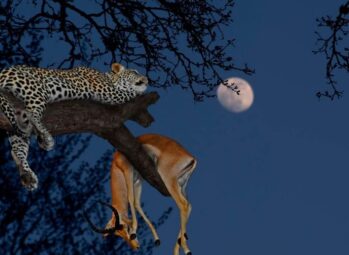
This is one of Africa's most surreal and captivating wildlife sights. You are cruising through open savannah in your 4x4 safari vehicle when your guide points upward. There, lounging across the broad branches of a sycamore fig tree fifteen feet above the ground, is an entire pride of lions — some sleeping, some watching the plains below, some grooming one another with complete indifference to the vehicle below. A large male with a distinctive dark mane stretches a massive paw over a branch. A young cub peers down with enormous amber eyes.
After mountain gorillas, lions are the second most sought-after species by travellers in Uganda.
Why Do Ishasha's Lions Climb Trees?
This question has fascinated researchers and safari guests alike for generations. Scientists have not reached a full consensus on why these lions in particular climb trees, but several theories have emerged.
The most widely accepted explanations include:
Escaping insects: Theories suggest they do this to escape the heat on the ground, avoid insects like tsetse flies, and gain a strategic view of their territory. The ground level in Ishasha can be dense with biting insects, while the breeze in the tree canopy provides welcome relief.
Staying cool: The shade of the broad fig tree branches offers shelter from the intense equatorial heat during the hottest hours of the day. Lions are most visible in trees during midday — precisely because the branches offer what the ground does not.
Hunting advantage: Perched in the trees, lions have an elevated vantage point over the open plains, allowing them to monitor the movements of Uganda kob — their primary prey — across vast distances before descending to hunt.
Learned behaviour: Tree climbing is thought to pass down from one generation to the next through learning rather than genetics. Lions in Ishasha learn to climb from their mothers and pride members — it is a cultural behaviour unique to this population.
The Ishasha Sector — Queen Elizabeth National Park
Ishasha is located in the southern sector of Queen Elizabeth National Park, Uganda's most popular national park. Around 20 to 35 lions live in the Ishasha sector, organised into several prides that roam the open savannah plains between the park and the border with the Democratic Republic of Congo.
The geography of Ishasha adds to the drama. This is a remote, wild corner of the park — less visited than the northern Kasenyi sector, with fewer vehicles and a rawer, more undisturbed atmosphere. Driving through Ishasha feels like entering an Africa that has changed very little in a thousand years.
Beyond the tree-climbing lions, Ishasha is also home to large herds of Uganda kob, African buffalo, elephants, warthogs, leopards, hyenas and a rich variety of bird species. The Ishasha sector is an excellent location for game drives as it is a quieter section of the park. You can enjoy the sights and sounds of the wilderness without the distant drone of other safari engines.
Best Time to See the Tree-Climbing Lions
Tree climbing lions can be spotted at any time of the year at Ishasha, but the dry months are the best for you to catch a glimpse. The dry months start in June, July, August, September and December, January and February. During these months, the ground is less slippery compared to wet months.
During the dry season, the shorter grass also makes it easier to spot wildlife on the open plains, and the lions tend to spend more time in the trees during the hotter midday hours — making afternoon game drives particularly rewarding.
Lions in Rwanda — Akagera National Park's Big Five Comeback
Rwanda's contribution to lions safaris in Africa is equally compelling, though the story is very different from Uganda's. In 2015, lions were released in Akagera National Park, followed by Eastern black rhinos two years later. These successful reintroduction programmes have made Akagera a celebrated Big Five safari destination for the first time in almost 20 years.
Akagera National Park in eastern Rwanda — bordering Tanzania — is now one of Africa's great conservation success stories. After decades of conflict and poaching that decimated its wildlife, Akagera has been transformed through a partnership between the Rwanda Development Board and African Parks. Today it is home to lions, leopards, elephants, buffaloes, black rhinos, hippos, giraffes and over 500 bird species.
A game drive in Akagera combined with gorilla trekking in Volcanoes National Park gives you a complete Rwanda safari experience — primates in the volcanoes, Big Five on the savannah.
The Perfect Safari Itinerary — Mountain Gorillas and Lions in Uganda and Rwanda
The most compelling mountain gorillas and lions safari in Africa combines Uganda's extraordinary wildlife with Rwanda's accessibility and conservation story. Here is a sample 10-day itinerary:
Day 1 — Arrive Entebbe, transfer to Fort Portal Day 2 — Chimpanzee trekking in Kibale National Park Day 3 — Drive to Queen Elizabeth National Park via crater lakes Day 4 — Morning game drive in Kasenyi sector, afternoon Kazinga Channel boat cruise Day 5 — Game drive in Ishasha sector — tree-climbing lions Day 6 — Drive to Bwindi Impenetrable Forest Day 7 — Mountain gorilla trekking in Bwindi Day 8 — Drive to Kigali, Rwanda — city tour Day 9 — Mountain gorilla trekking in Volcanoes National Park, Rwanda Day 10 — Return to Kigali, departure
This itinerary delivers gorilla trekking in both Uganda and Rwanda, the famous Ishasha tree-climbing lions, chimpanzee trekking in Kibale, game drives and a Kazinga Channel cruise — the complete East African primate and wildlife safari experience.
Shorter versions of this safari are available from 5 days, focusing specifically on gorilla trekking and the Ishasha lions.
Why Uganda and Rwanda Are Africa's Best Safari Destination Combination
No other pairing of African countries delivers the breadth of wildlife experiences that Uganda and Rwanda offer together. Consider what this combination gives you:
Primates: Mountain gorillas in Bwindi and Volcanoes, chimpanzees in Kibale and Kyambura Gorge, golden monkeys in Mgahinga and Volcanoes, colobus monkeys, red-tailed monkeys and many more.
Big cats: The unique tree-climbing lions of Ishasha — found nowhere else in East Africa with such reliability — leopards in Queen Elizabeth and Akagera, and the returning lion population in Rwanda.
Wildlife diversity: Elephants, buffaloes, hippos, crocodiles, giraffes, Uganda kob, warthogs and over 600 bird species in Queen Elizabeth alone — making it one of Africa's most biodiverse parks.
Landscapes: Ancient rainforests, volcanic mountain ranges, open savannahs, crater lakes, the mighty River Nile and some of the most beautiful lake scenery in Africa.
Conservation stories: Both countries are global leaders in wildlife conservation. Uganda's mountain gorilla population has grown steadily. Rwanda's Akagera lion and rhino reintroduction is celebrated worldwide. Your safari visit contributes directly to these conservation efforts through permit fees and park revenue.
Accessibility and safety: Both Uganda and Rwanda are safe, welcoming and well-developed for tourism. Kigali is one of Africa's cleanest and most sophisticated capital cities. Entebbe and Kampala offer excellent international connections.
Booking Your Mountain Gorillas and Lions Safari in Africa
Mountain gorilla permits must be booked well in advance — ideally three to six months ahead for Uganda and up to twelve months for Rwanda during peak season (June–September and December–February). The Ishasha tree-climbing lions can be visited year-round, with the dry season offering the best game viewing conditions.
At Tulambule Uganda Safaris, we handle every detail of your mountain gorillas and lions safari in Africa — gorilla and chimpanzee permits, accommodation across all budgets from comfortable lodges to luxury forest camps, reliable 4x4 safari vehicles, experienced professional guides, and seamless cross-border arrangements between Uganda and Rwanda.
We have been doing this since 2014. We know these parks, these animals and these roads. And we are proud to share them with you.
Uganda gorilla permit: $800 per person Rwanda gorilla permit: $1,500 per person Gorilla Habituation Experience (Uganda): $1,500 per person
Contact us today for your free personalised safari quote. The gorillas and lions of Africa are waiting.