Your Expert Guide to Guided Uganda Chimpanzee Safari Tours — Destinations, Permits & What to Expect
 There is a moment, deep in the canopy of Kibale Forest National Park, when the calls begin. A single whoop rises through the trees, answered by another, then another, until the entire forest seems to vibrate with sound. A moment later, the chimpanzees appear — swinging through branches, crashing down to the ground, going about their lives with startling confidence just metres from where you stand. It is the kind of experience that stays with you long after you return home.
Uganda is Africa's finest destination for guided chimpanzee safari tours, and it is not a close contest. With over 5,000 wild chimpanzees distributed across national parks and forest reserves — the highest concentration in East Africa — this small, green country offers encounters that rival anything the continent has to offer. This guide covers everything you need to plan your trip, from choosing the right destination to understanding permits, packing lists, and what to expect on the ground.
Why Uganda for a Guided Chimpanzee Safari?
Uganda's advantage over other East African destinations is simple: depth of access. While chimpanzees can be found in Tanzania and Rwanda, Uganda offers more habituated communities, more trekking locations, and a wider range of experiences at more accessible price points. The country's tropical forests have been home to structured, research-backed chimpanzee habituation programmes since the early 1990s — giving visitors extraordinarily relaxed, natural encounters with animals that are genuinely comfortable around human observers.
Add to this the fact that a guided Uganda chimpanzee safari tour can be combined with mountain gorilla trekking, big game drives, and world-class birding — all within a week or less — and it becomes clear why Uganda consistently ranks among Africa's most rewarding safari destinations. Our Uganda wildlife safari overview gives a broader picture of everything the country has to offer.
Everything You Need to Know About Chimpanzees
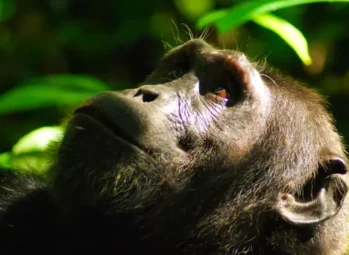
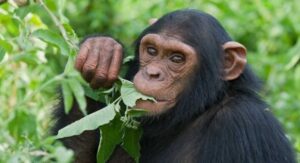 Chimpanzees (Pan troglodytes) share approximately 98% of their DNA with humans — a fact that becomes viscerally obvious the moment you watch one in the wild. Their facial expressions, their laughter-like play calls, the way mothers hold their infants — all of it carries an unmistakable familiarity. They are the world's most intelligent non-human primates, and spending time with them in their natural habitat is an experience with few parallels in wildlife travel.
Physically, chimps are powerfully built, with long arms that extend well beyond their knees and hands remarkably similar to our own. A fully grown male weighs up to 70 kilograms and is several times stronger than an adult human. Their coats are typically black, though some individuals carry brown or ginger tones, and infants are born with pale pink faces that darken as they age.
What makes wild chimpanzees so compelling to observe is their behaviour. They are strategic hunters, skilled tool users, and sophisticated social communicators. Their communities are organised around complex hierarchies, maintained through grooming, vocalisation, and at times fierce competition. No two encounters in the forest are the same — and that unpredictability is precisely what makes guided Uganda chimpanzee safari tours so addictive.
The Best Destinations for Guided Chimpanzee Safari Tours in Uganda
Uganda offers four main destinations for guided chimpanzee trekking, each with a distinct character. Choosing the right one depends on your broader itinerary, your budget, and how deep into the forest experience you want to go.
Kibale National Park
Kibale Forest is the undisputed headline act. Spanning 795 square kilometres of medium-altitude tropical rainforest in western Uganda, the park harbours around 1,500 chimpanzees — the highest density of wild chimpanzees anywhere in Africa. Habituation work at Kibale began in 1994, giving the park one of the most experienced ranger teams and most relaxed chimp communities on the continent. Encounter success rates here consistently exceed 90%.
Beyond chimpanzees, Kibale is home to 12 other primate species — including red colobus, grey-cheeked mangabeys, and L'Hoest's monkeys — and records 335 bird species, several of which are found nowhere else in Uganda. It is, genuinely, one of the world's great wildlife destinations. Most Uganda western circuit safaris begin or end here, with the park sitting conveniently between Murchison Falls to the north and Bwindi Impenetrable Forest to the south.
Kyambura Gorge, Queen Elizabeth National Park
Kyambura Gorge — known locally as the Valley of Apes — is a dramatic forested canyon cut into the floor of Queen Elizabeth National Park. Trekking here means descending into a lush, cathedral-like gorge with walls rising over 100 metres on either side. The habituated community is smaller than Kibale's, and encounters can be less predictable, but the setting is extraordinary.
Kyambura works brilliantly as part of a Queen Elizabeth itinerary — combining a morning chimp trek with an afternoon game drive across the park's open savannahs or a boat safari along the Kazinga Channel, where hippos, elephants, and over 600 bird species congregate in remarkable numbers.
Budongo Forest, Murchison Falls National Park
Budongo is one of Uganda's largest mahogany forests, tucked within the broader Murchison Falls National Park ecosystem. The chimpanzee communities here have been studied since the 1960s, making Budongo one of the longest-running primate research sites in Africa. Trekking in Budongo has a slightly wilder, more expedition-like feel than Kibale — a quality many experienced wildlife travellers actively prefer.
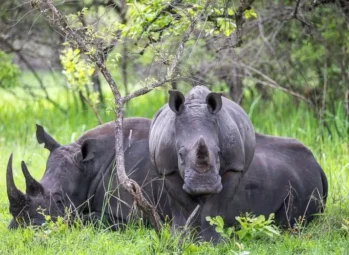
Pairing Budongo chimps with a Murchison Falls game drive and Nile boat cruise creates one of Uganda's most complete northern circuit safaris. It also gives you a realistic chance of ticking off all of Uganda's Big 5 — lions, leopards, elephants, buffaloes, and rhinos (at nearby Ziwa Sanctuary) — alongside the chimpanzees.
Kalinzu Forest Reserve
Kalinzu is Uganda's best-kept chimpanzee secret. This 137 km² forest reserve on the southern border of Queen Elizabeth National Park harbours around 300 wild chimpanzees across two fully habituated communities. Kalinzu chimpanzee trekking is offered at lower permit costs than Kibale and attracts far fewer visitors — making it an excellent choice for travellers who want an intimate, crowd-free forest experience. It pairs naturally with Queen Elizabeth's game drives for a well-rounded western Uganda itinerary.
Trekking vs. Habituation: Which Experience Should You Choose?
All guided Uganda chimpanzee safari tours fall into one of two categories, and understanding the difference is important before you book.
Standard chimpanzee trekking is what most visitors do. You enter the forest at first light with a small guided group of up to eight people, following rangers who track the chimps by sound, footprints, and feeding signs. The walk typically takes between two and five hours depending on where the chimps are that morning. Once you find them, you have one hour in their presence — one of the most concentrated, intense wildlife hours you will ever spend anywhere in Africa.
Chimpanzee habituation is a full-day, immersive experience designed for the most committed wildlife enthusiasts. You join a research team from dawn to dusk — up to eight hours — following a semi-habituated chimp community as it wakes, feeds, moves, socialises, and settles for the night. You witness behaviours that most trekkers never see: hunts, territorial disputes, mating, and nest-building. It is a significantly more demanding day physically and emotionally, but for many visitors it is the experience of a lifetime.
Chimpanzee Trekking Permit Costs in Uganda (2026 & 2027 Rates)
Permits are issued by the Uganda Wildlife Authority (UWA) and must be booked in advance through a licensed tour operator or directly through UWA's reservations office. Here are the current rates:
| Experience | Foreign Non-Resident | Foreign Resident | East African Citizen |
|---|---|---|---|
| Chimpanzee Trekking (Kibale) | $250 USD | $200 USD | UGX 180,000 |
| Chimpanzee Habituation (Kibale) | $300 USD | $250 USD | UGX 250,000 |
| Chimpanzee Trekking (Kyambura) | $100 USD | — | — |
| Low Season (Apr, May, Nov 2026) | $200 USD | — | — |
Important for 2027 travellers: UWA has announced revised pricing effective 1 January 2027. Kibale chimpanzee trekking will rise to $300 USD and the habituation experience to $400 USD. If you are planning a trip in 2027, booking your permit before the end of 2026 locks in the current lower rates — a worthwhile saving for groups and families. Check the latest UWA permit advisory for the most current information.
Tulambule Uganda Safaris handles permit booking on your behalf as part of every safari package — we secure your preferred dates, confirm availability, and manage all payments with UWA directly.
Best Time to Go for a Chimpanzee Safari in Uganda
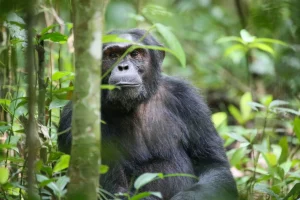 The good news: chimpanzees can be tracked in Uganda all year round. The trekking season never fully closes. However, the time of year does affect the quality and ease of the experience significantly.
The dry seasons — June to September and December to February — are widely considered the best time for guided Uganda chimpanzee safari tours. Trails are firm and passable, forest undergrowth is thinner, and chimps are often easier to locate as they concentrate around water sources. These are also Uganda's peak tourism months, so permits at Kibale in particular sell out fast. Booking three to six months in advance is strongly recommended for dry-season travel.
The green seasons (March–May and October–November) offer a quieter, lusher experience. The forest is at its most vivid, birding reaches its peak, and visitor numbers drop considerably — meaning smaller groups and more personal encounters. Trails can be muddy after heavy rain, so good waterproof boots and a rain jacket are essential. UWA's new low-season permit discount (bringing Kibale trekking to $200 USD in April, May and November 2026) makes this period increasingly attractive for budget-conscious travellers.
What to Expect on the Day of Your Chimp Trek
Most guided Uganda chimpanzee safari tours follow a similar structure, though the forest always has its own plans.
You will typically arrive at the park headquarters or visitor centre by 7:30am for your pre-trek briefing. A UWA ranger guide will cover the safety rules, explain chimpanzee behaviour, and outline what to do if a chimp approaches closer than expected. Groups are limited to a maximum of eight people — small enough to move quietly through the forest and minimise disturbance to the animals.
From the briefing point, the trek begins. Rangers follow a combination of advance tracking information (gathered by early-morning scout teams) and real-time signs — vocalisations, knuckle prints in the mud, feeding debris on the forest floor. The walk to the chimps can take anywhere from 30 minutes to three hours. When you find them, your one-hour encounter begins immediately.
That hour is unlike any other hour in wildlife travel. Chimps are fast, loud, and utterly unbothered by your presence. They may feed directly above your head, cross the path just metres away, or sit quietly grooming one another while juveniles play nearby. Rangers maintain your position carefully, but the chimps set the terms. When the hour is up, you walk back out — usually elated, often speechless — and the forest closes quietly behind you.
Chimpanzee Behaviours to Watch For
Part of what makes guided Uganda chimpanzee safari tours so compelling is the sheer variety of behaviour you might witness on any given morning. Here are some of the highlights.
Tool use is perhaps the most startling thing to observe up close. Kibale's chimpanzees use sticks to extract termites from mounds, leaves as cups to scoop water, and stones as hammers to crack open hard-shelled nuts. This is not instinct — it is learned behaviour, passed down through generations within specific communities.
The pant-hoot is the chimpanzee's defining call — a rising, cascading series of whoops and screams that can carry over a kilometre through the forest. When a full community joins in, the sound is extraordinary. Chimps use pant-hoots to announce their location, signal food discoveries, and reinforce social bonds across the forest.
Grooming is the social glue of chimpanzee society. Sitting quietly and watching one chimp carefully groom another — picking through fur, removing parasites, maintaining relationships through patient, focused contact — is one of the most peacefully human scenes you will witness in the wild.
Group hunting is rarer and requires luck to witness. Kibale's chimpanzees are known to cooperate in coordinated hunts for red colobus monkeys, communicating positions and roles across the canopy with apparent strategy. If you happen to witness a hunt, you are among a small number of visitors who ever have.
What to Pack for Your Guided Chimpanzee Trek
Proper preparation makes a significant difference to your comfort in the forest. These are the essentials Tulambule recommends for every guided Uganda chimpanzee safari tour:
- Sturdy, ankle-supporting hiking boots — broken in before travel, not brand new
- Long trousers and a long-sleeved shirt — for skin protection and warmth in the early-morning forest
- A lightweight, packable waterproof jacket
- DEET-based insect repellent — the forest variety; standard citronella is not sufficient
- Garden gloves — invaluable for gripping roots and branches on steep sections
- Long socks to tuck your trousers into
- 1.5 to 2 litres of water and light snacks for the trail
- A camera with a fully charged battery and a spare — no flash, ever
- A small daypack to carry everything without bulk
One styling note that matters more than it sounds: leave bright colours at the lodge. Muted greens, khakis, and greys help you blend into the forest environment and avoid startling the chimps at close range.
Conservation Rules Every Visitor Must Follow
Uganda's chimpanzee trekking guidelines exist to protect the animals — and by extension, to protect the quality of the experience for every visitor who comes after you. UWA enforces these rules on every guided trek, with no exceptions:
- Maintain a minimum distance of 8 metres from the chimpanzees at all times
- No flash photography, under any circumstances
- Do not eat or drink within sight of the chimps — food disease transmission is a genuine risk
- If you are unwell on the morning of your trek, you must stand down — chimpanzees are highly vulnerable to human respiratory infections
- Keep voices low throughout the encounter; follow your ranger's movements and signals at all times
- Maximum eight visitors per group, one hour maximum in the presence of any habituated community
These rules are the foundation of responsible primate tourism. The chimpanzees' long-term wellbeing will always take precedence over any individual visitor's preferences — and that is exactly as it should be.
Combining Your Chimpanzee Safari With Other Uganda Experiences
A guided Uganda chimpanzee safari tour is extraordinary on its own — but Uganda's real magic is in combination. The country's western circuit allows you to connect Kibale Forest, Queen Elizabeth National Park, and Bwindi Impenetrable Forest in one seamless road trip through some of Africa's most spectacular landscapes.
The most popular pairing is chimpanzees in Kibale followed by mountain gorilla trekking in Bwindi — a back-to-back great ape experience that is genuinely unmatched anywhere in the world. Our fully planned 7 Day Uganda Gorilla and Chimpanzee Safari is our most popular itinerary for exactly this reason, combining Kibale, Queen Elizabeth, and Bwindi into one week of exceptional wildlife encounters.
For travellers with more time, extending north to Murchison Falls National Park adds Budongo's chimpanzees, lion country, the Nile boat cruise, and a stop at Ziwa Rhino Sanctuary — completing Uganda's remarkable wildlife portfolio in a single trip. And for birdwatchers, Uganda's 1,060-plus bird species mean that any forest trek doubles as a serious birding opportunity, particularly in and around Kibale's canopy.
Frequently Asked Questions
Is chimpanzee trekking safe?
Yes. Habituated chimpanzees are accustomed to calm human presence, and all treks are led by trained UWA rangers who know individual animals by name and understand their behaviour intimately. Follow your guide's instructions and maintain the required distances and the experience is very safe.
How physically demanding is the trek?
Standard trekking requires moderate fitness — comfortable walking on uneven, occasionally steep forest trails for up to five hours. The pace is guided and relaxed. If you have any mobility concerns, let us know when booking and we will advise on the most suitable location and format for your trek.
What is the minimum age for chimpanzee trekking?
UWA sets the minimum age at 12 years for standard chimpanzee trekking. The full-day habituation experience is recommended for adults and older teenagers only.
What are my chances of seeing chimpanzees?
At Kibale — the most popular destination — encounter success rates are consistently above 90%, thanks to the park's long habituation history. Sighting rates at Budongo and Kalinzu are similarly high. Kyambura Gorge can be less reliable, though the setting makes it worth attempting as part of a Queen Elizabeth itinerary.
How far in advance should I book?
For peak season travel (June–September, December–February), book permits at least three months ahead — Kibale in particular sells out quickly. For the green season, six to eight weeks is usually sufficient, though earlier is always safer. Contact our team and we will check availability immediately.
Ready to Plan Your Uganda Chimpanzee Safari?
Tulambule Uganda Safaris is a 100% Ugandan-owned tour operator with over a decade of experience planning guided chimpanzee safaris across Uganda. We are fully accredited by UTB, UWA, and AUTO, and we handle every detail — permits, accommodation, transport, and guiding — so you arrive in the forest with nothing to think about except the chimps. Plan My Safari →
Uganda Lion Tracking Safari Tours: The Complete 2026/2027 Guide
Guided Uganda Gorilla Safari Tours: Everything You Need to Know Before You Trek
Bwindi vs Mgahinga: Which Uganda Gorilla Park Should You Choose in 2026?
East Africa Safari Cancellations 2026: Why Smart Travellers Are Booking Uganda & Rwanda Right Now
Uganda National Parks Safe During Ebola: A Complete Guide for Safari Travellers