Fort Portal is one of Uganda's most beautiful and strategically located cities, sitting in the western region at the base of the Rwenzori Mountains approximately 300 kilometres from Kampala. Officially designated as Uganda's Tourism City, Fort Portal is the gateway to some of the country's most extraordinary wildlife and nature destinations — Kibale Forest National Park, the Kasenda crater lakes, Semuliki National Park, and Queen Elizabeth National Park are all within easy reach.
This Fort Portal Uganda travel guide is your complete resource for planning a visit to western Uganda's most important safari hub. Whether you are planning a chimpanzee trekking safari, a crater lake hiking adventure, or a full western Uganda circuit, everything you need is covered here. Fort Portal rewards every type of traveller — from wildlife enthusiasts and birdwatchers to hikers, coffee lovers, and cultural explorers.
How to Get to Fort Portal — Getting There from Kampala
Fort Portal is approximately 300 kilometres west of Kampala via the A109 highway through Mityana and Mubende. The drive takes between 4 and 5 hours by private vehicle under normal road conditions. The route passes through Mubende town, roughly halfway, where you can stop for fuel, refreshments, and a stretch break.
The road is well-maintained tarmac throughout and suitable for saloon cars in dry conditions. However, a 4WD vehicle is strongly recommended for any traveller planning to explore the crater lakes, Kibale Forest trails, or Semuliki National Park on side roads off the main highway. Departing Kampala by 6.00 am gets you into Fort Portal by midday — in time for an afternoon crater lake walk or chimp trek briefing.
For travellers short on time, charter flights from Entebbe International Airport to Kasese Airstrip take approximately 1.5 hours. From Kasese, Fort Portal is a further 50-kilometre, 1-hour drive north. Aerolink operates charter flights on this route for safari travellers combining multiple western Uganda parks.
Fort Portal can also be reached from the south via Kasese and from Mbarara in the southwest. The city is accessible year-round, as the main A109 road is well maintained throughout both dry and wet seasons.
The Kasenda Crater Lakes — Fort Portal's Crown Jewel
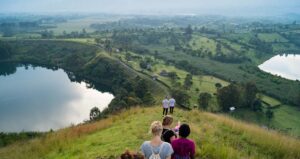
The Kasenda crater lakes are Fort Portal's most iconic natural attraction and one of the most visually stunning landscapes in all of East Africa. Over 50 volcanic crater lakes are scattered across the hills south of Fort Portal city, formed by ancient eruptions approximately 8,000 to 10,000 years ago. Each lake is distinct — some are deep emerald green, others turquoise blue, and several are surrounded by dense tropical vegetation, banana plantations, and small farming communities.
The lakes lie approximately 20 to 30 kilometres south of Fort Portal along the Fort Portal-Kasese road near Kibale Forest National Park. Key lakes worth visiting include Lake Nyinambuga — famously pictured on Uganda's 20,000-shilling note — Lake Nkuruba, Lake Kifuruka, and Lake Nyabikere. Activities around the lakes include guided crater rim hikes, birdwatching, swimming in select bilharzia-free lakes, and cycling tours through surrounding tea plantations.
The Ndali-Kasenda crater field is the most concentrated cluster, with multiple lakes visible from a single viewpoint on clear days. Several eco-camps and crater-rim lodges offer accommodation directly overlooking the water, making this one of Uganda's most photogenic and peaceful overnight settings. Sunrise and sunset from a crater rim are experiences that stay with travellers long after they leave.
Over 300 bird species have been recorded in the crater lake area, alongside colobus monkeys, butterflies, and a rich variety of forest wildlife. The hiking trails between the lakes pass through local villages, tea estates, and farmland, offering an authentic and unhurried glimpse into rural western Uganda life. No Fort Portal Uganda travel guide would be complete without placing the crater lakes at the very top of your itinerary.
Kibale Forest National Park — 15 km from Fort Portal
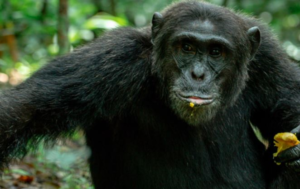
Kibale Forest National Park is the world's best destination for chimpanzee trekking and sits just 15 kilometres south of Fort Portal city. The park is home to over 1,500 wild chimpanzees — the highest concentration in Uganda — alongside 12 other primate species including red colobus monkeys, grey-cheeked mangabeys, and olive baboons. Morning chimpanzee treks depart at 8.00 am from the Kanyanchu Visitor Centre; afternoon treks depart at 2.00 pm.
A standard chimpanzee trekking permit costs USD 250 per person and includes up to 1 hour with a habituated chimp community. The Chimpanzee Habituation Experience (CHEX), which allows 4 to 6 hours with a chimp community from dawn, costs USD 300 per person.
Both permits must be booked in advance through the Uganda Wildlife Authority and sell out fast during peak season.
Beyond chimpanzees, Kibale records over 375 bird species and connects directly with Queen Elizabeth National Park to the south via a vital 180-kilometre wildlife corridor. The forest is traversed by well-maintained trails suitable for a range of fitness levels.
Most travellers staying in Fort Portal Uganda complete their chimp trek in the morning and spend the afternoon exploring the crater lakes or Bigodi Wetland — making for an incredibly full and rewarding single day.
Kibale is also home to the Bigodi Wetland Sanctuary — a community-managed papyrus swamp adjacent to the park that records over 200 bird species and offers excellent guided primate walks at a fraction of the park permit cost. For any traveller using this Fort Portal Uganda travel guide, Kibale Forest is the single most important wildlife destination to plan around.
Read our full Chimpanzee Trekking in Uganda guide for detailed permit booking tips and preparation advice.
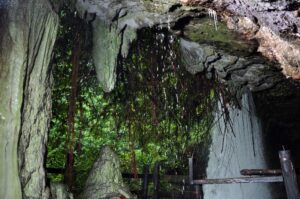
Amabere Caves — History and Geology Near Fort Portal
The Amabere Caves, also known as the Nyakasura Caves, are located approximately 5 kilometres west of Fort Portal on the Bundibugyo Road. These unique limestone and volcanic rock caves are steeped in Toro Kingdom legend and folklore, making them one of western Uganda's most fascinating cultural and geological sites. The caves sit alongside an ancient crater lake and a small picturesque waterfall surrounded by lush tropical garden.
The caves are famous for their stalactite and stalagmite formations dripping with calcium-rich water, which locals call "Amabere ga Nyinamwiru" — meaning the breasts of Nyinamwiru, referencing a powerful and deeply held legend about a Toro princess. Local guides bring the story to life with genuine passion, making the cultural dimension of the visit as rich as the geological one.
Guided tours of the Amabere Caves take approximately 1 to 2 hours and are affordable for all budgets. The site is well maintained, family-friendly, and makes an excellent half-day excursion from Fort Portal before or after a Kibale chimpanzee trek. It is consistently one of the most underrated and most memorable stops on any Fort Portal Uganda travel itinerary.
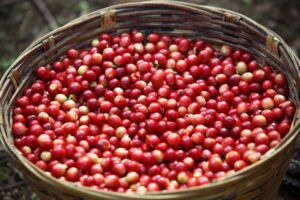
Fort Portal Coffee Tours — Taste Uganda's Finest Arabica Coffee.
Fort Portal and the surrounding Tooro region sit at the heart of Uganda's finest Arabica coffee-growing zone. The cool highland climate, volcanic soils, and consistent rainfall create ideal conditions for producing some of East Africa's most celebrated single-origin coffee.
Several farms and cooperatives around Fort Portal welcome visitors for guided coffee tours that walk you through the entire journey from tree to cup.
A typical Fort Portal coffee tour takes 2 to 3 hours and covers planting, picking, pulping, fermenting, drying, milling, and roasting — all demonstrated by local farmers with decades of experience. You taste freshly brewed coffee at each stage, making it one of the most sensory experiences available in western Uganda.
Many coffee tour operators also offer a simple farm lunch of local food cooked over firewood, rounding off an immersive and deeply authentic morning.
Fort Portal coffee tours are available year-round and can be combined with a crater lake walk or Kibale Forest visit on the same day. Several lodges near the crater lakes also offer their own on-site coffee experiences using beans grown directly on the property. Taking home a bag of freshly roasted Fort Portal Arabica is one of the most authentic souvenirs a traveller can carry from Uganda.
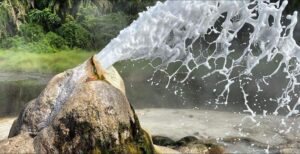
Semuliki National Park — 52 km from Fort Portal
Semuliki National Park lies approximately 52 kilometres west of Fort Portal in Bundibugyo District and protects a lowland tropical rainforest that is an extension of the vast Congo Basin — the second-largest rainforest on earth. The park records over 400 bird species including 58 found nowhere else in Uganda, making it one of the continent's most important birding destinations.
The Sempaya Hot Springs — where boiling water erupts dramatically from the forest floor at temperatures exceeding 100 degrees Celsius — are the park's headline attraction and one of Uganda's most extraordinary natural wonders.
There are two hot spring sites within Semuliki — the female spring known as Nyansimbi and the male spring known as Bintente — each with its own local legend and spiritual significance for the Bamba and Bakonzo communities who have lived around the forest for generations. The walk to the springs passes through dense lowland forest alive with birdsong and the calls of primates.
Semuliki also supports forest elephants, chimpanzees, buffalos, and a wide range of rare small forest mammals. Because it remains largely off the main tourist circuit, wildlife encounters here feel especially intimate and unscripted. Most travellers visit Semuliki as a day trip or overnight extension from Fort Portal before continuing south toward Queen Elizabeth National Park.
Discover more birding destinations across Uganda on our Bird Watching in Uganda page or visit the Semuliki National Park official page.
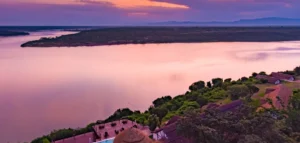
Queen Elizabeth National Park — 100 km from Fort Portal
Queen Elizabeth National Park lies approximately 100 kilometres south of Fort Portal via the Kasese road — about a 2-hour drive. The park covers 1,978 square kilometres of savannah bush, wetlands, crater lakes, and tropical forest and is Uganda's most visited safari destination.
It is also one of Africa's most ecologically diverse protected areas, with habitats ranging from open grassland to dense riverine forest teeming with over 600 recorded bird species.
The park's most famous attraction is the tree-climbing lions of the Ishasha sector in the far south — a rare behaviour documented in only two places on earth. The Kazinga Channel boat safari, connecting Lakes George and Edward, brings you face to face with one of Africa's highest concentrations of hippos, crocodiles, and waterbirds.
Kyambura Gorge offers a completely different experience — chimpanzee tracking inside a dramatic riverine forest canyon that cuts deep into the open savannah plains.
Most travellers on a western Uganda circuit combine Fort Portal and Kibale with at least 2 nights in Queen Elizabeth National Park before continuing to Bwindi or Lake Bunyonyi. A typical route runs: Kampala — Fort Portal — Kibale — crater lakes — Queen Elizabeth — Bwindi — Kampala. Browse our 7 Best Uganda Safari Packages to see how Fort Portal fits into a complete western Uganda safari.
Visit the Queen Elizabeth National Park official page for current park fees and activity bookings.
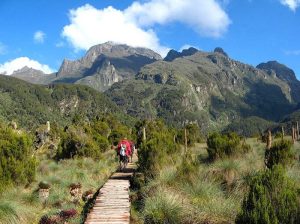
Rwenzori Mountains — 54 km from Fort Portal
The Rwenzori Mountains — known throughout history as the Mountains of the Moon — lie approximately 54 kilometres south of Fort Portal and rise to 5,109 metres at Margherita Peak, Africa's third-highest summit after Kilimanjaro and Mount Kenya. The mountains are a UNESCO World Heritage Site recognised for their extraordinary biodiversity and dramatic Afroalpine landscapes.
Multi-day Rwenzori trekking expeditions range from 7 to 12 days, passing through bamboo forest, giant heather moorland, and glacial zones before reaching the snow-capped peaks. The mountains are also a world-class birding destination with several Albertine Rift endemic species along the lower forest trails.
Day hikes on the lower slopes are available for travellers with limited time. The experience of standing on a tropical glacier just one degree north of the equator is unlike anything else on earth.
Rwenzori expeditions are best undertaken during the dry seasons — June to September and December to February — when trails are most accessible and views are clearest. The mountains are managed by Rwenzori Mountaineering Services in partnership with the Uganda Wildlife Authority and require advance booking and proper trekking equipment.
Fort Portal Town Attractions — What to See and Do
Beyond its role as a safari gateway, Fort Portal city itself is well worth exploring for at least half a day. The Toro Palace sits on a commanding hill above the town and is the seat of the Toro Kingdom — one of Uganda's most celebrated and oldest traditional kingdoms.
The palace was restored in the 1960s and its hilltop position offers sweeping views across the city and toward the distant Rwenzori peaks on clear days.
Fort Portal's local market is lively, colourful, and deeply authentic — an excellent place to sample local produce, buy freshly roasted Arabica coffee, and browse handcrafted souvenirs and traditional crafts. The city centre is clean, compact, and significantly quieter than Kampala.
Several well-regarded restaurants and cafés serve both Ugandan home cooking and international food, making Fort Portal a genuinely refreshing base for safari travellers visiting western Uganda.
A statue of Sir Gerald Herbert Portal — the British Special Commissioner after whom the city is named when he visited in the 1890s — stands along the main road and makes for an interesting historical reference point. The Anglican and Catholic cathedrals in the town centre are also architecturally notable and reflect the deep role of religion in Toro Kingdom culture.
Suggested 3-Day Fort Portal Itinerary
Planning your Fort Portal Uganda visit around 3 days gives you enough time to cover the main highlights without rushing. Here is a practical itinerary that works well for most travellers.
Day 1 — Arrive and Explore the Crater Lakes Depart Kampala by 6.00 am and arrive in Fort Portal by midday. After lunch, drive 20 kilometres south to the Kasenda crater lake cluster for a guided 2-hour crater rim hike. Stop at the Lake Nyinambuga viewpoint for sunset. Overnight at a crater lake lodge.
Day 2 — Chimpanzee Trekking in Kibale Forest Early morning departure for Kibale Forest Kanyanchu Visitor Centre for the 8.00 am chimp trek. Return to your lodge for lunch, then spend the afternoon at Bigodi Wetland Sanctuary for birding and primate walks. Overnight near Kibale Forest or Fort Portal city.
Day 3 — Amabere Caves and Coffee Tour Morning guided tour of the Amabere Caves and crater lake garden. After lunch in Fort Portal town, join a 2-hour Arabica coffee farm tour before departing back toward Kampala or continuing south to Queen Elizabeth National Park.
Best Time to Visit Fort Portal Uganda
Fort Portal and the surrounding western Uganda attractions can be visited year-round. However, the dry seasons — June to September and December to February — offer the best conditions for chimpanzee trekking in Kibale, crater lake hiking, and game drives in Queen Elizabeth National Park. Trails are firmer, skies are clearer, and the Rwenzori Mountains are more visible on the horizon.
The wet seasons — March to May and October to November — bring heavier rainfall that can make forest trails muddier and some crater lake access roads more challenging. However, birdwatching during the rains is exceptional as migratory species arrive, vegetation is at its most lush and photogenic, and accommodation rates across Fort Portal Uganda are typically lower.
For travellers combining a Fort Portal Uganda visit with Bwindi Impenetrable Forest for gorilla trekking, planning around the dry season is particularly important as the steep trekking terrain becomes significantly more demanding in heavy rain.
Read our full Best Time to Visit Uganda guide for a complete month-by-month breakdown.
Where to Stay in Fort Portal Uganda
Fort Portal and the surrounding area offer a wide range of accommodation from luxury crater-rim lodges to mid-range guesthouses and budget campsites. Key areas to stay when visiting Fort Portal Uganda include the city centre for convenience, the Kibale Forest edge for primate immersion, and the Kasenda crater lakes area for the most scenic and peaceful overnight setting.
Luxury: Ndali Lodge is the standout option, perched on the rim of an ancient crater overlooking Lake Nyinambuga with stunning Rwenzori views. Primate Lodge Kibale offers forest immersion luxury right on the edge of Kibale National Park, with chimpanzees sometimes heard calling from the lodge at night.
Mid-range: Kibale Forest Camp is a comfortable tented camp near the Kanyanchu gate with reliable service and good food. Crater Safari Lodge on Lake Nkuruba offers a beautiful mid-range crater setting with community-based tourism activities directly on site.
Budget: Dutchess Motel and Ruwenzori Travellers Inn in Fort Portal city centre are reliable and affordable options for budget-conscious travellers who prefer to be based in town and drive to activities daily.
All accommodation bookings, transfers, and complete safari packages through Fort Portal can be arranged through Tulambule Uganda Safaris for a seamless, fully guided, and worry-free experience.
Practical Travel Tips for Visiting Fort Portal Uganda
A few essential practicalities to keep in mind when planning your Fort Portal Uganda visit.
Currency: Uganda shillings are the local currency. ATMs are available in Fort Portal city centre. US dollars are widely accepted at lodges and national park gates but carry shillings for local markets and small purchases.
Mobile network: MTN and Airtel both have coverage in Fort Portal and along the main A109 highway. Coverage in Semuliki and some crater lake areas can be limited — download offline maps before leaving town.
Health: Malaria prophylaxis is recommended for all travellers to western Uganda. Pack insect repellent, a basic first aid kit, and sunscreen. The elevation of Fort Portal (approximately 1,500 metres) keeps temperatures cooler than Kampala — evenings can be fresh so bring a light jacket.
Permits: Kibale chimpanzee trekking permits sell out fast during peak season. Book at least 3 to 6 months in advance through the Uganda Wildlife Authority or through Tulambule Uganda Safaris to guarantee your slot.
Plan Your Fort Portal Uganda Safari with Tulambule
This Fort Portal Uganda travel guide covers the full picture — from how to get there and what to see, to where to stay, when to visit, and how to plan a 3-day itinerary. Fort Portal is the single most important hub on the western Uganda safari circuit, connecting chimpanzees, crater lakes, hot springs, and big game drives within one compact travel zone.
At Tulambule Uganda Safaris, we are a Kampala-based operator with deep local expertise across every destination in this guide. We design customised Fort Portal Uganda safari packages for solo travellers, couples, honeymooners, families, and groups — handling permits, accommodation, transfers, and guiding from start to finish.
Contact us today to start planning your Fort Portal Uganda safari.
Check out our Related short Safaris: