Young Mountain Gorillas in Uganda and Rwanda — The Most Joyful Sight in African Wildlife
Young mountain gorillas in Uganda and Rwanda are, without question, the highlight of every gorilla trekking experience. When a group of eight visitors falls silent in the forest and watches a juvenile gorilla tumble through the undergrowth, crash into its sibling and spring back up with complete indifference — something happens that no guidebook can fully prepare you for.
You laugh. Then you feel something else. Something quieter and harder to name.
This blog is a complete guide to the young mountain gorillas of Uganda and Rwanda — how they are born, how they develop, how they behave, what role they play in their family group and where you can see them in 2026. By the time you finish reading, you will understand why trekkers who have seen them once spend years planning to go back.
The Population Context: Why Every Young Gorilla Matters
 Before exploring the lives of young mountain gorillas in Uganda and Rwanda, it is essential to understand the population they are born into. As of 2025, only 1,063 mountain gorillas exist on earth — the only great ape whose global population is currently growing rather than declining.
These 1,063 individuals are split between two isolated populations. Approximately 604 live in the Virunga Massif — a chain of volcanic mountains straddling Uganda, Rwanda and the Democratic Republic of Congo. The remaining 459 — from the 2018 census — inhabit Uganda's Bwindi Impenetrable National Park, with a new census launched in May 2025 expected to confirm continued growth.
Female mountain gorillas give birth only once every four to five years. With such a slow reproductive rate, every infant born is a significant event in population terms. Every young gorilla you see during a trekking experience represents not just a moment of wildlife joy but a measurable contribution to the species' recovery.
A new birth is celebrated by conservation rangers, veterinary teams and community members alike. It is both a family event and a conservation milestone.
Birth: The Beginning of a Mountain Gorilla Life
Young mountain gorillas in Uganda and Rwanda are born after a gestation period of approximately 8.5 months — closely mirroring the human pregnancy timeline. At birth, an infant gorilla weighs just 1.5 to 2 kilograms, making them tiny relative to their parents. A mature silverback can weigh over 180 kilograms.
The infant gorilla Bwindi and Virunga mothers nurse arrives with a large head, short silky hair, a powerful grip reflex and complete dependence on its mother. The infant cannot walk, cannot regulate its body temperature effectively and cannot survive without continuous physical contact in the first weeks of life.
The first hours after birth involve intense bonding. The mother inspects her infant, cleans it, cradles it against her chest and begins nursing immediately. This first physical bond is not sentimental — it is biological survival. The warmth of the mother's body, the nutrition of her milk and the security of her embrace are the entire world of a newborn gorilla.
Within days, the infant's grip — already remarkable — becomes strong enough to cling to the mother's fur as she moves through the forest. The mother carries the infant on her front for the first weeks, supporting it with one arm as she feeds and moves. Later, as the infant grows stronger, it will ride on her back.
The First Year: Total Dependence and the Mother Bond
In the first year of life, young mountain gorillas in Uganda and Rwanda remain almost entirely with their mothers. They nurse exclusively for the first four to six months, then begin experimenting with solid food while continuing to nurse. Gorilla mothers nurse their infants for an extraordinary duration — typically three to four years, with nursing continuing until age five recorded in some mountain gorilla populations.
This extended nursing period is not merely nutritional. It plays a vital role in immune system development, psychological bonding and the gradual introduction to the plant-based diet that will sustain the gorilla for the rest of its life.
By eight weeks, infant gorillas begin displaying behaviours that are deeply familiar to any human observer. They play, they respond to sounds and movement with wide-eyed curiosity and they begin what can only be described as laughing — a soft, repetitive exhalation that researchers have confirmed is functionally homologous to human laughter. At nine weeks, they begin to climb — displaying both physical determination and an apparently insatiable curiosity for everything around them.
Infants rarely leave their mother's side during the first year. This intense attachment fosters trust and social learning which are crucial for integration into the troop. The infant is watching everything: how the mother selects and processes food, how she interacts with other group members, how she responds to the silverback's signals.
The Silverback's Role: More Than a Father Figure
A common misconception about mountain gorilla families is that the silverback is a distant, intimidating authority figure who has little to do with infants. The reality is far more nuanced and considerably more touching.
Silverbacks frequently engage in play behaviour with juveniles — wrestling, gentle chasing and mock displays. These interactions build confidence, teach physical coordination and strengthen social bonds between the dominant male and the young gorillas he protects. The silverback acts as the group's primary protector against predators and rival males, and his presence alone creates the safety that allows infants to explore.
If a mother dies or leaves the group, the silverback typically becomes the primary caregiver of her orphaned infant — even allowing the infant to sleep in his nest. This extraordinary behaviour has been documented in multiple mountain gorilla families in both Uganda and Rwanda and challenges simplistic assumptions about gorilla social life.
The silverback is the centre of the troop's attention and young gorillas spend considerable time close to him — playing near him, observing him and occasionally interrupting his rest in ways that he tolerates with remarkable patience.
Ages and Stages: How Young Gorillas Develop
Understanding the developmental stages of young mountain gorillas in Uganda and Rwanda transforms what you observe during a trekking encounter. Each age group behaves differently, and knowing what you are looking at makes the experience richer.
Newborns (0–6 months): Completely dependent, carried on mother's front. Black-pink face, sparse hair, enormous eyes. Spend almost all time nursing or sleeping. Rarely visible unless the mother is resting in an open position. When you encounter a baby gorilla Uganda's forests shelter — peering over the mother's arm with wide curious eyes, it is one of the most affecting wildlife sightings on earth.
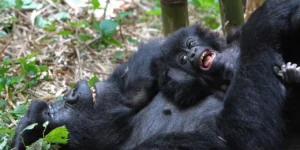
Infants (6 months–3 years): Increasingly mobile and interactive. Begin riding on mother's back. Start playing tentatively with siblings and other infants. Teeth emerge and solid food supplements nursing. Vocal and physically expressive. This is the age when baby gorillas begin to display the behaviours — the tumbling, the falling, the getting up again — that make trekkers break into involuntary smiles.
Juveniles (3–6 years): The performers of the gorilla family. Fully mobile, energetic and apparently fearless. Play occupies a huge portion of their day — wrestling, chasing, swinging from branches and exploring boundaries. Juveniles are the young gorillas most likely to approach your group out of curiosity before a ranger intervenes. Their facial expressions are unmistakably readable: curiosity, excitement, mild mischief.
Sub-adults (6–8 years): Growing rapidly and beginning to develop adult behaviours. Females start to show interest in infants. Males begin to test social boundaries and practice dominance displays, though without the weight or authority to enforce them. Sub-adults occupy a fascinating social middle ground — too old for infant play groups, not yet established as adults.
Blackbacks (8–12 years): Male gorillas in this age range are called blackbacks — named for the fact that the signature silver saddle of the silverback has not yet developed. Blackbacks are physically impressive but socially subordinate. They are exploratory and mobile, often venturing further from the group's core than other members.
Play: The Language of Young Gorillas
If there is one word that defines the experience of watching young mountain gorillas in Uganda and Rwanda, it is play. Juvenile gorillas play with an intensity and inventiveness that makes them genuinely entertaining to watch — and genuinely illuminating to understand.
Play is not recreation for young gorillas. It is their primary learning mechanism. Through wrestling, chasing and social grooming, juveniles learn physical coordination, social hierarchy, dominance etiquette and the complex vocabulary of gorilla communication. Gorillas even make play vocalisations — a sound that researchers describe as functionally similar to human laughter — during extended play sessions.
Gorilla play also has a distinctly improvisational quality. Juveniles create games that have no apparent rules, abandon them mid-action and begin something entirely new. They fall deliberately, right themselves and do it again. They perform what appear to be deliberately comedic tumbles from low branches, then look around the group as if checking for a reaction.
Play interactions involving adult males — particularly silverbacks — are some of the most extraordinary things a trekker can witness. Seeing a 180-kilogram silverback allow a baby gorilla Uganda forest guides estimate weighs around 10 kilograms — to climb on his back, pull at his fur and generally make a nuisance of itself without any visible irritation is a reminder that mountain gorilla social bonds are not just transactional. They are genuinely affectionate.
Where to See Young Mountain Gorillas in Uganda
These young gorillas can be observed in habituated family groups across several parks. In Uganda, the primary destination is Bwindi Impenetrable National Park, which hosts over 25 habituated mountain gorilla family groups across its four sectors — Buhoma, Ruhija, Rushaga and Nkuringo.
Gorilla families in Bwindi typically include infants and juveniles, as each mountain gorilla family ranges from 5 to over 30 members. When booking your gorilla trekking Uganda permit through a registered operator, it is worth asking which families currently have infants or young juveniles — your guide and operator will have current monitoring information on mountain gorilla family composition.
Rushaga sector in southern Bwindi has the largest number of habituated families and therefore statistically the greatest concentration of young gorillas across the park. It is also the only sector offering the Gorilla Habituation Experience — four hours rather than one, giving you extended time to observe young gorillas through a full cycle of feeding, play and rest.
Buhoma sector is the most popular entry point for seeing infant gorilla Bwindi families and historically the most visited. Families here include the long-established Mubare group — one of the first habituated families in Bwindi — which has seen multiple infant gorilla Bwindi births over its decades of habituation.
Mgahinga Gorilla National Park in south-western Uganda has one habituated family with approximately 20 to 30 members. Mgahinga families occasionally cross into Rwanda, but when present, offer a more intimate trekking experience.
Where to See Young Mountain Gorillas in Rwanda
Gorilla trekking Rwanda takes place exclusively in Volcanoes National Park in the north-west of the country. Rwanda's Volcanoes National Park hosts 10 habituated gorilla families, and Rwanda's gorilla population in the Virunga Massif has grown consistently thanks to robust conservation investment and ranger patrols.
Rwanda positions gorilla trekking as a premium experience — permits cost USD 1,500 per person — and the shorter drive from Kigali (approximately 2.5 hours) makes it the most accessible of the gorilla destinations for international travellers on tight schedules.
The families in Volcanoes National Park include several with established infant populations. The Susa group — one of the largest families studied by Dian Fossey and now one of the most famous gorilla families in the world — frequently has young members. Gorilla trekking Rwanda encounters have a reputation for being slightly shorter on average than Bwindi treks, as the terrain in Volcanoes is somewhat less steep.
Many experienced gorilla trekkers combine both destinations. Trek gorillas in Bwindi's ancient forest on one day, cross into Rwanda and trek again in Volcanoes on another. Two entirely different ecosystems, two different gorilla families, two unforgettable encounters with young mountain gorillas in Uganda and Rwanda.
The Conservation Significance of Every Young Gorilla
Every baby gorilla Uganda and Rwanda's forests produce is a conservation event. With only 1,063 individuals remaining and a reproductive rate of one birth every four to five years per female, population growth is slow and every death — whether from disease, snaring or human encroachment — is a measurable setback.
The recovery from fewer than 300 individuals in the 1980s to over 1,000 today has been driven by sustained, science-based conservation funded substantially by gorilla tourism revenue. Every gorilla permit purchased — USD 800 in Uganda, USD 1,500 in Rwanda — contributes directly to ranger salaries, veterinary care through the Gorilla Doctors programme and community development projects that turn potential poachers into conservation partners.
20% of Uganda Wildlife Authority permit revenue goes directly to communities surrounding Bwindi and Mgahinga. In Rwanda, the Tourism Revenue Sharing Programme has funded over 700 community projects since 2005. These are not peripheral benefits. They are the economic architecture that makes local communities stakeholders in mountain gorilla survival — and ultimately, stakeholders in the future of every infant gorilla born into these forests.
When you sit in the forest watching a young mountain gorilla play, you are looking at the outcome of decades of conservation work, community partnership and responsible tourism. It is worth pausing to understand that before the laughter and the delight take over.
Tips for Making the Most of Your Young Gorilla Encounter
If seeing young mountain gorillas is a priority, here is what to know before you book.
Ask your operator about family composition. Gorilla families are continuously monitored, and guides know which groups currently have infants or young juveniles. Your operator can request a family assignment that reflects your interests — though this cannot be guaranteed.
Consider the Gorilla Habituation Experience in Bwindi. Four hours with a semi-habituated family gives you exponentially more time to observe young gorillas through their natural behavioural cycle than the standard one-hour encounter.
Travel during the dry season for clearer sightings. June to September and December to February bring firmer trails and less dense vegetation, which means better visibility when young gorillas are moving and playing in the undergrowth.
Arrive fit and ready. The trek to find the gorillas can last from 30 minutes to several hours. Being physically prepared means you arrive at the gorilla family with energy to fully absorb what you are seeing.
Respect the distance rules. The minimum seven-metre distance from gorillas exists to protect them — including young ones — from human diseases. Never attempt to get closer, even when a curious juvenile approaches your group boundary.
Book Your Gorilla Trek with Tulambule Uganda Safaris
As a safari management company, we have been organising gorilla trekking Uganda and Rwanda safaris since 2014. We know which families in Bwindi currently have infants and young juveniles. We can help you choose the right sector, the right experience level and the right timing to give you the best possible chance of witnessing young mountain gorillas in their most playful, most expressive moments.
We also organise combined gorilla trekking Uganda and Rwanda itineraries — trekking Bwindi one day, crossing into Volcanoes National Park for gorilla trekking Rwanda the next, with all logistics, permits and accommodation handled seamlessly.
Contact us today to check permit availability and receive a personalised quote for your 2026 gorilla safari.
The young gorillas are waiting.
Affordable 3-Day Gorilla Trekking Uganda Safari tour
4 Days Affordable Rwanda Gorilla & Genocide Memorial Tour
7 Days Uganda Birding Tour | Shoebills, Chimps, Gorillas, & More
12 Days Uganda Safari, Big Five, Chimps, Gorillas and Culture
Mountain Gorilla Trekking Permits Uganda: Your 2026 Insider Guide for an Unforgettable Safari
Booking a Gorilla Trekking Safari in Uganda: A Life-Changing Journey Awaits 2026
Idi Amin No More: Let’s go Mountain gorilla trekking in Bwindi Forest 2026
Gorilla Habituation Experience in Uganda: The Unforgettable Safari 2026