You have saved for this trip. You have booked your gorilla trekking permit. You have planned every park, every game drive, every sunrise on the Nile. Then a headline appears — Ebola in Uganda — and the question nobody wants to ask lands squarely in front of you: are Uganda's national parks safe during an Ebola outbreak?
We are going to answer that directly, honestly, and in full. Not with vague reassurances, but with geography, history, official statements, and the facts that headlines consistently leave out.
Uganda national parks safe during Ebola is not a slogan. It is a documented reality, backed by 25 years and nine outbreaks — through every one of which Uganda's parks stayed open and safaris continued.
By the time you finish this guide, you will understand exactly why — and you will be ready to view our Uganda safari itineraries and book your trip with complete confidence.
Why Uganda National Parks Stay Safe During an Ebola Outbreak
Uganda covers nearly 242,000 square kilometres — roughly the size of the United Kingdom. Its ten national parks are distributed across six distinct geographic regions: southwest, west, northwest, north, northeast, and east.
These parks are not neighbours. They are separate destinations, each requiring its own travel day, each sitting within its own ecological zone, each managed independently by the Uganda Wildlife Authority (UWA).
When an Ebola outbreak is confirmed — in Uganda or in neighbouring DRC — it is confirmed in a specific location. A district. A health zone. Not one of Uganda's ten national parks sits in any recorded outbreak area.
Safari operations, gorilla trekking, chimpanzee tracking, and cultural tours continue under normal tourism guidelines during outbreak periods. The Uganda Tourism Board (UTB) has confirmed this officially, and the historical record over 25 years makes it impossible to argue otherwise.
The Geography That Changes Everything
Before we walk you through each park, here is the single most important number to hold on to.
The 2026 Ebola outbreak originated in Ituri Province, northeastern DRC — more than 600 kilometres from Bwindi Impenetrable National Park in Uganda's southwest. That is the distance from London to Edinburgh. The outbreak zone and the safari zone are not the same place.
Uganda's most visited safari and gorilla trekking destinations lie in the south and southwest — Bwindi, Queen Elizabeth, Kibale, Murchison Falls. These regions are geographically distant from Ituri Province and from every central Ugandan district where past outbreaks have occurred.
That distance is not a technicality. It is a physical reality that has protected tourism in Uganda's parks through every outbreak this country has experienced, and it continues to do so.
All 10 Uganda National Parks: Open, Safe, and Ready for You
Let us take you through each one. Because when you see what is waiting for you at every park, cancelling becomes very hard to justify. When you are ready, browse our full Uganda safari itineraries here.
1. Bwindi Impenetrable National Park — Gorilla Country, Southwestern Uganda
 If there is one park that draws the world to Uganda, it is Bwindi Impenetrable National Park. A UNESCO World Heritage Site, Bwindi is home to nearly half of the world's remaining mountain gorillas — spread across 50 habituated families in four trekking sectors: Buhoma, Ruhija, Rushaga, and Nkuringo.
With around 1,004 mountain gorillas existing on Earth today, Uganda is home to more than half. Bwindi holds the vast majority of that population, making it the single most important gorilla destination on the planet.
Bwindi is fully open. There are no Ebola cases in or near the park. The Uganda Wildlife Authority has not restricted trekking, and no international travel advisory advises against visiting.
What is waiting for you here: An hour face-to-face with a mountain gorilla family in ancient forest. A silverback who ignores you while his family moves through the undergrowth. One of the most profound wildlife encounters on Earth.
➡ Book mountain gorilla trekking in Bwindi — Tulambule Uganda Safaris
2. Mgahinga Gorilla National Park — The Volcanic Garden, Southwestern Uganda
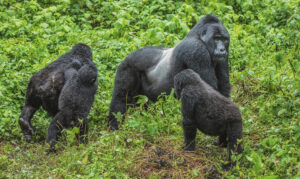 Smaller than Bwindi but equally extraordinary, Mgahinga Gorilla National Park sits at the foot of the Virunga volcanoes — the same mountain chain sheltering gorillas across Uganda, Rwanda, and DRC.
Mgahinga offers gorilla trekking alongside golden monkey tracking, backed by three towering volcanoes: Mount Muhabura, Mount Gahinga, and Mount Sabyinyo. It is a more intimate experience than Bwindi, with smaller visitor numbers and a wilderness feel that many travellers prefer.
Sitting deep in southwest Uganda, Mgahinga is far from any outbreak zone and fully operational.
What is waiting for you here: Golden monkeys leaping through bamboo forest. Gorillas against a volcanic skyline. A landscape that looks like the beginning of the world.
➡ Plan your gorilla trek — view our Uganda safari packages
3. Queen Elizabeth National Park — Uganda's Wildlife Crown, Western Uganda
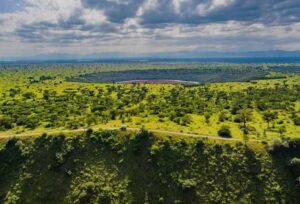 Queen Elizabeth National Park is Uganda's most biodiverse savannah park — where open grasslands meet tropical forest, wetlands merge with crater lakes, and the Kazinga Channel connects Lakes George and Edward.
The Ishasha sector hosts one of Africa's most famous wildlife curiosities: lions that climb fig trees and drape themselves across branches. Over 600 bird species, chimpanzees in Kyambura Gorge, and the legendary boat cruise complete the experience.
The park is fully operational. Game drives, boat cruises, and all activities continue without restriction.
What is waiting for you here: Tree-climbing lions in Ishasha. Hundreds of hippos and elephants at the Kazinga Channel banks. A park so rich in life that no two visits are ever the same.
➡ Explore Queen Elizabeth National Park with Tulambule
4. Kibale Forest National Park — The Primate Capital of the World, Western Uganda
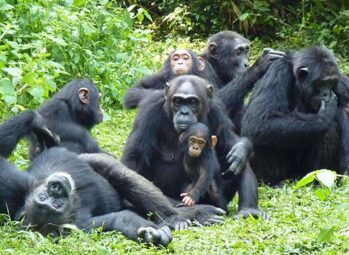
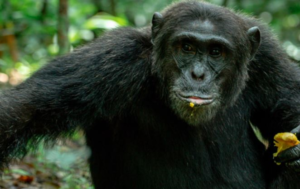 If Bwindi belongs to the gorillas, Kibale Forest National Park belongs to the chimpanzees. Kibale is home to more than 1,200 East African chimpanzees — the highest density in Africa — across five habituated communities. Chimpanzee trekking here is 99% guaranteed.
Covering 795 square kilometres of tropical forest, Kibale hosts 13 primate species in total, over 375 bird species, forest elephants, and buffalo. It adjoins Queen Elizabeth National Park to the south, making it a natural companion on any western Uganda circuit.
Kibale is fully open and nowhere near any outbreak zone.
What is waiting for you here: Chimpanzees charging through the forest canopy above your head. Thirteen primate species in a single morning walk. One of Africa's most extraordinary and studied forest ecosystems.
➡ Book a chimpanzee trekking safari — view our Uganda tours
5. Murchison Falls National Park — The Nile in All Its Power, Northwestern Uganda
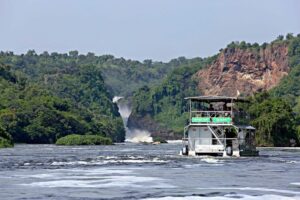 Uganda's largest national park is built around one of the most dramatic natural spectacles on the continent — the point where the entire Nile River forces itself through a seven-metre gap in the rock and thunders out the other side.
Beyond the falls, Murchison's sweeping savannah north of the Nile is home to elephants, Rothschild's giraffes, lions, leopards, and Uganda's largest hippo population. A boat cruise from Paraa to the base of the falls, with hippos surfacing at arm's length and crocodiles lining the banks, is one of Africa's truly unmissable experiences.
Murchison is in northwestern Uganda — geographically separate from every recorded outbreak zone — and is fully open.
What is waiting for you here: The most powerful waterfall on the Nile. Rothschild's giraffes silhouetted against a golden sky. A boat cruise where the wildlife comes to you.
➡ Plan a Murchison Falls safari — browse our Uganda packages
6. Kidepo Valley National Park — Uganda's Wild North, Northeastern Uganda
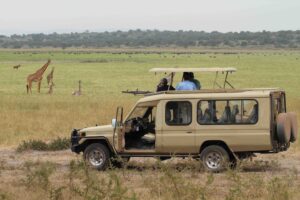 Kidepo Valley National Park is Uganda's most remote and arguably most spectacular park — a semi-arid wilderness in the far northeast that feels like a different country entirely.
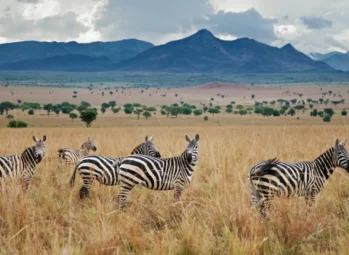
Kidepo hosts species found nowhere else in Uganda: cheetah, bat-eared fox, caracal, aardwolf, ostrich, and Burchell's zebra. The Narus Valley concentrates wildlife in numbers that rival the great East African parks during dry season. Surrounded by mountains and dramatic rocky inselbergs, Kidepo is raw, cinematic, and unforgettable.
Kidepo is heavily guarded, safe, and its remote northeast location puts it firmly outside every recorded Ebola outbreak zone in Uganda's history.
What is waiting for you here: Cheetah on open plains. Ostriches stalking through dry grass. A wilderness so spectacular that most visitors say Kidepo becomes the highlight of their entire Africa journey.
➡ Discover Kidepo Valley — view our Uganda adventure safari
7. Lake Mburo National Park — Uganda's Hidden Savannah Gem, Western Uganda
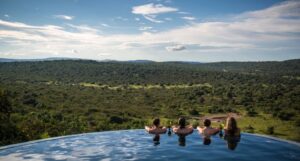 Lake Mburo National Park is Uganda's most accessible savannah park — a compact landscape of rolling hills, acacia woodland, swamps, and five interconnected lakes. It is the only park in Uganda where you can see zebra, impala, and eland together.
What makes Lake Mburo particularly special is what you can do here that few other East African parks allow: game walks and horseback safaris through wild game on a regular basis.
Lake Mburo sits perfectly on the Kampala–Bwindi route — ideal as an opening or closing night on any western Uganda itinerary. It is fully operational and well away from any outbreak zone.
What is waiting for you here: Zebra at sunrise. A horseback safari through acacia woodland alongside impala and buffalo. The intimate satisfaction of a park so personal it feels like it belongs to you.
➡ Add Lake Mburo to your Uganda itinerary — view our safari packages
8. Rwenzori Mountains National Park — The Mountains of the Moon, Western Uganda
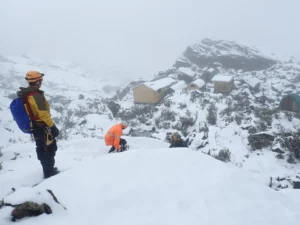 The Rwenzori Mountains are Africa's third-highest range and the legendary "Mountains of the Moon" that ancient explorers believed were the source of the Nile. Rwenzori Mountains National Park is a UNESCO World Heritage Site protecting glaciers, alpine meadows, giant heather forests, and plant species found nowhere else on Earth.
This is a hiking and trekking destination of the highest order — for travellers who want to push into an otherworldly landscape of giant lobelias, Senecio trees, and mist-wrapped ridges rising to Margherita Peak at 5,109 metres.
Located in western Uganda and far from any outbreak area, Rwenzori is open, operational, and as extraordinary as ever.
What is waiting for you here: Glaciers that have endured for millennia. A landscape unlike anywhere in Africa. A hike that puts you inside one of the continent's great geographical mysteries.
➡ Explore Uganda's mountains and wildlife — view our adventure tours
9. Semuliki National Park — The Congo Basin in Uganda, Western Uganda
 Semuliki National Park is one of the oldest forests in Africa — an extension of the Congo Basin's Ituri Forest that spills into Uganda's Albertine Rift. It shelters species that survived the last Ice Age when most of the continent's forests retreated.
Semuliki is home to birds and mammals found nowhere else in East Africa — Central African species that reach their eastern limit here, making it one of the continent's finest birding destinations. The Sempaya Hot Springs, where geysers erupt from the forest floor, are among Uganda's most memorable natural attractions.
Located in western Uganda, far from any outbreak zone, the park is open for forest walks, chimpanzee tracking, and birdwatching.
What is waiting for you here: Forest so ancient it feels primordial. Bird species you will not see in any other Uganda park. Boiling geysers erupting from the floor of a tropical rainforest.
➡ Explore Uganda's rare and remote wildlife destinations
10. Mount Elgon National Park — The Elephant Mountain, Eastern Uganda
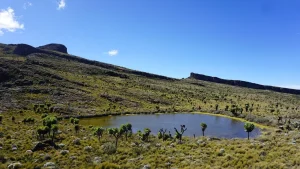 Mount Elgon National Park is home to Africa's largest volcanic caldera and a remarkable elephant population famous for something seen almost nowhere else in the world — cave-dwelling elephants that enter ancient mountain caves at night to mine mineral salts from the walls using their tusks.
The park offers hiking, waterfall trails, cave exploration, and cultural encounters with the Bagisu people on the lower mountain slopes. Located in eastern Uganda, Mount Elgon is entirely separate from any western or central outbreak zones.
It is open, accessible, and one of Uganda's most underrated and rewarding safari discoveries.
What is waiting for you here: Elephants walking into caves in the dark. Africa's largest volcanic caldera. A landscape shaped by millions of years of geological force — and very few crowds.
➡ Plan a full Uganda safari combining multiple parks
25 Years of Proof: Uganda Safari Tourism Has Never Stopped
Here is the historical record that removes any remaining doubt.
Uganda has experienced Ebola outbreaks in 2000, 2007, 2008, 2012 (twice), 2019, 2022, 2025, and 2026. Nine outbreaks in 26 years. Through every single one, Uganda's national parks remained open and tourism continued.
The 2000 outbreak — Uganda's worst ever, with 425 cases — impacted Gulu, Masindi, and Mbarara in the north. Bwindi stayed open. Gorilla trekking continued without interruption.
The 2022 Mubende District outbreak recorded 142 confirmed cases and was declared over in January 2023. During those four months, Bwindi, Queen Elizabeth, Murchison Falls, and Kidepo all ran safaris as normal.
The 2025 Sudan virus outbreak was declared over on April 26, 2025, with just 14 cases and four deaths. Not one park closed for a single day.
The pattern is not coincidence. Outbreaks happen in specific places — and those places have never been Uganda's safari parks.
What Uganda's Authorities Officially Say
The Uganda Tourism Board has officially confirmed that Uganda remains safe, open, and operational for tourism, with zero local community transmission in tourism areas and all national parks continuing to operate normally.
The Uganda Ministry of Health has activated rapid response teams, enhanced screening at Entebbe International Airport, and coordinated contact tracing — all focused on specific affected districts, not on any safari destination.
The Uganda Wildlife Authority has reinforced hygiene protocols at all trekking entry points — temperature checks, handwashing stations, face masks during gorilla trekking. These are precautionary measures in a well-run system, not signs of danger.
The World Health Organization (WHO) and Africa CDC have both called for the avoidance of unnecessary travel restrictions, noting that such restrictions penalise the very transparency that brings outbreaks under control.
How Uganda Compares to Other Safari Destinations
Kenya, Tanzania, South Africa, and Zimbabwe — all beloved safari destinations — have experienced cholera, political unrest, and public health events at various points. Travellers rarely cancel safaris to those countries over events in specific regions.
Uganda deserves the same measured, geography-based judgment. The US CDC issued Uganda a Level 1 travel notice in May 2026 — the mildest possible advisory, equivalent to "practice usual precautions." It is not a warning. It is not a reason to cancel.
Also read: Is Gorilla Trekking in Uganda During an Ebola Outbreak Safe? — our full companion guide for gorilla trekking travellers specifically.
Practical Advice for Tourists: Travel Smart, Not Scared
You booked this trip for a reason. Here is how to travel confidently and responsibly.
Check the Outbreak Location — Not Just the Country
Every advisory references a specific district or province. Find it on a map and compare it to your itinerary. In virtually every scenario, they do not overlap. The WHO Outbreak News page and the Uganda Ministry of Health provide precise, regularly updated location data.
Allow Extra Time at Entebbe Airport
Temperature checks and health questionnaires are in place during declared outbreak periods. They are quick and in your interest. Arrive at least four hours before departure to allow for enhanced screening comfortably.
Do Not Trek if You Feel Unwell
This rule exists at all times and matters most during an outbreak period. If you wake up with a fever or feel unwell on trekking morning, stay at the lodge. Inform your operator immediately — permits can almost always be rescheduled within your stay.
Stay Connected With Your Operator
A good operator monitors developments daily and adjusts itineraries if any route is affected. At Tulambule Uganda Safaris, we track every development in real time, communicate honestly, and have contingency plans ready for every scenario.
Review Your Travel Insurance Before You Fly
Ensure your policy covers medical evacuation and trip amendments for public health events. Confirm coverage with your insurer before departure. This is good practice on any international safari.
Why Travelling to Uganda Supports Conservation, Not Just Your Holiday
There is a conservation argument here that deserves to be made plainly.
Uganda's mountain gorilla population has grown from an estimated 620 individuals in 1989 to over 1,000 today. That recovery happened because responsible tourism gave governments, communities, and conservation bodies a direct financial stake in the gorillas' survival.
Permit revenue funds rangers. Lodge fees fund wildlife veterinary teams. Community levies fund the livelihoods that make human-wildlife coexistence possible and permanent.
When tourists cancel objectively safe safaris based on geography-blind fear, that funding weakens — quietly and with real consequences for the wildlife. Every national park in Uganda carries the same story. Travelling during a safe period is one of the most meaningful things a wildlife traveller can do.
Frequently Asked Questions
Are Uganda's national parks safe during an Ebola outbreak?
Yes. Uganda's ten national parks are spread across six geographic regions, none of which overlap with any recorded Ebola outbreak zone. The Uganda Wildlife Authority has never closed a park due to Ebola in over 25 years of outbreaks.
Which Uganda national parks are affected by the 2026 Ebola outbreak?
None. The 2026 outbreak originated in Ituri Province, northeastern DRC, with a small number of imported cases in Kampala. All ten parks — Bwindi, Mgahinga, Queen Elizabeth, Kibale, Murchison Falls, Kidepo, Lake Mburo, Rwenzori, Semuliki, and Mount Elgon — are fully open and unaffected.
Has gorilla trekking ever been suspended due to Ebola?
No. Gorilla trekking permits have been continuously issued and honoured at Bwindi and Mgahinga through every Ebola outbreak since 2000. The Uganda Wildlife Authority has never suspended trekking due to Ebola.
Is Kidepo Valley National Park safe during an Ebola outbreak?
Yes. Kidepo is heavily guarded, remote, and its northeastern location is firmly outside every recorded outbreak zone. US State Department travel advisories do not include Kidepo in any elevated-risk area.
Where do I find official, current outbreak information?
- Uganda Ministry of Health — health.go.ug
- Uganda Tourism Board — utb.go.ug
- Uganda Wildlife Authority — ugandawildlife.org
- World Health Organization — Outbreak News
- US CDC — Ebola Situation Summary
- Africa CDC — africacdc.org
The Bottom Line: Uganda's National Parks Are Open, Safe, and Extraordinary
Uganda national parks safe during Ebola is not a marketing slogan. It is a documented fact backed by 25 years of uninterrupted tourism through nine outbreaks — a record that no headline has ever changed, because the parks were never in the outbreak zones to begin with.
All ten of Uganda's national parks are open right now. Every gorilla family is in the forest. Every chimpanzee community is in the trees. Every lion pride is on the plains. The Nile is crashing through Murchison Falls. Kidepo is waiting, wild and magnificent, for the travellers bold enough to reach it.
Come. Uganda is ready for you.
Book Your Uganda Safari Today
Do not let a headline decide your adventure for you. The parks are open. The wildlife is there. The experience of a lifetime is waiting.
Plan and book with Tulambule Uganda Safaris:
➡ View our Uganda safari itineraries and packages — find the right trip for you ➡ Book mountain gorilla trekking in Uganda — permits, lodges, and expert guidance ➡ Explore all Uganda safari tours and destinations ➡ Speak to our team directly — get a free personalised quote
Also read: Is Gorilla Trekking in Uganda During an Ebola Outbreak Safe?
3-Day Murchison Falls Wildlife Safari: Big Game & Beautiful Scenery