 Gorilla trekking in Uganda during an Ebola outbreak is one of the most searched travel questions whenever health alerts surface in East and Central Africa. It is a fair question, and it deserves a straight answer. This guide exists for exactly that reason — to cut through the noise, present the facts from official sources, and help you decide with confidence rather than fear.
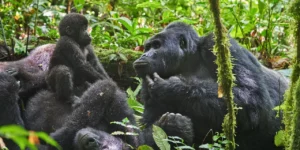
Uganda is home to more than half of the world's remaining mountain gorillas, and the experience of tracking them through the ancient forests of Bwindi or Mgahinga is unlike anything else on earth. That experience does not disappear because of a health alert hundreds of kilometres away. What disappears is clarity — and this article brings it back.
Every time Ebola makes the news in East or Central Africa, the same question lands in travellers' inboxes: is gorilla trekking in Uganda during an Ebola outbreak still safe — and should I cancel my safari?
The short answer, in almost every scenario, is no — and this guide explains exactly why, drawing on the official positions of Uganda's Ministry of Health, the Uganda Tourism Board, the Rwanda Development Board, and international health authorities including the World Health Organization (WHO).
This is not a piece written to sell you a trip at any cost. It is a factual, regularly updated travel resource designed to give you the context and confidence to make an informed decision. We believe panic and cancellation should always be the last resort, especially when the facts on the ground tell a very different story from the headlines.
Understanding Ebola: The Basics Every Traveller Should Know
Before discussing geography, tourism, or travel advisories, it helps to understand what Ebola actually is — and what it is not.
Ebola Virus Disease (EVD) is a severe illness caused by one of several strains of the Ebola virus. The most well-known strain is the Zaire ebolavirus, responsible for the devastating 2014–2016 West Africa outbreak. Other strains include Sudan virus and Bundibugyo virus, the latter named after Bundibugyo District in western Uganda, where it was first identified in 2007.
How Ebola Spreads — and How It Does Not
This is the most important thing to understand: Ebola is not airborne.
The virus spreads through direct contact with the blood or bodily fluids of a person who is sick with or has died from Ebola. It does not spread through casual contact, breathing shared air, or mosquito bites. It is not transmitted through food, water, or general tourism environments.
Healthcare workers caring for patients, and family members involved in traditional burial practices involving direct contact with the deceased, are the groups most at risk. A traveller on a safari, sitting in a game vehicle, trekking through Bwindi Impenetrable Forest, or staying at a lodge, does not fall into either of those categories.
This is why the WHO, the CDC, and Uganda's own health authorities consistently draw a distinction between the outbreak zone and the rest of the country — and why tourism continues to operate normally in Uganda's national parks even during declared outbreak periods.
What Uganda's Ministry of Health Says
Uganda's Ministry of Health has issued official communications during every Ebola outbreak affecting the region. Their position has been consistent: swift activation of response systems, transparent communication with the public, and clear messaging that isolates the affected zones from the rest of the country.
In May 2026, when the Bundibugyo virus outbreak originating in DRC's Ituri Province produced imported cases in Kampala, the Ministry of Health confirmed the outbreak immediately and activated rapid response teams in partnership with international health organisations including WHO and the Africa Centres for Disease Control and Prevention (Africa CDC).
Critically, the Ministry confirmed that the cases recorded in Uganda were imported cases — individuals who had travelled directly from the Ituri Province outbreak area in northeastern DRC. No local community transmission was confirmed in Uganda outside of direct contact tracing linked to those imported cases.
The Ministry's response included:
- Immediate activation of Ebola Rapid Response Teams
- Contact tracing and monitoring of all individuals linked to confirmed cases
- Enhanced health screening at Entebbe International Airport and major border crossings
- Coordination with the Uganda Wildlife Authority (UWA) on health protocols at national parks
- Regular public briefings and media updates to prevent misinformation
Uganda has dealt with Ebola more times than almost any other country in the world. In 2022–2023, the country successfully contained a Sudan strain outbreak that reached Kampala, declaring the country Ebola-free in January 2023 after passing the WHO's required 42-day window with no new cases. The same year, Uganda's Health Minister stated: "We have successfully controlled the spread of Ebola in Uganda." That track record of fast, effective containment is not accidental. It is the result of years of investment in outbreak response capacity. Official resource: Uganda Ministry of Health – health.go.ug
What the Uganda Tourism Board Says
The Uganda Tourism Board (UTB) is the official government body responsible for promoting and regulating Uganda's tourism industry. Their position during the 2026 Ebola situation was unambiguous.
In an official statement, the UTB confirmed that Uganda remains safe, open, and operational for tourism, following imported Ebola cases involving travellers from DRC. The statement noted zero local transmission or community infection within Uganda, with robust surveillance and response measures in place nationwide. Tourism activities, national parks, hotels, and transport services were confirmed to be continuing normally.
The UTB's statement specifically addressed travellers with upcoming bookings and encouraged them not to cancel, emphasising that Uganda's tourism destinations — including Bwindi Impenetrable National Park and Mgahinga Gorilla National Park — were operating under enhanced hygiene and health screening protocols, not under restriction.
This is consistent with the UTB's broader position that responsible, informed tourism is part of Uganda's public health and conservation strategy. Gorilla trekking permits, which generate significant revenue for conservation and community development, directly fund the protection of mountain gorillas and the employment of thousands of Ugandans in and around the national parks. Unnecessary cancellations damage both. Official resource: Uganda Tourism Board – utb.go.ug
What Rwanda Says About Gorilla Trekking Safety
Rwanda shares a border with DRC and is home to Volcanoes National Park, one of the world's premier gorilla trekking destinations. During any DRC-linked Ebola event, Rwanda's response is closely watched by international travellers.
Rwanda has no confirmed Ebola cases during the 2026 outbreak. The Rwanda Development Board (RDB), which oversees all gorilla tourism at Volcanoes National Park, has maintained normal trekking operations under enhanced health protocols.
Rwanda's government moved swiftly to intensify screening at all border crossings with DRC, particularly at major entry points. Despite these precautionary measures, Rwanda's tourism industry has remained active and operational, with hotels, conference venues, safari operations, and gorilla trekking all continuing to welcome international visitors.
The Rwanda Development Board's position is that strong public health systems and open tourism operations can and do work side by side. Gorilla trekking activities in Volcanoes National Park continue under carefully monitored health protocols designed to protect both travellers and the mountain gorillas themselves, which as great apes share enough genetic similarity with humans to be susceptible to human diseases.
Notably, the US State Department's travel advisory for Rwanda rates Volcanoes National Park as not included in any elevated-risk area, and Rwanda holds strong travel safety ratings across major international advisory systems. Official resource: Rwanda Development Board – rdb.rw
Gorilla Trekking in Uganda During an Ebola Outbreak: The Geography That Changes Everything
Here is the single most important piece of information for any traveller considering a gorilla trekking safari in Uganda or Rwanda.
The Ebola outbreaks that make headlines in connection with Uganda originate in Ituri Province, northeastern DRC — or occasionally in other provinces of northeastern and eastern DRC. Gorilla trekking in Uganda takes place at the opposite end of the country.
Bwindi Impenetrable National Park and Mgahinga Gorilla National Park are located in southwestern Uganda, near the borders of Rwanda and DRC's South Kivu Province. Ituri Province is in northeastern DRC, more than 600 kilometres from Bwindi. The two regions share no population corridor, no direct road, and no transport route that connects them. They are separated by the entirety of eastern DRC — a vast, forested region of extraordinary geographic scale.
Volcanoes National Park in Rwanda is in the country's northwest, separated from Ituri Province by hundreds of kilometres with no shared border or direct connection to the outbreak zone.
To put the distances in perspective: 600 kilometres is roughly the same as the distance from Nairobi to Mombasa, or from Amsterdam to Berlin. When a news headline says "Ebola linked to Uganda", it is almost never happening anywhere near Bwindi.
This geographic reality is why Uganda Wildlife Authority (UWA) has not restricted trekking activities at either gorilla park during recent outbreak periods, why international travel advisories do not advise against visiting southwestern Uganda, and why the parks remain fully open.
Are Gorilla Trekking Permits Still Available?
Yes. Gorilla trekking permits for both Uganda and Rwanda have continued to be issued and honoured during Ebola outbreak periods, including during the 2026 situation.
In Uganda, gorilla trekking permits are managed by the Uganda Wildlife Authority (UWA) and priced at USD 800 per person for Bwindi and Mgahinga. They allow one hour in the presence of a habituated gorilla family, under the guidance of trained park rangers.
In Rwanda, permits for Volcanoes National Park are issued by the Rwanda Development Board and priced at USD 1,500 per person.
Both permit systems include strict health protocols — trekkers are screened on the morning of their trek, anyone showing symptoms of illness is not permitted to proceed, and the 7-metre distancing rule from gorillas is enforced at all times. These protocols have been in place for years and serve double duty: protecting visitors and protecting the gorillas from human-borne disease.
Learn more about gorilla trekking permits with Tulambule Uganda Safaris
How Uganda Has Handled Ebola Before
Uganda's track record on Ebola response is one of the strongest in Africa. Since the virus was first identified in DRC in 1976, Uganda has experienced multiple outbreaks — including a Bundibugyo strain outbreak in 2007 in Bundibugyo District, which gave the strain its name.
Every outbreak has been successfully contained. The 2022 Sudan strain outbreak, which reached Kampala before being brought under control, ended with a clean bill of health in January 2023. The 2025 Sudan strain outbreak was declared over in April 2025 after 42 days with no new cases.
The pattern is consistent: Uganda detects quickly, responds transparently, contains effectively. This is not a country that conceals or mismanages outbreaks. It is a country with established systems, trained personnel, and a political will to act fast — precisely because it has done this before.
International organisations including WHO have repeatedly recognised Uganda's outbreak response capacity as a model for the region.
What the WHO and Africa CDC Say About Travel
The World Health Organization has been explicit that declaring a Public Health Emergency of International Concern (PHEIC) — the highest alert level — is a call for coordinated global health action, not a signal for panic or broad travel cancellation.
Africa CDC has gone further, publicly calling on all countries to refrain from imposing unnecessary travel or trade restrictions in response to Ebola outbreaks, noting that such restrictions penalise the very transparency and effective outbreak management that makes containment possible. Africa CDC drew a direct parallel with Rwanda's handling of the 2024 Marburg outbreak, where swift, transparent action was ultimately rewarded when travel restrictions were lifted after Rwanda demonstrated strong containment.
The US CDC's travel notices offer a useful calibration:
- Level 1 (Practice usual precautions) — issued for Uganda in May 2026
- Level 3 (Reconsider travel) — issued for DRC in May 2026
A Level 1 notice for Uganda is not a warning. It is the mildest possible advisory, equivalent in practical terms to being aware and washing your hands.
Practical Advice for Travellers With Bookings
If you have a gorilla trekking safari booked with us or with any reputable operator, here is what we recommend:
1. Don't cancel based on headlines alone.
Read the geography. Find out where the outbreak actually is and compare it to where your safari takes you. In the vast majority of cases, they are not the same place.
2. Check the official advisory for your country of residence.
The UK FCDO, US State Department, Australian Smartraveller, and other government advisories are regularly updated and give specific regional guidance. Most do not advise against travel to Uganda's southwestern parks.
3. Follow health protocols without fear.
Temperature checks, health questionnaires, and hand sanitiser stations at lodges and trekking entry points are there for your benefit. Cooperate with them. They take minutes.
4. Do not trek if you feel unwell.
This rule exists at all times, not just during outbreak periods. If you have a fever, respiratory symptoms, or feel off on trekking morning, stay at the lodge. Your permit can typically be rescheduled. Do not push through — for your own sake and for the gorillas' wellbeing.
5. Avoid high-risk border areas that are not part of your itinerary anyway.
None of Uganda's premier safari destinations — Bwindi, Mgahinga, Queen Elizabeth, Murchison Falls, Kibale — sit in areas linked to any Ebola outbreak zone. Your itinerary is almost certainly unaffected.
6. Keep your travel insurance documentation in order.
Ensure your policy covers medical evacuation and is current. This is good practice regardless of any health situation.
7. Stay in contact with your operator.
A good operator — like Tulambule Uganda Safaris — monitors the situation daily and will contact you proactively if anything changes that genuinely affects your itinerary. If we have concerns, we will tell you honestly.
Contact Tulambule Uganda Safaris for personalised travel advice
Why Continuing to Trek Matters for Gorilla Conservation
Uganda's mountain gorillas — approximately half of the world's entire remaining population of fewer than 1,100 individuals — exist today in part because of gorilla tourism. Permit revenue, lodge fees, and community levies fund the rangers, veterinary teams, anti-poaching patrols, and community programmes that make long-term conservation possible.
When tourism stops, that funding stops. Empty forests are not safer forests — they are financially vulnerable ones. The mountain gorilla population has grown from an estimated 620 individuals in 1989 to over 1,000 today, a recovery made possible precisely because responsible tourism gave local communities and governments a direct financial stake in the gorillas' survival.
Cancelling a safe safari is not a cautious act. In a very real sense, it works against conservation.
Read more about Uganda's mountain gorillas and where to see them
Frequently Asked Questions
Is gorilla trekking in Uganda during an Ebola outbreak safe?
In virtually all cases, yes. Gorilla trekking in Uganda during an Ebola outbreak remains safe because Uganda's gorilla parks — Bwindi Impenetrable National Park and Mgahinga Gorilla National Park — are in the far southwest of the country, hundreds of kilometres from any DRC-linked outbreak zone. The Uganda Wildlife Authority has not restricted trekking activities, and the Uganda Tourism Board has confirmed that parks remain open and operational.
Where is the Ebola outbreak located relative to Bwindi?
The 2026 Ebola outbreak originated in Ituri Province, northeastern DRC — more than 600 kilometres from Bwindi. They are in entirely separate geographic regions with no shared corridor.
Has Rwanda suspended gorilla trekking due to Ebola?
No. Volcanoes National Park in Rwanda is fully operational. Rwanda has no confirmed Ebola cases and the Rwanda Development Board has continued to issue and honour gorilla trekking permits under enhanced health protocols.
What is Uganda's Ministry of Health's position on tourism?
The Ministry has confirmed that Uganda's tourism destinations are not in outbreak zones and that tourism activities continue normally under enhanced surveillance. They have activated rapid response systems for affected areas while making clear that the broader country remains open.
Should I cancel my safari if WHO declares a PHEIC?
A PHEIC is a call for international health coordination, not a blanket travel ban. Always check your specific destination against current travel advisories from your home country's government. In most cases, Uganda's gorilla parks are not included in elevated-risk zones.
What happens if I feel sick on the morning of my trek?
You must not trek. Health screeners at the park gate will conduct temperature checks. Informing your operator promptly gives you the best chance of rescheduling your permit for another day during your stay.
The Bottom Line
Ebola outbreaks in the DRC–Uganda border region are a recurring reality of living and travelling in this part of the world. They are serious public health situations that require attention, expert response, and honest communication. They are not, in most cases, reasons to abandon your gorilla trekking safari.
Uganda's government has shown repeatedly that it can contain these outbreaks. The parks where gorilla trekking takes place are not the outbreak zones. The tourism industry is open, operating, and supported by every official body from the Ministry of Health to the Uganda Tourism Board.
At Tulambule Uganda Safaris, we monitor health and safety developments daily. We will always be honest with you about what is happening on the ground. If we ever had genuine concerns about the safety of a safari, we would say so — and we would work with you to reschedule or adjust your trip accordingly.
Until that moment, your gorillas are in their forest. The mist is in the trees. And the experience waiting for you at Bwindi is as extraordinary as it has always been.
What you need to note:
Gorilla trekking in Uganda during an Ebola outbreak is not the risk that headlines make it appear. The parks are open. The gorillas are there. The governments of Uganda and Rwanda have spoken clearly, the Ministry of Health has its systems running, and the Uganda Tourism Board has confirmed that tourism continues normally.
Geography, science, and official guidance all point in the same direction — your safari is safe, your permit is valid, and your decision to travel is the right one. At Tulambule Uganda Safaris, we will be here every step of the way, monitoring the situation and keeping you informed. When you finally stand in that forest and a silverback looks you in the eye, you will be glad you did not cancel.
Ready to plan your gorilla trekking safari? Get in touch with our team or browse our gorilla trekking packages.