Cut into the open savanna of Queen Elizabeth National Park is a hidden world that most first-time visitors to Uganda never expect to find. Kyambura Gorge, known locally and among safari guides as the Valley of Apes, is a steep-sided ravine roughly one hundred meters deep and a kilometer across, carved over thousands of years by the Kyambura River as it cuts its way toward the Kazinga Channel.
From the flat grassland above, there is little hint of what lies below. Then the ground simply falls away, and travelers find themselves descending into a dense, tangled riverine forest that feels entirely disconnected from the open plains just moments earlier. This is Kyambura Gorge, and for anyone building a Uganda safari around Queen Elizabeth National Park, it is one of the most rewarding and most overlooked stops on the itinerary.
Kyambura Gorge earns its nickname honestly. The gorge is home to a community of wild chimpanzees, along with several other primate species, all sheltering in the pocket of forest that the steep walls of the ravine have protected from the surrounding savanna fires and grazing pressure for generations.
Chimpanzee trekking in Kyambura Gorge is Uganda's most underrated primate experience, offering many of the same thrills as trekking in Kibale Forest at a fraction of the permit cost, and with a dramatic, almost otherworldly setting that few other trekking sites in the country can match. This guide covers everything worth knowing about visiting Kyambura Gorge, from what the trek actually involves to how it fits into a wider Queen Elizabeth National Park itinerary.
The gorge's name comes from the Kyambura River, which continues to carve its way through the soft volcanic soils of the region even today, deepening the ravine gradually with every rainy season. Local Banyaruguru communities living along the plains above have long known this hidden valley as a distinct place apart from the surrounding grassland, a reputation that predates its adoption as a tourist attraction by decades.
Rangers who work the gorge daily often describe it as feeling like a completely different park stitched into the middle of the savanna, and first-time visitors tend to agree the moment they step off the rim and begin the descent. Few places in Uganda offer such a stark, immediate change of scenery within a walk of only a few minutes.
What to Expect on a Kyambura Gorge Chimpanzee Trek
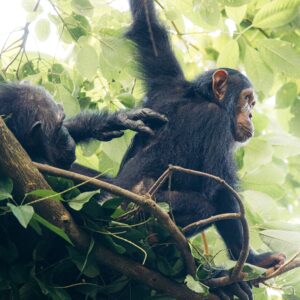
A chimpanzee trek in Kyambura Gorge begins at the ranger station on Kyambura Gorge's rim, where a Uganda Wildlife Authority guide briefs visitors before leading them down a steep, sometimes slippery path into the ravine itself. The descent alone is part of the experience: within a few minutes, the wide-open savanna disappears behind a curtain of fig trees, vines, and dense undergrowth, and the temperature and light shift noticeably as the forest canopy closes overhead. Guides at Kyambura Gorge track the chimpanzee community by following calls, feeding signs, and knowledge built up over years of daily patrols through the ravine.
Success rates for spotting chimpanzees in Kyambura Gorge are lower than in Kibale Forest, typically estimated at around sixty percent on any given trek, a figure every visitor should go in understanding clearly. The chimpanzee community here is smaller and less thoroughly habituated than Kibale's famous groups, and the dense, tangled vegetation of Kyambura Gorge makes tracking genuinely harder work for guides. What Kyambura Gorge trades in certainty, though, it makes up for in atmosphere and value.
Even when the chimpanzees prove elusive, walking through this hidden forest world, listening to hornbills and monkeys moving through the canopy, is worthwhile in its own right, and many guides note that Kyambura Gorge itself is as much the draw as the primates it shelters.
When chimpanzees are located in Kyambura Gorge, visitors typically spend up to an hour observing them, watching social grooming, feeding, and the occasional dramatic display from an adult male asserting dominance within the group. Treks generally last between two and four hours round trip, depending on how far into Kyambura Gorge the chimpanzees have ranged that day, and depart twice daily from the ranger post, usually at first light and again in the early afternoon.
Sturdy footwear is essential, since the trail through Kyambura Gorge alternates between muddy riverbank sections and steep, root-tangled climbs.
Group sizes on a typical trek are kept deliberately small, usually no more than six to eight visitors accompanied by one or two rangers, which keeps the experience personal and reduces disturbance to the chimpanzee community. Rangers communicate constantly during the trek, comparing notes on recent movement and feeding activity, and are often willing to explain what specific signs, a dropped fruit rind, a fresh knuckle print in the mud, a distant pant-hoot call, tell them about where the group is likely to be.
This running commentary turns what could be a simple walk into something closer to a tracking lesson, and many visitors find it adds real value to the experience regardless of how quickly the chimpanzees themselves are found.
Permit Costs and Why Kyambura Gorge Offers Real Value
One of the strongest arguments for adding Kyambura Gorge to a Uganda itinerary is straightforward economics. A chimpanzee trekking permit for Kyambura Gorge costs around fifty US dollars, a fraction of the two hundred dollars charged for a permit in Kibale Forest National Park, Uganda's flagship chimpanzee destination.
For travelers on a tighter budget, or those who have already trekked chimpanzees elsewhere and want a second, more affordable encounter, Kyambura Gorge represents genuinely excellent value, especially when factored against the dramatic scenery that comes as part of the experience.
This pricing difference exists precisely because success rates in Kyambura Gorge are lower than in Kibale, and it is worth weighing that trade-off honestly when deciding where to trek. Travelers with only one opportunity to trek chimpanzees, and for whom a guaranteed sighting matters most, are usually better served heading to Kibale Forest.
But for anyone already spending several days in Queen Elizabeth National Park for game drives and a Kazinga Channel cruise, adding a Kyambura Gorge trek costs relatively little in either money or time, and Kyambura Gorge's unique geology means the experience stands on its own merits even on days when the chimpanzees stay out of sight.
Because permits for Kyambura Gorge are far less in demand than those for Kibale, availability is rarely an issue, and same-day or next-day bookings are usually possible through your lodge or directly at the Uganda Wildlife Authority office within Queen Elizabeth National Park. This flexibility makes Kyambura Gorge an easy, low-friction addition to an itinerary that might otherwise already be tightly scheduled around bigger-ticket activities elsewhere in the park.
Beyond Chimpanzees: Wildlife in the Gorge
While chimpanzees are the headline attraction, Kyambura Gorge shelters a wider community of wildlife within its narrow, protected forest strip. Several other primate species share Kyambura Gorge, including olive baboons, black-and-white colobus monkeys, and red-tailed monkeys, all of which are commonly encountered along the trekking route even on days when the chimpanzee community proves harder to locate.
Birdlife in Kyambura Gorge is similarly rewarding, with the dense riverine forest supporting species rarely seen out on the open savanna above, including the striking African finfoot along quieter stretches of the river and various forest hornbills moving through the canopy.
The gorge's unique microclimate, cooler and more humid than the surrounding grassland thanks to the shelter provided by its steep walls, supports plant life distinct from the rest of Queen Elizabeth National Park as well. Towering fig trees form much of the canopy, their root systems gripping Kyambura Gorge's sides, while thick vine tangles and understory vegetation create the dense, jungle-like atmosphere that gives Kyambura Gorge its immersive character. For visitors who have spent previous days on open savanna game drives, the sudden shift into this enclosed forest world is often cited as one of the more memorable contrasts of an entire Uganda safari.
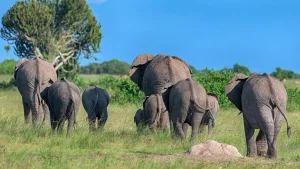
Occasionally, larger mammals including elephant and buffalo pass through parts of Kyambura Gorge system, particularly where it opens out toward the Kazinga Channel, and guides remain alert to fresh signs throughout each trek. This element of unpredictability adds a genuine sense of wilderness to Kyambura Gorge that more heavily trafficked chimpanzee trekking sites elsewhere in Uganda have sometimes lost.
Combining Kyambura Gorge with Queen Elizabeth National Park
Kyambura Gorge sits within easy reach of Queen Elizabeth National Park's other headline activities, making it straightforward to combine into a broader itinerary without significant extra driving. A typical day might pair a morning chimpanzee trek in Kyambura Gorge with an afternoon boat cruise along the nearby Kazinga Channel, where hippos, elephants, and buffalo gather along the water's edge in some of the highest wildlife concentrations found anywhere in the park. The proximity between these two activities means travelers rarely need to sacrifice one for the other, even on a relatively tight schedule.
Game drives across the Kasenyi Plains, known for lion sightings and large herds of Uganda kob, and the Ishasha sector further south, famous for its tree-climbing lions draped across the branches of fig trees, both fit naturally around a Kyambura Gorge trek as part of a multi-day Queen Elizabeth National Park stay. Many travelers structure their visit so that a Kyambura Gorge trek anchors one day, leaving mornings and afternoons on either side free for game drives elsewhere in the park's varied habitats, from open savanna to crater lake country near Katwe.
For travelers heading onward to Bwindi Impenetrable Forest for gorilla trekking, Kyambura Gorge also works well as a warm-up primate encounter earlier in the itinerary, giving a taste of forest trekking before the more demanding hike that awaits in Bwindi. The contrast between Kyambura Gorge's short, dramatic descent and the longer climbs typical of gorilla trekking gives travelers a useful sense of what forest trekking in Uganda generally involves, at a lower physical intensity.
Best Time to Visit Kyambura Gorge
Kyambura Gorge can be visited throughout the year, though conditions vary meaningfully between the wet and dry seasons. The dry months, broadly June to September and December to February, offer firmer footing on the gorge's steep trails and generally more comfortable trekking conditions, making these the most popular months for a Kyambura Gorge chimpanzee trek. Visibility within the gorge's dense canopy also tends to be marginally better during drier periods, when undergrowth is less overgrown.
The wetter months bring their own rewards, with the forest inside Kyambura Gorge at its most lush and the surrounding savanna green and productive for game viewing elsewhere in Queen Elizabeth National Park. Trails can be considerably more slippery during the rains, and travelers planning a Kyambura Gorge trek during the wetter months should budget extra time and come prepared with appropriate footwear. Regardless of season, morning treks in Kyambura Gorge tend to offer slightly better chimpanzee activity, since the community is often most vocal and active in the cooler hours shortly after dawn.
Where to Stay Near Kyambura Gorge
Accommodation near Kyambura Gorge ranges from a dedicated lodge built directly beside the ravine to a wider selection of properties elsewhere in Queen Elizabeth National Park. Kyambura Gorge Lodge, perched on the very edge of the gorge on a former coffee plantation at the foot of the Rwenzori Mountains, offers the most immersive base for a visit, with rooms named after individual chimpanzees from the resident community and direct access to the trekking start point each morning. Staying here means guests can be among the first on the trail each day, before larger groups arrive from lodges further afield.
For travelers based elsewhere in Queen Elizabeth National Park, reaching Kyambura Gorge for a morning or afternoon trek is straightforward, with most lodges around Mweya, Kasenyi, and the central park area within an hour or so of the gorge's ranger post. This makes Kyambura Gorge accessible as a single activity slotted into a wider Queen Elizabeth National Park stay, without necessarily requiring a change of accommodation. Budget and mid-range options are available throughout the park, giving travelers flexibility in how closely they want to base themselves to the gorge itself.
Practical Tips for Trekking Kyambura Gorge
A few practical details make a real difference to a visit to Kyambura Gorge. Sturdy, broken-in hiking boots with good grip are essential, since the descent and climb back out involve sections of loose soil, exposed roots, and riverbank mud that can be genuinely slippery, particularly after rain. Long trousers and sleeves offer useful protection against thorny vegetation and biting insects along the narrower stretches of trail inside the gorge, and a walking stick, sometimes offered by guides at the trailhead, can help considerably on the steeper sections.
Permits for Kyambura Gorge can typically be booked through your lodge or tour operator with relatively short notice, unlike the more competitive Kibale permits, though booking a day or two ahead during peak season removes any uncertainty. Bring binoculars, since some of the best sightings inside Kyambura Gorge, whether chimpanzees resting in the canopy or birds moving through the dense foliage, sit at a distance that rewards a closer look. A reasonable zoom lens is similarly useful for photography, given the low light conditions under the gorge's forest canopy.
Physical fitness requirements for Kyambura Gorge are moderate rather than extreme, but the descent and subsequent climb back to the rim should not be underestimated, particularly in heat or after rain. Travelers with knee or mobility concerns should discuss the trail conditions with their guide or tour operator in advance. Finally, patience matters: given the sixty percent success rate typical of Kyambura Gorge, arriving with realistic expectations, and an appreciation for the gorge itself regardless of the outcome, tends to produce the most satisfying visits.
Why Kyambura Gorge Deserves More Attention
It is worth stating plainly: Kyambura Gorge is one of the most underrated stops in the entire Queen Elizabeth National Park itinerary , and the reasons for that are mostly about marketing rather than substance. Kibale Forest, with its near-guaranteed sightings and larger, more thoroughly habituated chimpanzee community, dominates the conversation around chimpanzee trekking in Uganda, and understandably so.
But that dominance has left Kyambura Gorge sitting in Kibale's shadow despite offering an experience that, in some respects, is more atmospheric and more affordable than its better-known counterpart.
Part of what makes Kyambura Gorge distinctive is the sheer drama of the landscape itself. Few places in Uganda offer such an abrupt transition between two completely different worlds: open savanna dotted with grazing Uganda kob one moment, dense equatorial forest the next, separated by nothing more than a steep drop in elevation. Descending into Kyambura Gorge feels less like a nature walk and more like discovering a secret pocket of wilderness that the rest of Queen Elizabeth National Park does not know exists.
Photographers and travelers with a taste for the unusual consistently rank this sense of discovery among the highlights of a visit to Kyambura Gorge, regardless of whether the chimpanzees themselves put in an appearance.
There is also a conservation story worth telling about Kyambura Gorge. The isolated strip of forest survives today largely because the steep walls of the gorge have protected it from the fires and grazing pressure that have reduced forest cover elsewhere on the surrounding plains. This makes Kyambura Gorge a rare and fragile habitat island, sustaining a small community of chimpanzees and other primates in a landscape that would otherwise offer them no cover at all. Guides at Kyambura Gorge are often eager to explain this history, and understanding it adds a layer of appreciation to the trek that goes beyond simply hoping for a good sighting.
For travel consultants and operators building Uganda itineraries, Kyambura Gorge is an easy activity to underuse simply because it sits in the shadow of bigger attractions nearby. But every additional day spent in Queen Elizabeth National Park is an opportunity to include Kyambura Gorge without materially disrupting the rest of the schedule, and travelers who do so consistently report it as one of the more memorable, if lesser known, parts of their trip.
Given the modest permit cost and minimal extra driving required, there are few activities anywhere in Uganda that offer this much distinctiveness for so little additional investment of time or money. Recommending Kyambura Gorge as a standard addition to any multi-day Queen Elizabeth National Park stay, rather than an optional extra, is increasingly the approach taken by operators who know the park well.
Planning Your Visit to Kyambura Gorge
Kyambura Gorge sits within Queen Elizabeth National Park in southwestern Uganda, roughly five to six hours by road from Kampala, or a shorter transfer for travelers already touring the park after arriving via Bwindi or Kibale. Most well-planned Uganda itineraries that include Queen Elizabeth National Park can accommodate a Kyambura Gorge trek with minimal additional driving, since the gorge sits close to the park's other major attractions rather than requiring a separate detour.
A single morning or afternoon is generally sufficient for a Kyambura Gorge chimpanzee trek, making it easy to combine with a Kazinga Channel boat cruise, a game drive across the Kasenyi Plains, or a visit to the tree-climbing lions of Ishasha within the same two or three day stay in Queen Elizabeth National Park.
For travelers looking to add real depth and value to their Uganda safari without significant extra cost or complexity, Kyambura Gorge delivers a genuinely different kind of primate encounter, set in one of the country's most dramatic and least visited landscapes. A knowledgeable Uganda-based travel consultant can help build a Kyambura Gorge trek into your wider Queen Elizabeth National Park itinerary at exactly the right point, ensuring the Valley of Apes gets the time it deserves rather than being squeezed in as an afterthought.