Uganda gorillas are one of the last strongholds of a species that very nearly disappeared entirely. Roughly half of the world's remaining mountain gorillas live within Uganda's borders, concentrated in two forests that together represent one of conservation's genuine success stories.
This guide looks at who these animals actually are, how they live day to day, and why their survival remains fragile despite decades of protection.
If you are planning the logistics of an actual visit, our Uganda gorilla safaris guide and gorilla trekking permits guide cover booking, costs, and sectors in detail.
Understanding the animals themselves changes how the trek feels once you are actually standing a few meters from a family. Knowing why a silverback beats his chest, why juveniles wrestle constantly, or why the group moved overnight adds a layer of meaning that a rushed briefing rarely covers.
Who Are Uganda's Mountain Gorillas
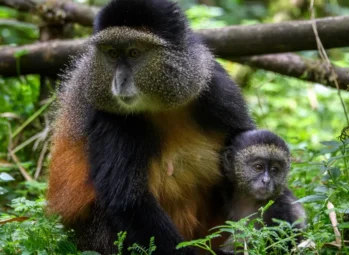
Uganda gorillas belong to the mountain gorilla subspecies, Gorilla beringei beringei, one of two subspecies of the eastern gorilla. They share roughly 98 percent of their DNA with humans, which shows clearly in their expressions, social bonds, and problem solving.
The species was once classified as Critically Endangered, but sustained conservation work led the IUCN to downgrade mountain gorillas to Endangered in 2018, a rare piece of good news in primate conservation. Current estimates put the global population at just over a thousand individuals.
Roughly half of that population lives in Uganda, split between two national parks that together protect nearly every wild mountain gorilla left on earth.
Where Uganda Gorillas Live
Bwindi Impenetrable National Park, a UNESCO World Heritage Site in southwestern Uganda, holds the majority of the country's gorilla families across four trekking sectors.
The forest's tangled understory and steep terrain give the park its name, and its isolation is part of what has kept the gorillas relatively protected.
Mgahinga Gorilla National Park, further south along the Virunga volcanoes, is smaller and quieter, home to a single habituated family that moves freely across the borders of Uganda, Rwanda, and the Democratic Republic of Congo.
Both parks fall under the Uganda Wildlife Authority, which manages permits, ranger patrols, and the broader conservation strategy for both populations.
Family Life and Social Behavior
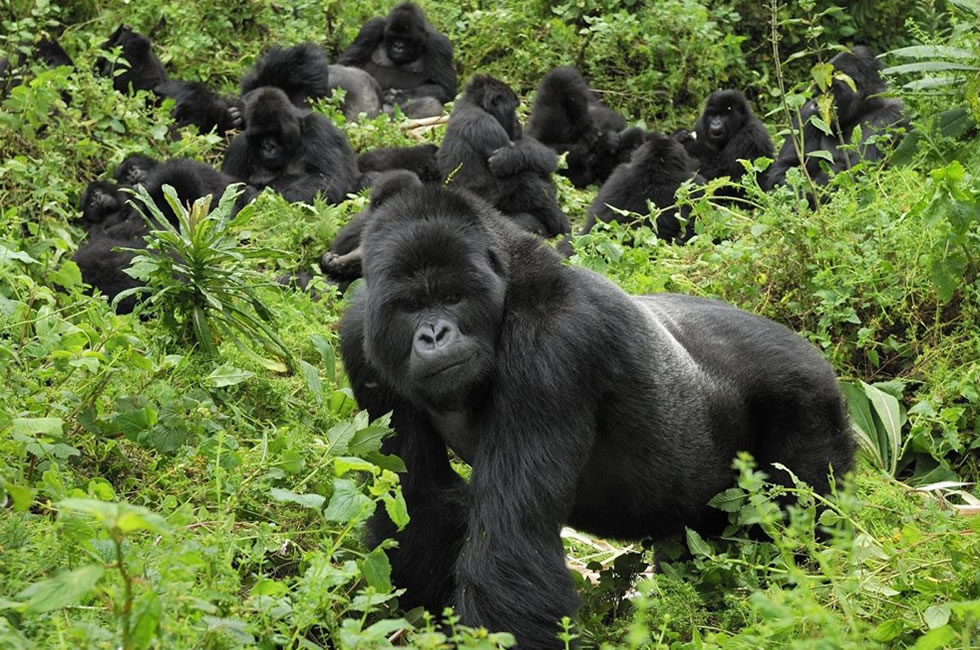
Uganda gorillas live in tight family groups typically led by a single dominant silverback, identifiable by the band of silver hair across his back that develops with age. The silverback protects the group, settles disputes, and decides where the family forages and rests each day.
Groups usually include several adult females, their offspring, and sometimes younger males not yet ready to lead their own family. Interactions within the group are notably gentle for an animal of such size, built around grooming, play, and quiet physical closeness.
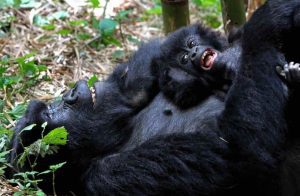
Young gorillas behave remarkably like human toddlers, wrestling with siblings and testing boundaries under the watchful eye of their mothers. Females typically stay with their birth group or transfer to another, while young males eventually leave to establish families of their own.
What Uganda Gorillas Eat and How They Spend Their Day
Despite their imposing size, mountain gorillas are almost entirely herbivorous, feeding on leaves, shoots, stems, and occasionally fruit and insects. An adult silverback can eat over 18 kilograms of vegetation daily, which shapes much of how the group moves through the forest.
A typical day follows a loose rhythm of foraging in the morning, resting through the heat of midday, and foraging again before building fresh nests to sleep in each night.
Gorillas rarely sleep in the same spot twice, constructing a new nest of bent branches and leaves every evening.
This constant movement across a relatively small home range is one reason habituated families can still be located reliably each morning, even without collars or tracking devices.
Trackers who monitor each group daily can often predict roughly where a family will be based on the previous night's nest site and the direction the group was last feeding.
This local knowledge is what makes trekking Uganda gorillas feasible within a single morning rather than requiring days of searching.
How Uganda Gorillas Become Habituated
Not every gorilla family in Bwindi or Mgahinga can be visited. Only families that have gone through habituation, a slow process of controlled human exposure lasting two to three years, are considered safe for daily tourist visits.
Trackers and researchers visit the same family every day during this period, gradually reducing the distance and the animals' wariness until the group tolerates a small group of quiet observers nearby. The process is deliberately unhurried, since rushing it risks stress responses that can harm the gorillas' wellbeing.
Once habituated, a family is assigned to either standard tourism visits or, in a smaller number of cases, longer habituation experience permits that allow visitors to shadow the ongoing process itself rather than a fully settled family.
Roughly twenty families across Bwindi's four sectors and the single Mgahinga family are currently open to visitors, out of many more that remain unhabituated and left undisturbed deep in the forest.
Uganda gorillas that have never been habituated are deliberately kept out of tourism entirely, preserved as a genetically diverse, low-stress reserve population.
Threats Facing Uganda Gorillas
Habitat loss remains the most persistent threat, as agriculture and settlement continue to press against the edges of Bwindi and Mgahinga. Because mountain gorillas cannot be relocated into captivity for breeding the way some endangered species can, protecting existing forest is the only real safeguard for the population.
Disease transmission is a genuine concern given how closely related gorillas are to humans. Respiratory infections passed from trekkers to habituated families have caused deaths in the past, which is why strict distancing rules now apply during every visit.
Poaching, though rarely targeted at gorillas directly, still claims occasional victims through snares set for other animals. Human-wildlife conflict around crop raiding near park boundaries adds further pressure, though community-based conservation programs have measurably reduced these incidents over the past decade.
How Uganda Gorillas Are Being Protected
Permit revenue is the backbone of gorilla conservation funding in Uganda, paying for ranger salaries, anti-poaching patrols, and veterinary monitoring of habituated families. Every trek effectively functions as a direct contribution to the survival of the species.
A share of that revenue also flows into surrounding communities through the Uganda Wildlife Authority's revenue-sharing program, funding schools, clinics, and small infrastructure projects in villages bordering the parks. This link between tourism income and community benefit has done more to reduce poaching than enforcement alone ever could.
The result is one of the few conservation stories trending in the right direction. Population counts have risen steadily since the 1980s, when fewer than 300 mountain gorillas were thought to remain across their entire range.
That recovery is fragile rather than guaranteed. Uganda gorillas still depend entirely on continued permit revenue, active ranger presence, and community buy-in.
Any disruption to tourism, as happened briefly during global health scares in recent years, puts real pressure back on the funding model that keeps the population growing.
Trekking Rules That Protect Uganda Gorillas
The rules enforced during every trek exist specifically because of how vulnerable these animals are to human contact. Visitors must stay at least seven meters from the gorillas at all times, a distance chosen to limit the risk of respiratory disease transmission between species.
Flash photography is prohibited, since sudden bursts of light can startle a silverback into a defensive reaction that puts both the animal and nearby visitors at risk.
Eating, drinking, and loud conversation near the family are also restricted, since gorillas habituated to quiet human presence can become stressed by unfamiliar noise.
Anyone showing signs of a cold or respiratory illness is asked to skip their trek entirely, sometimes with a rebooking option, because a single transmitted infection can spread rapidly through a tight-knit family group.
These rules feel restrictive in the moment, but they are the reason habituated families have survived decades of daily tourist contact without a major disease outbreak.
Uganda Gorillas Compared to Rwanda and Congo
Mountain gorillas exist in only three countries, and Uganda holds the largest share of habituated families of the three. Rwanda's population lives entirely in Volcanoes National Park, while Congo's Virunga side has been affected far more heavily by regional instability over the years.
Uganda's advantage lies in the sheer number of habituated families spread across Bwindi's four sectors, which gives trekkers a wider range of options and generally shorter waiting lists for permits than neighboring countries offer.
Rwanda's Volcanoes National Park sits closer to Kigali and offers shorter, generally easier hikes, which appeals to travelers prioritizing comfort over choice of sector. Permit prices there also run considerably higher, which is deliberately built into that country's conservation funding model.
Congo's Virunga National Park holds gorilla families as well, but decades of regional conflict have made access unpredictable, and most operators, including us, do not currently recommend it as a primary gorilla trekking destination.
For travelers weighing the two more accessible options, our detailed comparison of gorilla trekking in Uganda versus Rwanda breaks down cost, terrain, and permit availability side by side.
Meeting Uganda Gorillas in Person
Spending an hour with a habituated family remains the only way most people will ever encounter mountain gorillas in the wild, and it is an experience that tends to affect people more deeply than they expect going in.
We have covered the practical side of arranging that encounter extensively elsewhere. Our ultimate gorilla trekking packing list and one hour with mountain gorillas guides walk through what to bring and what an actual trek involves, sector by sector.
Travelers wanting a deeper encounter sometimes opt for mountain gorilla double trekking, spending two consecutive days with different families to observe a wider range of behavior than a single hour typically allows.
Best Time to See Uganda Gorillas
Trekking is possible year round, since habituated families do not migrate seasonally the way some wildlife does. The dry seasons, June through August and December through February, simply make the forest trails firmer and the hike physically easier.
Visiting during the rains means muddier, slower trekking, but also thinner crowds and a forest that looks genuinely different, dense, green, and dripping. Neither season changes the fundamental experience of the encounter itself.
Frequently Asked Questions About Uganda Gorillas
How many mountain gorillas live in Uganda? Uganda is home to roughly half the world's mountain gorilla population, spread across Bwindi Impenetrable National Park and Mgahinga Gorilla National Park.
Are Uganda gorillas endangered? Yes, mountain gorillas are classified as Endangered by the IUCN, though their population has grown steadily since conservation efforts intensified in the 1980s.
What is the difference between Bwindi and Mgahinga gorillas? Bwindi holds the majority of Uganda's habituated gorilla families across four sectors, while Mgahinga is home to a single family that moves across the Uganda, Rwanda, and Congo border region.
How closely related are gorillas to humans? Mountain gorillas share approximately 98 percent of their DNA with humans, which is reflected in their social structures, emotional expressions, and problem-solving behavior.
Can Uganda gorillas be seen outside of guided treks? No, all encounters with habituated gorilla families require a licensed guide, park rangers, and a valid permit issued by the Uganda Wildlife Authority to protect both visitors and the gorillas themselves.
How long have Uganda gorillas been protected? Formal conservation efforts date back to the 1930s, when parts of Bwindi were first designated as forest reserves, though population recovery only became measurable from the 1980s onward.
No two visits to Uganda's mountain gorillas are quite alike, since each family has its own personality, its own history, and its own place in a recovery story that is still unfolding.
Continue Planning Your Trip
Ready to plan your own encounter with Uganda's mountain gorillas? Our team can help you choose the right sector, secure your permit, and build a complete itinerary around it.
Guided Uganda Gorilla Safari Tours: Everything You Need to Know Before You Trek
Bwindi vs Mgahinga: Which Uganda Gorilla Park Should You Choose in 2026?