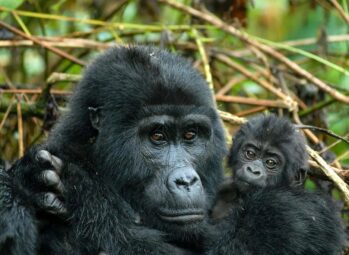
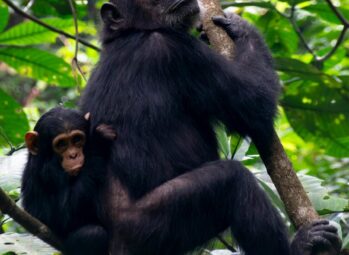
Gorilla vs chimpanzee: both are great apes, both share most of their DNA with us, and both live in the forests of Uganda. Yet they look, live and behave in very different ways. A silverback gorilla can weigh three to four times more than a chimpanzee, while a chimp is faster, louder, more playful and far more likely to hunt.
Uganda is one of the few places on earth where you can track both apes on the same trip: mountain gorillas in Bwindi and Mgahinga, and chimpanzees in Kibale Forest. In this guide, our primate safari team at Tulambule compares the gorilla vs chimpanzee on size, looks, habitat, diet, behaviour, strength, intelligence and conservation, and explains how you can see both in the wild.

Gorilla vs Chimpanzee at a Glance
| Feature | Gorilla | Chimpanzee |
| Scientific group | Genus Gorilla (2 species, 4 subspecies) | Genus Pan (common chimpanzee and bonobo) |
| Adult male weight | About 140 to 220 kg | About 40 to 70 kg |
| Height standing | Up to about 1.8 m | About 1.2 to 1.5 m |
| Ears | Small, set back on the head | Large, on the sides of the head |
| Diet | Mainly leaves, stems and shoots | Mainly fruit, plus insects and some meat |
| Group | Family of about 5 to 30, led by a silverback | Community of 20 to 150, splits into small groups |
| Where they spend time | Mostly on the ground | On the ground and high in trees |
| Temperament | Calm and gentle | Noisy, energetic, sometimes aggressive |
| Status | Endangered to Critically Endangered | Endangered |
| Uganda permit | US$800 (Bwindi, Mgahinga) | US$250 (Kibale) |
Gorilla vs Chimpanzee: Classification
Gorillas and chimpanzees both belong to the great ape family, together with orangutans and humans. But they sit in different groups.
Gorillas belong to the genus Gorilla. There are two species, the eastern gorilla and the western gorilla, and each has two subspecies. The eastern gorilla includes the mountain gorilla and the eastern lowland (Grauer's) gorilla. The western gorilla includes the western lowland gorilla and the rare Cross River gorilla.
Chimpanzees belong to the genus Pan, which has two species: the common chimpanzee and the bonobo. Bonobos live only in DR Congo. The chimpanzees you see in Uganda are eastern chimpanzees, a subspecies of the common chimpanzee.
Chimpanzees and bonobos are our closest living relatives, sharing about 98.8% of our DNA. Gorillas are close behind, at around 98%.
Gorilla vs Chimpanzee: Size and Build


Size is the easiest way to tell a gorilla from a chimpanzee. Gorillas are the largest primates on earth. A wild adult male, or silverback, usually weighs between 140 and 220 kg and can stand about 1.8 metres tall on two legs, with an arm span of up to 2.6 metres. Females are about half his size.
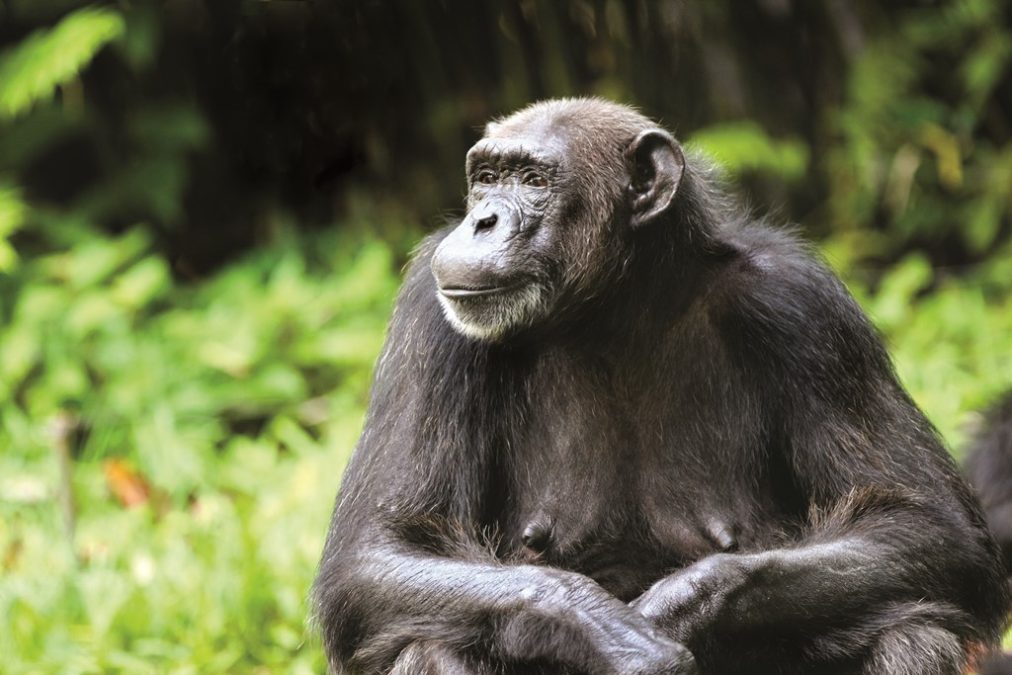
Chimpanzees are much smaller. Adult males usually weigh 40 to 70 kg, and females a little less. Standing upright, a chimp is about 1.2 to 1.5 metres tall.
Their body shapes differ too. Gorillas are broad and barrel-chested, with huge shoulders and a tall, cone-shaped head created by a bony crest on top of the skull in adult males. Chimpanzees are slimmer and more agile, with long arms built for climbing and swinging through the trees.
How to Tell a Gorilla From a Chimpanzee by Face and Ears
Look closely at the head and you will spot the gorilla vs chimpanzee difference straight away:
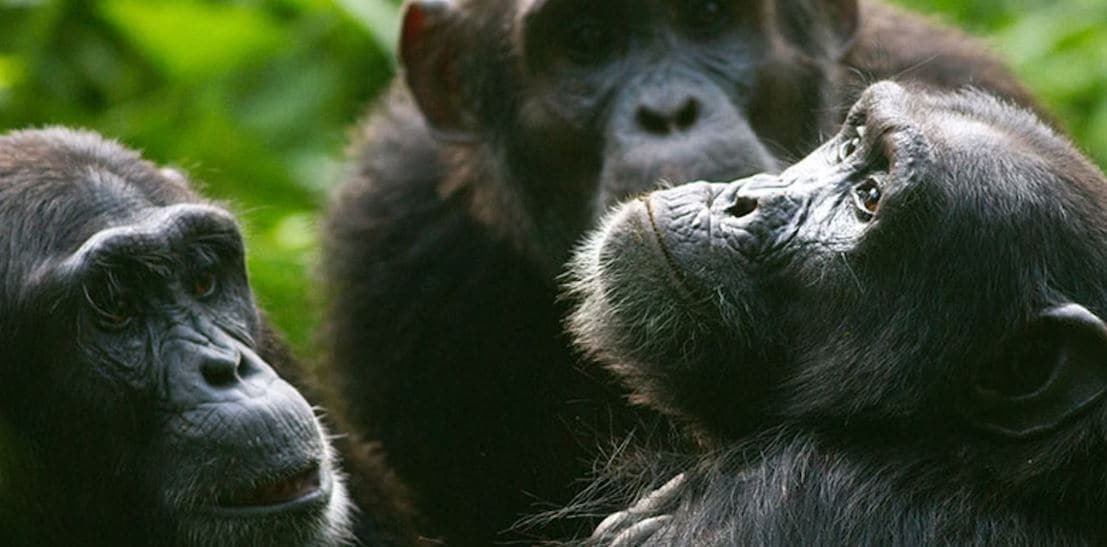
- Ears: chimps have large, rounded ears on the sides of the head, a bit like ours. Gorilla ears are small and set close to the head.
- Face: gorillas have dark, leathery faces with a wide, flat nose and large nostrils. Chimps often have lighter or pinkish faces, a smaller nose and a more pushed-out mouth.
- Brow and head: gorillas have a heavy brow and, in males, a tall crest on top of the head. Chimps have a rounder head and very expressive lips.
- Hair: mature male gorillas grow a silver saddle of hair on the back, which is where the name silverback comes from. Chimpanzees stay black or dark brown, though older chimps may go grey or bald.
Gorilla vs Chimpanzee: Habitat and Range
Gorillas live only in the tropical forests of central and east Africa. Mountain gorillas, the subspecies you can trek, live high on volcanic slopes and in montane forest at roughly 1,400 to 4,000 metres. They are found only in Uganda, Rwanda and DR Congo, and Uganda's Bwindi Impenetrable National Park holds about half of them. Lowland gorillas live in dense forests and swamps in west and central Africa.
Chimpanzees are far more adaptable. They live across around 20 African countries, in rainforest, swamp forest, woodland and even dry savanna. In Uganda, the best place to see them is Kibale Forest National Park, home to about 1,500 chimps. They also live in Budongo Forest near Murchison Falls and in Kyambura Gorge in Queen Elizabeth National Park.
Gorillas spend most of their time on the ground. Chimps move between the ground and the treetops, which can make them harder to see on a trek, as you will often find yourself looking up.
Gorilla vs Chimpanzee: Social Life
A gorilla family is a quiet, close-knit unit. Most groups have about 5 to 30 members, led by one dominant silverback with several adult females and their young. Some groups include more than one silverback. The family travels, feeds and rests together, and the silverback protects them and settles disputes.
Chimpanzees live in much larger communities of 20 to 150 individuals, ruled by an alpha male. A chimp community constantly splits into smaller groups that wander, feed and later reunite. Scientists call this a fission-fusion society. There is always drama: males competing for rank, youngsters playing, mothers grooming, and groups patrolling the edges of their territory.
This makes a chimp trek lively and unpredictable, while a gorilla visit is calmer and more intimate.
See Gorillas and Chimps in One Trip: Ask Us on WhatsApp
Gorilla vs Chimpanzee: Diet
Gorillas are almost entirely vegetarian. Mountain gorillas eat mainly leaves, stems, shoots and pith, plus some bark, roots and a little fruit, along with the occasional ant or termite. An adult silverback can eat 18 kg or more of plants a day. Learn more in our guide to the diet for gorillas.
Chimpanzees eat mostly ripe fruit, especially figs, but their diet is much broader. They eat leaves, seeds, flowers, honey, insects and eggs. Chimps also hunt. In Kibale they regularly hunt red colobus monkeys, working together and sharing the meat. Gorillas never hunt.
Gorilla vs Chimpanzee: Communication
Gorillas are usually quiet. They communicate with soft grunts, rumbles and belches that show the family is content, especially while feeding and resting. When a silverback wants to impress or warn, he may hoot, stand upright, beat his chest and make a short charge. Most of these displays are bluff, not real attacks.
Chimpanzees are among the noisiest animals in the forest. Their famous "pant-hoot" call builds from soft hoots to loud screams and can be heard over a kilometre away. It helps scattered groups keep in touch. Chimps also drum on the buttress roots of big trees and use a wide range of facial expressions, gestures and grooming to manage their relationships.
Gorilla vs Chimpanzee: Strength
In a gorilla vs chimpanzee strength contest, the gorilla wins easily, simply because a silverback weighs three to four times as much as a chimp. Estimates suggest a silverback is many times stronger than an adult human, and he can snap bamboo and pull down branches with ease. See our full guide to silverback gorilla strength.
Chimps are also very strong for their size. Studies suggest a chimp's muscles are around one and a half times as powerful as a human's, pound for pound, thanks to a higher share of fast-twitch muscle fibres. That makes chimps explosive climbers and fighters, but still no match for a silverback.
Which Is More Aggressive, a Gorilla or a Chimpanzee?
Despite their size, gorillas are the gentler of the two. They avoid conflict, and a silverback usually uses noisy displays to warn rather than fight. Habituated gorilla families are calm around visitors, which is why gorilla trekking is so safe.
Chimpanzees are more unpredictable. Males compete fiercely for rank, communities can attack neighbouring groups, and chimps hunt other animals. On a guided trek with experienced rangers, though, chimp tracking is very safe. You simply keep your distance and follow your guide's instructions.
Gorilla vs Chimpanzee: Intelligence
Both apes are highly intelligent, with excellent memories, problem-solving skills and complex emotions. Both have learned sign language in captivity and recognise themselves in a mirror.
Chimpanzees are especially famous for using tools in the wild. They poke sticks into termite mounds to "fish" for termites, crack nuts with stones and use leaves as sponges to drink water. Gorillas use tools less often, perhaps because their food is all around them, but they have been seen using sticks to test the depth of water. Different chimp communities even have their own traditions, a simple form of culture.
Gorilla vs Chimpanzee: Lifespan
In the wild, gorillas usually live about 35 to 40 years. In zoos, some live into their fifties and beyond. The oldest known gorilla, Fatou at Berlin Zoo, passed her 65th birthday.
Wild chimpanzees can live 40 to 50 years, although many die younger from disease, injury or fights. In captivity, some chimps have lived past 60.
Conservation: Are Gorillas and Chimpanzees Endangered?
Both apes are threatened by habitat loss, poaching and disease, including illnesses caught from humans.
- Mountain gorillas: about 1,000 remain, all in the wild. Thanks to strong protection and gorilla tourism, they were moved from Critically Endangered to Endangered in 2018, a rare conservation success.
- Other gorillas: eastern lowland, western lowland and Cross River gorillas are all Critically Endangered.
- Chimpanzees: listed as Endangered, with an estimated 170,000 to 300,000 left in the wild, down from around a million a century ago.
Your trekking permit directly supports these apes. Part of every permit fee funds park protection and local communities, giving people around the parks a reason to protect the forest.
Where to See Gorillas and Chimpanzees in Uganda


Uganda is the best country in Africa for a combined gorilla and chimpanzee safari. The two parks are linked by a scenic drive through Queen Elizabeth National Park, so you can add boat cruises and game drives along the way.
- Gorilla trekking: in Bwindi Impenetrable National Park or Mgahinga Gorilla National Park. A gorilla trekking permit costs US$800 per person, you spend one hour with the family, and trekkers must be at least 15 years old.
- Chimpanzee trekking: in Kibale Forest National Park, where a permit costs US$250 per person and success rates are very high. Kyambura Gorge and Budongo Forest are good alternatives.
- Rwanda: gorilla permits in Volcanoes National Park cost US$1,500. Compare all options in our gorilla permit prices guide.
Gorilla vs Chimpanzee Trekking: Which Is Better?
You do not have to choose. The two experiences are very different, which is why most visitors do both.
Gorilla trekking is a slower, deeper encounter. After a hike through thick forest, you sit quietly near a gorilla family for an hour and watch them feed, rest and play. Most visitors describe it as the most moving wildlife moment of their lives.
Chimpanzee trekking is fast and exciting. You follow a noisy community through the forest, hear the pant-hoots echo around you and watch chimps climb, groom and squabble above your head. Kibale is also home to 12 other primate species and hundreds of birds.
Together they make the perfect primate safari, and Uganda lets you do both in under a week.
Plan Your Gorilla and Chimpanzee Safari With Tulambule
Tulambule Uganda Safaris is a licensed, 100% Ugandan-owned tour operator that has planned primate safaris since 2014. We secure your permits, book your lodges and arrange an experienced driver-guide, so you can enjoy the gorilla vs chimpanzee experience side by side. Popular trips:
- 3 Day Gorilla Trekking Uganda Tour
- 3 Day Kibale Chimp Trekking Tour
- 5 Days Uganda Safari: Gorillas, Chimps, Wildlife and Culture
- 7 Day Uganda Gorilla and Chimpanzee Safari
- All Uganda gorilla safaris
Call or WhatsApp +256 782 915 447 or +256 703 171 855, or email info@tulambule.com.
Book Your Primate Safari on WhatsApp