Silverback gorilla strength is among the most impressive in the animal kingdom. A fully grown silverback can weigh up to about 220 kg (485 pounds), stand around 1.8 metres (6 feet) tall on two legs, and is estimated to be between 4 and 10 times stronger than an adult human.
Yet this same giant spends most of his day eating leaves, resting and quietly watching over his family. In this guide, we look at how hard a silverback can punch, how much he can lift and how strong his bite is. We also show you how to stand just metres from one on a gorilla trekking safari in Uganda, the best-value place in Africa to see mountain gorillas.
Get a Free Gorilla Trekking Quote on WhatsApp
Silverback Gorilla Strength in Numbers: 9 Key Facts
Here is silverback gorilla strength at a glance. Most figures are estimates, because no wild gorilla has ever been formally tested.
| Fact | Estimate |
|---|---|
| 1. Strength compared to an adult man | About 4 to 10 times stronger |
| 2. Punch or strike force | Roughly 1,300 to 2,700 pounds of force |
| 3. Bite force | About 1,300 PSI, roughly double a lion |
| 4. Lifting power | Often quoted at about 800 kg (1,760 pounds) |
| 5. Weight of a wild silverback | 140 to 220 kg (310 to 485 pounds) |
| 6. Height standing upright | About 1.7 to 1.8 metres |
| 7. Arm span | Up to about 2.6 metres |
| 8. Canine teeth | Up to about 5 cm (2 inches) |
| 9. Daily food | Up to about 18 kg of plants a day |
How Hard Can a Silverback Gorilla Punch?
Punching power is the part of silverback gorilla strength people ask about most. No one has ever measured a gorilla's punch with scientific equipment, so every figure you read is an estimate. Popular estimates put a silverback's strike at roughly 1,300 to 2,700 pounds of force, which would be around two to three times harder than the punch of an elite heavyweight boxer.
Gorillas don't actually punch the way boxers do. When silverbacks fight, they slap, shove, grab and bite, using open hands and forearms as much as fists. A single blow from those arms could still cause serious, even fatal, injuries to a person.
The good news is that gorillas almost never use this power. They avoid conflict whenever they can, and silverback gorilla strength is mostly shown through displays rather than actual fighting.
Silverback Gorilla Strength Compared to Humans
Scientists estimate that silverback gorilla strength is between 4 and 10 times that of an average adult man. The wide range exists because gorillas can't be tested in a lab the way athletes can, so researchers compare body size, muscle mass and what gorillas do in the wild.
You'll often read that a silverback can lift around 800 kg (about 1,760 pounds), roughly twice what a top weightlifter manages. Treat that as a rough estimate too. What we do know from watching them is that silverbacks can bend and snap trees, tear apart banana stems and pull down thick branches with ease.
Much of silverback gorilla strength sits in the upper body. A silverback's arms are longer than his legs, with an arm span of up to about 2.6 metres, and his shoulders, back and chest carry a huge amount of muscle.
Gorillas also walk on their knuckles, so their arms carry part of their body weight every day. This constant use keeps the upper body strong without any gym required. You can see how this compares with our closest relatives in our guide to gorilla vs chimpanzee.
What Is a Silverback Gorilla?
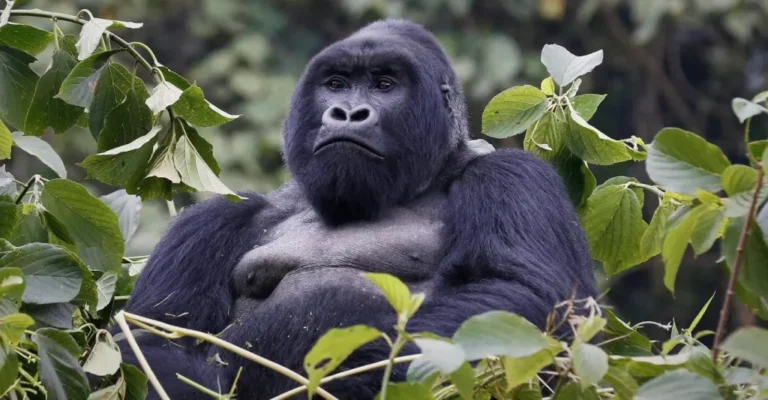
A silverback is not a separate species of gorilla. It's an adult male gorilla that has reached full maturity, usually from around 12 to 15 years old. At this stage, a saddle of silvery grey hair grows across his back, contrasting with the black hair on the rest of his body.
Only males develop this silver saddle, along with full silverback gorilla strength. Adult females stay dark all over, which makes the silverback easy to spot in a gorilla family.
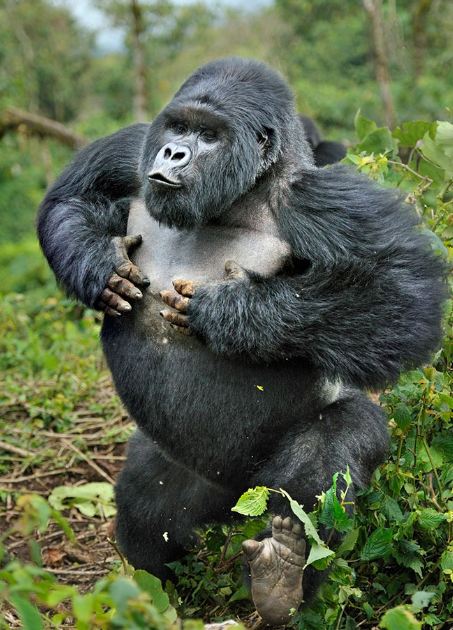
The silverback leads his group. He decides where the family feeds and rests, settles arguments and protects everyone from threats. He shows dominance through hooting, chest-beating, charging and slapping the ground or trees, and only rarely through real fights. Learn more in our guide to mountain gorilla behaviour in Uganda.
A male gorilla goes through several stages before becoming a silverback:
- Infant (0 to 3 or 4 years), still carried and breastfed by the mother
- Juvenile (4 to 6 years), weaned and becoming more independent
- Sub-adult (6 to 8 years), not yet sexually mature
- Blackback (8 to 12 years), sexually mature but not fully grown
- Silverback (12 years and older), fully mature with the silver saddle
Silverback Gorilla Size and Weight
To understand silverback gorilla strength, start with size. The gorilla is the largest ape in the world, and adult males are about twice the size of females. Wild silverbacks usually weigh between 140 and 220 kg (about 310 to 485 pounds) and stand around 1.7 to 1.8 metres tall when upright.
The heaviest wild gorilla on record, a male from Ambam in Cameroon, weighed about 267 kg (589 pounds). Gorillas in zoos can grow even heavier, sometimes over 300 kg, because they eat richer food and move far less than wild gorillas.
Size is a big part of silverback gorilla strength. More body mass means more muscle, and more muscle means more power, which is why a silverback is so much stronger than a person of similar height.
How Strong Is a Silverback Gorilla Bite?
Bite force is another striking part of silverback gorilla strength. A silverback's bite is one of the strongest of any land mammal. It's commonly estimated at around 1,300 PSI (pounds per square inch), about double the roughly 650 PSI of a lion.
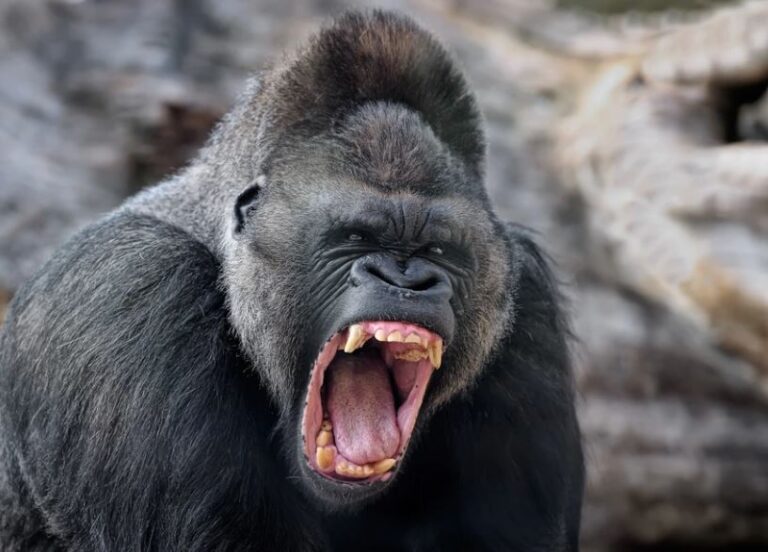
This bite comes from huge jaw muscles anchored to a bony ridge on top of the skull, called the sagittal crest, which gives adult males their tall, cone-shaped head. Gorillas need this power to chew tough stems, bark, roots and bamboo for hours every day.
Silverbacks also have long canine teeth, which can grow up to about 5 cm (2 inches). These aren't used for eating meat. Instead, they're shown off in displays to warn rivals and intruders, and used only in serious fights between males.
Why Is Silverback Gorilla Strength So Great?
Silverback gorilla strength comes from a mix of size, body shape and daily lifestyle. Gorillas are built heavy and wide, with thick bones and a very high share of muscle in their shoulders, back and arms.
Their daily life also works like non-stop training. Knuckle-walking puts weight through the arms with every step, and feeding means constantly pulling down branches, stripping bark and breaking open tough stems. Young males build this strength over years as they grow into silverbacks.
Diet plays its part too. Mountain gorillas are almost entirely vegetarian, eating leaves, shoots, stems, roots, bark and some fruit, plus the occasional ant or termite. An adult male can eat up to about 18 kg of plants a day. See our guide to the diet of gorillas.
Gorillas have a long gut filled with helpful bacteria that break down tough plant fibre and turn it into energy. This lets them build and power huge muscles on a diet that would leave a human hungry and weak.
Could a Human Fight a Silverback Gorilla?
No. Silverback gorilla strength is far beyond any person, and an unarmed human would have no realistic chance. A silverback weighs two to three times more than an average adult man, has far more muscle, much longer arms, and a bite strong enough to crush bone.
Gorillas also don't fight by any rules. In the rare cases when silverbacks fight each other, they charge, grab, strike and bite, and these clashes can leave serious wounds even on another gorilla.
Thankfully, this is a question for curiosity only. Habituated gorillas are calm around people, and on a guided trek, the rangers make sure no one ever gets close to that kind of situation.
Gorilla vs Lion: Who Would Win?
This match-up will never happen in the wild. Gorillas live in dense mountain and lowland forests, while lions live on open savannah. In Uganda, you'll find lions in Queen Elizabeth National Park and Murchison Falls National Park, and gorillas in the forests of Bwindi and Mgahinga.
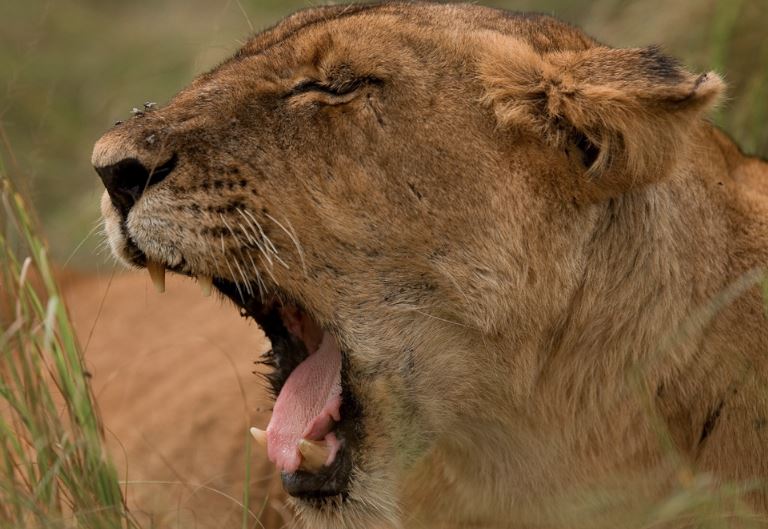
On paper, the two are closely matched in size, which makes silverback gorilla strength against lion power a close contest. A male lion can weigh up to about 190 kg, similar to a silverback. The gorilla has the stronger bite and more upper body power, but the lion is a trained hunter with sharp claws, meat-tearing teeth and a hunting instinct that aims straight for the throat.
Most experts give the lion the edge, because fighting and killing is what a lion does for a living, while a gorilla mainly uses his strength to eat and to scare off rivals. The good news for travellers is that Uganda lets you see both on one safari.
What Animals Are Stronger Than a Silverback Gorilla?
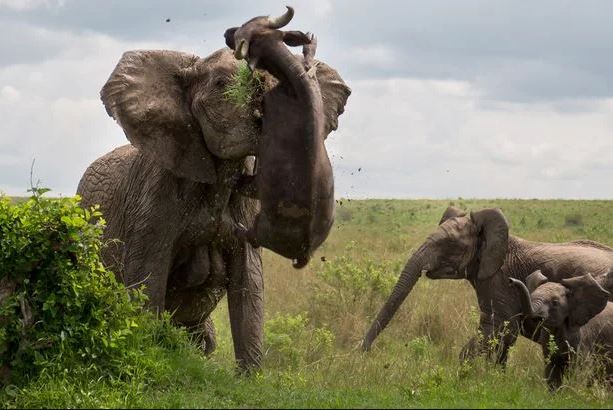
Silverback gorilla strength is remarkable, but a few animals are stronger. The African elephant is the strongest land animal, able to push over trees and lift heavy logs with its trunk. Grizzly bears are also generally considered stronger than gorillas.
When it comes to bite force, several animals beat the gorilla's 1,300 PSI. Hippos can bite at around 1,800 PSI, and the saltwater crocodile holds the record at about 3,700 PSI.
For strength compared with body size, the winner is tiny. Some dung beetles can pull more than 1,100 times their own body weight, a feat no gorilla could ever match.
Are Silverback Gorillas Aggressive?
No. Despite their huge silverback gorilla strength, they are generally calm, peaceful animals, which is why they're often called gentle giants. They use their power to feed and protect their families, not to attack.
When a silverback feels threatened, he first tries to scare the threat away. He may stand upright, beat his chest, roar, tear at plants or make a short mock charge. These displays are warnings, and a real attack is very rare.
The gorilla families you visit on a trek are habituated, meaning they've spent years slowly getting used to people. To keep both you and the gorillas safe, every visitor follows the Uganda Wildlife Authority's gorilla trekking rules:
- Keep a distance of at least 7 metres from the gorillas at all times.
- Don't use flash photography, as it can startle them.
- Speak quietly and avoid sudden movements.
- If a gorilla comes closer or charges, stay still, crouch down slowly and look away. Never run.
- Avoid staring into a gorilla's eyes, as this can be read as a challenge.
- Don't eat, drink or touch anything near the gorillas, and never touch a gorilla, even a playful baby.
- Don't trek if you have a cold, flu or any other illness, since gorillas can catch human diseases.
- Always stay with your group and follow your ranger and guide.
Each group has a maximum of eight visitors and spends one hour with the gorillas. Trekkers must be at least 15 years old. You can read the full regulations on the Uganda Wildlife Authority website, and our guide Is gorilla trekking safe? answers the most common worries.
Meet a Silverback Safely: Ask Us on WhatsApp
See Silverback Gorilla Strength Up Close in Uganda
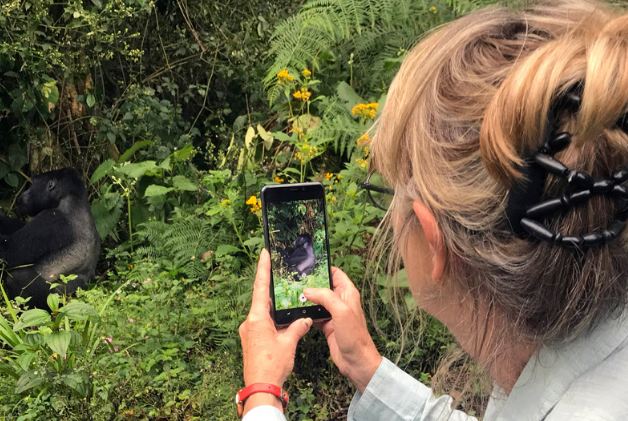
Reading about silverback gorilla strength is one thing. Watching a silverback strip a bamboo stem in seconds, or beat his chest a few metres away, is something you never forget. Mountain gorillas live only in the wild, in Uganda, Rwanda and the Democratic Republic of Congo, and there are none in any zoo in the world.
Uganda is home to about half of the world's mountain gorillas, spread across two parks:
- Bwindi Impenetrable Forest, with the most habituated gorilla families in Africa, spread across four trekking sectors.
- Mgahinga Gorilla National Park, a smaller park on the slopes of the Virunga volcanoes, also known for golden monkey tracking.
What a Gorilla Trekking Day Looks Like
Your day starts with an early briefing at the park headquarters, where rangers assign you to a gorilla family. You then hike through the forest with an experienced guide and trackers, which can take from one to several hours.
When you reach the family, you spend one unforgettable hour watching silverback gorilla strength in action as the silverback feeds and guards his family, alongside the mothers and playful babies. Porters can carry your bag and help on steep slopes. Read what really happens in one hour with mountain gorillas in Bwindi.
Uganda Gorilla Permit Prices
| Experience | Foreign non-resident price |
|---|---|
| Gorilla trekking permit, Uganda | US$800 per person |
| Gorilla trekking permit, Rwanda | US$1,500 per person |
That makes Uganda the best-value place to see silverback gorilla strength up close. East African citizens and residents pay much lower rates, so see gorilla trekking for Ugandans if you live in the region. For more detail, read our Uganda gorilla trekking permits guide and our gorilla permit prices comparison.
Want more time with the gorillas? Compare the standard trek with the longer gorilla habituation experience, which lets you spend up to four hours with a family still getting used to people.
Check Gorilla Permit Availability on WhatsApp
Gorilla Safaris to Meet a Silverback

These Tulambule safaris give you the chance to witness silverback gorilla strength for yourself. Every trip includes your permit, transport, guide and accommodation, and we can adjust the lodges to suit your budget.
| Safari | Highlights |
|---|---|
| 2-Day Gorilla Tour via Kigali | The quickest route to Bwindi if you fly into Rwanda |
| 3-Day Gorilla Trekking Uganda Tour | Our most popular gorilla trip from Kampala or Entebbe |
| 3-Day Fly-In Gorilla Safari | Fly from Entebbe to Bwindi and skip the long drive |
| 4-Day Gorillas, Chimps and Lake Bunyonyi | Gorillas plus chimpanzees and Uganda's most beautiful lake |
| 7-Day Uganda Wildlife Safari | Gorillas, chimps, lions and the Big Five |
| 10-Day Murchison Falls to Bwindi Safari | The full Uganda experience, from the Nile to the gorillas |
Coming from Rwanda? Our Rwanda national parks guide shows how to combine both countries. For more ideas, browse all our Uganda gorilla safaris and Uganda safaris, or see the cheapest ways to see gorillas in Uganda.
Tips for Your Gorilla Trek
- Book early: if you want to see silverback gorilla strength in person, remember that permits for June to September and December to February often sell out months ahead.
- Prepare your fitness: regular walks in the weeks before help a lot. See how to prepare for gorilla trekking.
- Pack for the forest: waterproof boots, a rain jacket, long sleeves and gardening gloves. Use our gorilla trekking packing list.
- Hire a porter: it makes the hike easier and supports a local family.
- Pick the right time: you can trek all year, but the dry seasons make the trails easier. Read about the best time to visit Uganda.
Silverback Gorilla Strength: Frequently Asked Questions
1. How strong is a silverback gorilla compared to a human?
A silverback is estimated to be between 4 and 10 times stronger than an average adult man. No gorilla has ever been formally tested, so this figure is based on body size, muscle mass and behaviour in the wild.
2. Do gorillas really punch?
Not like boxers. When silverbacks fight, they mostly slap, shove, grab and bite. Estimates put the force of a blow at roughly 1,300 to 2,700 pounds.
3. Can a silverback gorilla kill a human?
It is physically capable of it, but attacks on people are extremely rare. Habituated gorillas are calm around visitors, and following your ranger's instructions keeps you safe.
4. Is gorilla trekking in Uganda safe?
Yes. Treks are led by armed, experienced Uganda Wildlife Authority rangers, and the gorilla families have been habituated to people over many years. Thousands of visitors trek safely every year.
5. How much does a gorilla permit cost in Uganda?
A gorilla trekking permit in Uganda costs US$800 per person for foreign non-residents. Permits sell out in busy months, so book early, especially if you're travelling in the dry seasons.
6. Where is the best place to see silverback gorillas?
Bwindi Impenetrable Forest in Uganda is the best place to see silverback gorilla strength. It has the most habituated gorilla families in Africa, and Uganda's permits cost about half the price of Rwanda's.
Meet a Silverback with Tulambule
Tulambule Uganda Safaris is 100% Ugandan-owned, accredited by the Uganda Tourism Board and the Uganda Wildlife Authority, a member of the Association of Uganda Tour Operators (AUTO) and rated 4.9 stars on TripAdvisor. Since 2014 we have taken travellers from around the world to see silverback gorilla strength for themselves, safely and responsibly.
We secure your permit, plan your route and handle every detail. Call or WhatsApp +256 782 915 447 or email info@tulambule.com for a free quote.