Every safari brochure talks about the Big Five. Fewer mention the Ugly Five, a far less glamorous but arguably more entertaining lineup of African wildlife that rarely gets the attention it deserves. The classic Ugly Five, as the term is used across East and Southern Africa, includes the spotted hyena, the marabou stork, the vulture, the warthog, and the wildebeest, five species united less by biology than by a shared reputation for being, by most conventional standards, not especially pretty. The name is playful rather than scientific, a counterpoint to the swagger of lion, leopard, elephant, buffalo, and rhino, and it has become a genuinely popular talking point on safaris across the continent.
What makes the Ugly Five worth knowing about is not just the joke of the name but the substance behind it. Every member of the Ugly Five plays an outsized ecological role, often as a scavenger or ecosystem engineer, doing unglamorous work that keeps the wider savanna functioning. This guide introduces each member of the Ugly Five, explains where Uganda fits into the picture, and is honest about one detail that many articles on this topic quietly skip over: not every member of the classic Ugly Five actually lives in Uganda, and understanding why makes for a far more interesting story than simply pretending otherwise.
The Ugly Five concept has grown steadily in popularity alongside a broader shift in how safari operators talk about wildlife. Where older marketing leaned almost entirely on the drama of predators and the status of the Big Five, a newer generation of guides and travel consultants has found that travelers respond just as strongly, sometimes more strongly, to animals with personality and a good story, regardless of how conventionally attractive they are. The Ugly Five fits neatly into this shift, offering a lighthearted hook that draws attention to species travelers might otherwise overlook entirely in favor of chasing a lion sighting.
For a country like Uganda, already rich in primates and forest wildlife that fall outside the traditional Big Five framework altogether, the Ugly Five offers another useful way to broaden how visitors think about what counts as a worthwhile safari sighting.
The Spotted Hyena
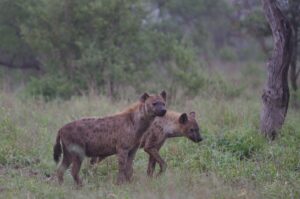
Few animals suffer from worse public relations than the spotted hyena, and it is usually the first name mentioned whenever the Ugly Five comes up in conversation. With a sloping back, oversized head, and a bone-crushing bite stronger than that of a lion, the spotted hyena has long been cast as the villain of African wildlife documentaries and folklore alike, a reputation only reinforced by its unsettling, almost human-sounding call. In reality, the spotted hyena is a highly intelligent, socially complex animal that lives in matriarchal clans and hunts far more often than popular mythology gives it credit for, rather than surviving purely on scavenged scraps.
In Uganda, members of the Ugly Five such as the spotted hyena are reasonably common across several savanna parks, including Queen Elizabeth National Park, Murchison Falls National Park, and Kidepo Valley National Park, where they are most often encountered on night game drives or at dawn, moving in small groups along tracks and waterholes. Because hyenas are primarily nocturnal, a dedicated night drive significantly improves the odds of a good sighting, and guides in parks like Queen Elizabeth are generally well practiced at locating active clans near known den sites.
For travelers curious about the Ugly Five specifically, the spotted hyena is usually the easiest member of the Ugly Five to tick off an East African itinerary, given how widespread the species remains across the region's savanna parks.
The Marabou Stork
If the spotted hyena wins on reputation, the marabou stork wins outright on appearance. Standing nearly five feet tall with a bald, mottled head, a drooping pink throat pouch, and an awkward, hunched posture, the marabou stork is frequently singled out as the single ugliest member of the entire Ugly Five, a title it seems to wear with total indifference.
Like vultures, marabou storks are primarily scavengers, often seen picking through carcasses alongside hyenas and vultures, though they are opportunistic enough to eat almost anything, from small mammals and fish to, notoriously, scraps scavenged from rubbish dumps near urban areas.
As one of the Ugly Five's most recognizable members, marabou storks are extremely common throughout Uganda, and unlike several other members of the Ugly Five, they are just as likely to be spotted in Kampala itself, perched on rooftops or stalking through markets, as they are in a national park. Within Uganda's protected areas, marabou storks are frequently seen around the Kazinga Channel in Queen Elizabeth National Park and along the Nile at Murchison Falls, often gathering in numbers near fresh kills or carcasses left by larger predators.
Despite the unflattering reputation, marabou storks are a genuinely fascinating species up close, with a wingspan among the largest of any bird in Africa and a surprisingly graceful soaring flight once airborne, a stark contrast to their ungainly appearance on the ground.
Vultures
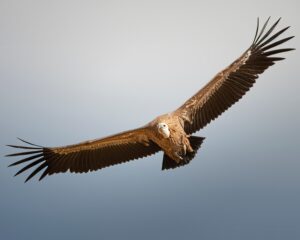
Several species of vulture are grouped together under the Ugly Five banner as scavengers, their bald heads and necks, an adaptation for hygienic feeding on carrion, earning them a permanent spot on the Ugly Five regardless of species. Uganda is home to several vulture species, including the white-backed vulture, the hooded vulture, and the increasingly rare lappet-faced vulture, all of which play a critical role in clearing carcasses quickly and limiting the spread of disease across the savanna. Without vultures working alongside hyenas and marabou storks, carcasses would linger far longer in the landscape, with knock-on consequences for the health of entire ecosystems.
Unfortunately, vulture populations across Uganda and the wider region have declined sharply in recent decades, driven primarily by poisoning, both accidental and, in some cases, deliberate, aimed at predators but catching scavenging vultures in the process. This decline has made genuine vulture sightings somewhat less reliable than they once were, though Queen Elizabeth National Park and Murchison Falls National Park remain among the better places in Uganda to see them, particularly near known kill sites or during a Kazinga Channel boat cruise, where vultures are often visible perched in trees along the water's edge. Conservation organizations working in Uganda have increasingly flagged vulture protection as a priority, given how disproportionately important these birds are to the health of the wider savanna ecosystem relative to their modest public profile.
The Warthog
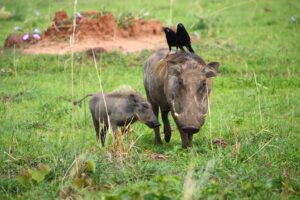
Of all the members of the Ugly Five, the warthog is probably the most universally endearing despite, or perhaps because of, its unconventional looks. With prominent facial warts, curved tusks, a bristly mane, and a thin tail that sticks straight up when it runs, the warthog has become something of an accidental mascot for African safaris, helped considerably by its starring role as Pumbaa in a famous animated film. Warthogs are almost comically common across Uganda's savanna parks, trotting across roads, grazing on their front knees in open grassland, and generally going about their business with an air of complete unconcern for passing safari vehicles.
Unlike several other members of the Ugly Five, warthogs present no real identification challenge or scarcity issue in Uganda, since they are reliably seen in Queen Elizabeth National Park, Murchison Falls National Park, Lake Mburo National Park, and Kidepo Valley National Park, often in family groups trailed by several piglets running in single file behind an adult.
Warthogs shelter in abandoned burrows, typically those dug by aardvarks, and back into them tail-first as a defense against predators, a behavior guides often point out as one of the more entertaining small details of a Uganda game drive. For travelers working through the Ugly Five checklist, the warthog is by far the easiest and most reliably amusing member of the Ugly Five to encounter.
Why Uganda Breaks the Pattern
The wildebeest, the fifth classic member of the Ugly Five, is not a resident species in Uganda. Despite Uganda's remarkable wildlife diversity, the country's savanna habitats, more broken up by woodland and swamp than the vast open plains of the Serengeti-Mara ecosystem, have never supported significant wildebeest populations, and none of Uganda's national parks host them today.
The great wildebeest migration that so many travelers associate with East African safaris takes place entirely within Kenya and Tanzania, and travelers hoping to complete a classic Ugly Five sighting purely within Uganda will come up one species short.
This is not a flaw in Uganda's wildlife credentials so much as a reflection of genuinely different habitat and ecology, and it is worth stating plainly rather than glossing over, since plenty of safari content simply repeats the standard Ugly Five list without checking whether every member actually belongs to the country being described. What Uganda does offer instead is the topi, a close relative of the wildebeest found in Queen Elizabeth National Park's Ishasha sector and in Kidepo Valley National Park, sharing much of the same ungainly charm and distinctive blue-jeans-and-yellow-socks coloring that safari guides love to point out.
Many Uganda-based guides and operators have also taken to informally nominating the giant forest hog, the world's largest wild pig species and a genuine resident of Kibale Forest and Queen Elizabeth National Park, as Uganda's own unofficial fifth member of the Ugly Five, a bristly, tusked, thoroughly unglamorous animal that fits the spirit of the Ugly Five even if it was never part of the original lineup devised further south.
For travelers who want the full, textbook Ugly Five experience with wildebeest included, that means combining a Uganda safari with time in Kenya or Tanzania. For those happy to embrace Uganda's own take on the Ugly Five concept, the hyena, marabou stork, vulture, warthog, and either topi or giant forest hog make a genuinely satisfying, and arguably more honest, Uganda-specific version of the Ugly Five.
Why the Ugly Five Matters
Beyond the novelty value of the name, the Ugly Five deserves genuine respect for the ecological work its members perform. Hyenas, vultures, and marabou storks together form much of the savanna's cleanup crew, consuming carcasses that would otherwise decompose slowly and potentially spread disease among other wildlife and livestock.
Warthogs, through their rooting and grazing habits, help shape vegetation patterns across the grassland, while their abandoned burrows provide shelter for numerous other species. Even the wildebeest, absent from Uganda but central to the ecosystems further south, plays an outsized role in shaping the vegetation and nutrient cycles of the Serengeti-Mara system through sheer scale of numbers.
Guides across Uganda increasingly use the Ugly Five concept as a teaching tool, a way to draw visitor attention toward the less obviously charismatic species that keep an ecosystem functioning, rather than letting every conversation default to lion and elephant sightings alone. Framing these animals through the lighthearted Ugly Five lens tends to land well with travelers precisely because it does not pretend these species are beautiful in a conventional sense, instead inviting a different kind of appreciation based on behavior, ecology, and, frankly, personality.
Where to See Uganda's Ugly Five
Queen Elizabeth National Park offers the single best concentration of Ugly Five sightings anywhere in Uganda, combining healthy hyena and warthog populations with reliable marabou stork and vulture activity around the Kazinga Channel and the Kasenyi plains, plus the topi herds of the Ishasha sector standing in for the missing wildebeest. A multi-day stay here, built around game drives and a boat cruise, gives travelers working through the Ugly Five concept their best single shot at covering most of the Ugly Five within one park.
Murchison Falls National Park runs a close second, with strong hyena and warthog numbers across the delta plains, plus marabou storks and vultures commonly seen along the Nile, particularly near the base of the falls where fish and other food sources concentrate. Kidepo Valley National Park, more remote and far less visited, offers a genuinely wild, uncrowded alternative for spotting hyenas, warthogs, and both topi and giant forest hog, albeit with a longer journey required to reach this far northeastern corner of the country. Lake Mburo National Park, smaller and easier to combine with a southwestern itinerary, reliably delivers warthog and occasional hyena sightings, particularly on one of its distinctive night game drives.
Photography Tips for the Ugly Five
Photographing the Ugly Five rewards a slightly different approach than chasing the Big Five. Marabou storks and vultures are most dramatic in flight or gathered around a carcass, so patience near a known feeding site, where your guide suspects recent predator activity, often pays off better than driving in search of a single perfect portrait shot.
Warthogs photograph best at eye level where possible, since their distinctive silhouette, tusks raised and tail held stiffly upright as they trot away, is a classic and genuinely charming safari image that rewards a slightly lower camera angle than the usual vehicle-seat vantage point.
Hyenas are most active, and therefore most photogenic, during the low light of early morning or a dedicated night drive, where a good spotlight technique from your guide can pick out eyeshine and movement well before the animals themselves come into clear view. Because several members of the Ugly Five are scavengers drawn to carcasses, photographers hoping for dramatic feeding interactions should be prepared for genuinely graphic scenes, and should discuss expectations with their guide in advance if that kind of sighting is not to every traveler's taste.
Frequently Asked Questions About the Ugly Five
Travelers encountering the Ugly Five concept for the first time tend to ask a similar handful of questions, and it is worth answering them directly rather than leaving the idea half explained. Is the Ugly Five an official wildlife classification? No. Unlike the Big Five, which originated from a specific historical context around big game hunting, the Ugly Five is an informal, affectionate label that safari guides and tour operators across East and Southern Africa have popularized over the past couple of decades, and there is no governing body or scientific consensus that fixes the membership permanently.
This is precisely why minor variations exist between countries and operators, and why Uganda's own take on the Ugly Five sensibly swaps in a locally resident species where the classic lineup does not quite fit.
Can you see the full Ugly Five on a single Uganda safari? Four of the Ugly Five, yes, reliably, particularly in Queen Elizabeth National Park. The fifth slot, traditionally held by the wildebeest, is the exception, and travelers determined to tick every classic member of the Ugly Five will need to extend their trip into Kenya or Tanzania to do so. Within Uganda alone, substituting topi or giant forest hog for the missing wildebeest gives a complete and satisfying version of the Ugly Five concept without requiring a second country on the itinerary.
Is the Ugly Five dangerous to view up close? Spotted hyenas and, less commonly, vultures gathered at a carcass can represent a genuinely intense wildlife encounter, and guides generally maintain a respectful distance during these sightings for good reason. Warthogs and marabou storks present essentially no danger to visitors observing from a vehicle, and most Ugly Five encounters in Uganda are calm, unhurried affairs rather than anything approaching the tension of a predator hunt.
Why do some operators include different animals in their version of the Ugly Five? Because the term was never formally standardized, different operators and regions have occasionally proposed their own variations, sometimes substituting the ostrich or the vulture for a different scavenger species depending on local wildlife. Uganda's informal substitution of topi or giant forest hog for wildebeest fits comfortably within this flexible tradition, and travelers should not be surprised if different guides describe Uganda's version of the Ugly Five slightly differently depending on their own regional experience and preference.
Planning a Uganda Safari Around the Ugly Five
Building an Ugly Five theme into a wider Uganda safari works best as a complement to, rather than a replacement for, the standard Big Five and primate trekking itinerary most travelers already have in mind. A few days in Queen Elizabeth National Park, ideally including both a game drive and a Kazinga Channel boat cruise, will deliver strong odds on the hyena, marabou stork, vulture, and warthog, while a short drive into the Ishasha sector adds topi to stand in for Uganda's missing wildebeest.
Travelers continuing on to Murchison Falls or Kidepo Valley will have further opportunities to round out sightings, particularly of hyena and warthog, which are reliably present across most of Uganda's savanna parks.
For travelers who genuinely want to complete the textbook Ugly Five, wildebeest included, combining a Uganda safari with a short extension into Kenya's Masai Mara or Tanzania's Serengeti remains the only reliable way to do so, and this kind of multi-country itinerary has become increasingly popular precisely because it lets travelers experience Uganda's primate and forest strengths alongside the open-plains wildlife spectacle found further south.
Whichever route a traveler chooses, the Ugly Five offers a genuinely entertaining lens through which to view an East African safari, a reminder that the most memorable wildlife encounters are not always the most conventionally beautiful ones, and a good Uganda-based travel consultant can help build an itinerary that gives this quirky, underrated lineup the attention it deserves alongside the more familiar headline species.
suggested packages for your safari in Uganda
7 Days Uganda Safari, Gorilla, Chimps, Culture & Wildlife
7 Days Uganda Birding Tour | Shoebills, Chimps, Gorillas, & More
7-Day Uganda Wildlife Safari | Chimps, Gorillas, Big 5 & More!
8 Days Uganda Safari, Big 5, gorillas, Chimps and Tree-Climbing Lions
8 Days Adventure Tour Uganda
9-Day Ultimate Uganda Safari: Unforgettable Gorillas, Wildlife & Cultural Encounters 2026
10-Day Uganda And Kenya: Gorilla & Big 5 Safari
10-Day Rwanda and Gorillas of Uganda Safari
11-Day Uganda Tanzania Safari | Gorillas & Big Game Viewing
12 Days Uganda Safari, Big Five, Chimps, Gorillas and Culture
13 Days Uganda, Rwanda and Kenya Safari