Most travelers arriving at Kibale National Park spend their energy preparing for the morning chimpanzee trek which is completely understandable. Kibale holds the highest density of primates in East Africa, and its chimpanzee communities are among the most studied and most rewarding to visit anywhere on the continent. But the majority of those same travellers completely overlook what waits for them just 6 kilometers away: Bigodi Wetland Sanctuary.
Bigodi Wetland Sanctuary is not a footnote to the Kibale experience. It is a destination in its own right a papyrus-choked, bird-loud, primate-rich swamp ecosystem where eight species of primates, over 200 bird species, rare mammals, and one of Africa's finest community conservation stories all converge in a trail that takes just 2 to 4 hours to walk.
Whether you are building a Uganda safari from Kampala, adding a half-day activity after your chimpanzee habituation experience in Kibale, or travelling with a birding checklist that needs filling fast, Bigodi Wetland Sanctuary will deliver one of the most unexpected and deeply satisfying wildlife experiences in Uganda. Here are 10 things you need to know before you go.
1. Bigodi Wetland Sanctuary Is a Community-Run Conservation Success Story
Before anything else, it is worth understanding who runs Bigodi Wetland Sanctuary and why that matters. Unlike Uganda's national parks managed centrally by the Uganda Wildlife Authority Bigodi is governed entirely by the Kibale Association for Rural and Environmental Development, better known as KAFRED.
KAFRED was established in 1992 by local residents who recognized that the Magombe Swamp bordering Kibale National Park was being rapidly degraded. Poaching was rampant. Primates raiding farms were killed in retaliation. The swamp's ecological value was being lost with no economic benefit flowing to the communities living around Bigodi Wetland Sanctuary.
What KAFRED achieved in just over three decades is remarkable by any measure. Bigodi Wetland Sanctuary is now frequently cited by USAID, UNDP, and conservation journals as one of Africa's most successful community-based conservation initiatives. The former poachers themselves have become some of the sanctuary's most knowledgeable and passionate trail guides.
Revenue from tourism has built schools including a secondary school a health centre, a water project, and micro-finance programmers that support the Batooro and Bakiga communities living alongside the wetland.
When you pay your entry fee at the KAFRED office, you are not buying a ticket to a tourist attraction. You are directly funding a conservation model that the world's leading development organizations study and reference. That meaningful distinction one transforms a swamp walk into something with genuine purpose.
2. The Name "Bigodi" Tells You Everything about the Journey to Get Here
The sanctuary's name is itself a piece of living history. Bigodi is derived from the Rutooro word kugodya, which translates roughly as "to walk in a weary, sluggish manner." The name arose because travelers arriving at the Magombe Swamp on foot after walking from distant villages and trading routes consistently reached the wetland exhausted and needing rest before they could continue.
Today the journey is considerably easier. Bigodi Wetland Sanctuary sits just 6 kilometers south of the Kanyanchu Tourist Centre in Kibale National Park, accessible by vehicle in a matter of minutes from the park's main visitor facilities. From Fort Portal town the gateway city for the western Uganda circuit it is under an hour's drive. From Kampala, the journey is approximately 330 kilometres and five hours by road.
The etymology is worth mentioning to your guide. It tends to spark some of the most enjoyable conversations about how the landscape has changed and what it meant for generations of people who walked this corridor long before tourists arrived.
3. Eight Primate Species Share the Sanctuary
The headline wildlife draw at Bigodi is its primates. Eight species are reliably present within the sanctuary's 4-square-kilometre extent a figure that is genuinely extraordinary for a wetland of this size. These include the red colobus monkey, the black and white colobus monkey, the grey-cheeked mangabey, the red-tailed monkey, the blue monkey, the olive baboon, the L'Hoest monkey, and the vervet monkey.
in Bigodi Wetland Sanctuary For many visitors, encountering grey-cheeked mangabeys leaping between canopy trees above the boardwalk section of the trail is the single most dramatic primate moment of their entire Uganda safari and one that even experienced wildlife photographers find difficult to anticipate or capture cleanly. The mangabeys move fast, travel in loud energetic groups, and seem entirely unconcerned by the presence of humans below.
Chimpanzees the star species of the adjacent Kibale National Park occasionally cross into the sanctuary to forage, though sightings are unscheduled and cannot be guaranteed.
If you are visiting Kibale primarily for chimpanzee trekking, read our guide to the Chimpanzee Habituation Experience for the most immersive and extended encounter available in Uganda. At Bigodi Wetland Sanctuary, the seven reliably resident species alone represent a primate diversity that rivals many larger protected areas across the continent.
4. Bigodi Is One of the Finest Birding Sites in Western Uganda
For serious birders, Bigodi Wetland Sanctuary is not a secondary activity. It is a primary destination. The sanctuary holds over 200 recorded bird species within a highly compact trail system meaning the hit rate per hour of walking is exceptionally high compared with larger forest birding areas. If birding is a central goal of your trip, explore our Uganda Birding Tours page for a complete picture of what Uganda's forests and wetlands offer.
The undisputed star of the avian cast is the Great Blue Turaco (Corythaeola cristata). At up to 76 centimeters in length and with plumage running from deep cobalt blue through turquoise and yellow, the Great Blue Turaco is one of the most visually spectacular birds in Africa. Bigodi Wetland Sanctuary is nicknamed the "Home of the Great Blue Turaco" and on most guided walks, spotting one is a near certainty rather than a hopeful possibility.
Beyond the turaco, the Bigodi Wetland Sanctuary hosts a spectacular array of species including the papyrus gonolek, the white-spotted flufftail, yellow-spotted barbet, hairy-breasted barbet, western nicator, grey-winged robin-chat, white-tailed ant-thrush, black-and-white casqued hornbill, blue-throated roller, superb sunbird, and the papyrus canary one of Uganda's most sought-after species for visiting birders.
Skilled birders regularly add 50 or more species to their trip list on a single Bigodi Wetland Sanctuary morning walk. Guided birding walks depart at 7:30 am, when the forest edge and papyrus habitat are most active. Request the morning slot and allow a full three to four hours rather than rushing.
5. The Bigodi Swamp Walk Is the Flagship Activity and It Is Extraordinary
The Bigodi Wetland Sanctuary Walk is a 4.5-kilometre guided circuit that takes between two and four hours depending on pace, wildlife sightings, and photography stops. It is the Bigodi Wetland Sanctuary headline activity and the format is unlike almost any other wildlife walk in Uganda.
The trail moves through several distinct habitat types in rapid succession. You begin on raised wooden boardwalks threading through dense papyrus swamp, where the sound of the wetland frogs, birds, rustling papyrus heads closes around you almost immediately.
The boardwalk transitions to forest edge walking along the boundary of Kibale National Park, where the tall hardwood canopy hosts the mangabeys, colobus monkeys, and the turaco. The trail then moves through community farmland at the Bigodi Wetland Sanctuary margin, where cultivated plots and wild vegetation exist side by side a landscape that tells the human story of conservation as clearly as any exhibit.
A trained local guide from the KAFRED community leads every walk. These guides are not simply trackers. They are naturalists with deep knowledge of the sanctuary's ecology, bird identification, primate behavior, and the social history of the communities around Bigodi. A good guide transforms what you see from a list of species into a connected, living system.
Walks depart twice daily: at 7:30 am and 3:00 pm. Mornings are strongly recommended for birding. Afternoon walks offer different light and occasional differences in primate activity patterns.
6. The Sitatunga Antelope Is One of Africa's Most Unusual Wetland Mammals
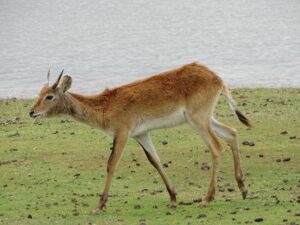
Among the mammals found at Bigodi Wetland Sanctuary, the sitatunga (Tragelaphus spekii) stands out as one of the most remarkable and specialised. The sitatunga is a semi-aquatic antelope one of very few large mammals that has evolved specifically to live in and around swamp habitats.
Males are shaggy and dark brown with white vertical stripes and spiralling horns. Females are smaller and reddish-brown without horns. Both sexes possess elongated, splayed hooves that function like snowshoes in soft mud, allowing them to move through papyrus and flooded ground that would trap other antelope species entirely.
Sitatungas are shy and crepuscular most active at dawn and dusk and sightings at Bigodi require a combination of patience, a quiet group, and a guide who knows the sections of the trail where these animals feed. When conditions align, watching a sitatunga move silently through the papyrus at the edge of the boardwalk section is one of the defining wildlife moments of the whole western Uganda circuit.
Other mammals present in the sanctuary include bushbuck, otters, bush pigs, mongooses, and the potto a slow-moving nocturnal primate encountered on optional night walks. For the full western Uganda mammal experience, combine Bigodi with a game drive in Queen Elizabeth National Park, which lies a short drive to the south.
7. Bigodi Has Won International Recognition for Sustainable Tourism
Bigodi Wetland Sanctuary is not simply admired locally. It has received formal international recognition for the model it represents including a UNESCO award for wetlands sustainable tourism acknowledging not only its biodiversity but the integrity and effectiveness of the community-based management structure that protects it.
The Uganda Wildlife Authority provides national policy oversight for wetland conservation across Uganda, while KAFRED handles the day-to-day management, guiding, and community benefit distribution at Bigodi.
The Bigodi Wetland Sanctuary is protected under Uganda's National Wetlands Conservation Policy, which recognises the ecological functions that wetland systems perform: water purification, carbon sequestration, flood regulation, and biodiversity habitat.
The Magombe Swamp's papyrus vegetation is particularly significant in this regard papyrus swamps are among the most productive carbon-storing ecosystems on earth, and their loss would have consequences that extend far beyond the wildlife that depends on them.
This partnership between national governance and grassroots community organisation is precisely the model that conservation practitioners worldwide argue should be replicated at far greater scale. A visit to Bigodi is, in a very real sense, a vote for that model continuing.
8. The Community Cultural Experience Is as Rich as the Wildlife
Bigodi Wetland Sanctuary is one of the rare wildlife destinations in Uganda where the cultural experience genuinely competes with the wildlife walk for depth and memorability. Most safari operators include or can arrange a community walk through the villages surrounding the wetland either before or after the swamp trail and this addition is strongly worth taking.
During the village walk, visitors engage directly with local artisans, weavers, and craftspeople many of them women involved in the Bigodi Women's Group project, which produces handmade baskets, mats, beads, and bags from materials sourced from the conserved swamp. These are not tourist trinkets manufactured far away.
They are genuinely local objects made from locally harvested materials by people whose livelihoods depend directly on the continued health of the wetland.
Visitors can also arrange demonstrations of traditional coffee roasting and preparation, banana beer brewing, and local cooking. The Bigodi Secondary School built with revenue generated by the sanctuary stands as the most visible symbol of what conservation-funded community development can look like in practice. Guides will often walk visitors past it with visible pride.
For families or travelers seeking a Uganda safari experience that extends beyond wildlife into authentic human culture, Bigodi delivers one of the most unscripted and meaningful community encounters in the country.
9. Optional Night Walks Reveal a Completely Different Wetland
Most visitors experience Bigodi in daylight but the sanctuary offers a completely different character after dark, and optional guided night walks are available for those whose schedules allow.
The primary targets on a Bigodi night walk are the nocturnal primates. The potto (Perodicticus potto) a slow-moving, wide-eyed primate that clings motionlessly to branches and is virtually invisible without a spotlight is one of the most unusual mammals in Uganda and one of the most reliably encountered on a good night walk. The Demidoff's galago, a tiny and agile nocturnal primate, is also present and audible across the sanctuary after dusk.
Beyond primates, the night walk offers a completely transformed soundscape: the explosive calls of tree frogs, the hunting patterns of owls moving through the forest edge, and the particular quality of darkness inside a papyrus swamp that very few visitors to Uganda ever experience. Nile monitor lizards that bask along the boardwalk trail during the day retreat to the water, replaced by different reptile activity that your guide will help you interpret.
Night walks must be arranged in advance through the KAFRED office and require a minimum group size. They are best combined with an overnight stay in or near Fort Portal, within easy reach of the sanctuary.
10. Bigodi Pairs Perfectly with Kibale and the Wider Western Uganda Circuit
Perhaps the single most important practical thing to know about Bigodi Wetland Sanctuary is how effortlessly it slots into a broader Uganda itinerary. It sits at the geographical and ecological heart of western Uganda's most productive safari circuit surrounded by some of the country's finest wildlife destinations within a compact driving radius.
A morning chimpanzee trek at Kibale National Park followed by an afternoon Bigodi Swamp Walk is one of the most satisfying single days available on any Uganda safari. The two activities complement each other perfectly in terms of habitat, species, and pace the high-energy forest tracking of the morning giving way to the quieter, contemplative rhythm of the boardwalk in the afternoon.
From Bigodi, the journey south to Queen Elizabeth National Park takes approximately two hours. Queen Elizabeth adds savanna game drives, hippo channel boat trips, and the famous tree-climbing lions of Ishasha making the Kibale–Bigodi–Queen Elizabeth combination a three-day western Uganda itinerary that delivers extraordinary species diversity without excessive travel time.
From Queen Elizabeth, the road to Bwindi Impenetrable Forest home to Uganda's mountain gorillas continues the circuit in a way that no other safari destination in Africa can match.
Read our full guide to Uganda Wildlife Safaris for a complete picture of how these experiences connect, or explore our Uganda Birding Tours page if Bigodi's avian richness is the centrepiece of your plans.
Plan Your Visit to Bigodi Wetland Sanctuary with
Bigodi Wetland Sanctuary is proof that Uganda's finest wildlife experiences are not always found inside the national parks themselves.
In a country where gorilla trekking in Bwindi and chimpanzee tracking in Kibale command the most attention, Bigodi stands as one of the most rewarding and most underrated half-days in the entire East African safari landscape a place where birds, primates, community, culture, and conservation all intersect on a trail you can walk in an afternoon.
Contact us today to start building your Uganda safari and we will make sure Bigodi Wetland Sanctuary is on the list.
Safaris That Include Bigodi Wetland Sanctuary
5 Days Uganda Safari – Gorillas, Chimps, Wildlife & Culture

6 Day Uganda Safari – Chimps, Gorillas and Wildlife

7 Days Uganda Safari – Gorilla, Chimps, Culture & Wildlife

7 Days Uganda Birding Tour – Shoebills, Chimps, Gorillas & More

8 Days Uganda Safari – Big 5, Gorillas, Chimps and Tree-Climbing Lions
Related Articles
Chimpanzee Trekking in Uganda

Bird Watching in Uganda: Ultimate Guide

Kibale National Park: Everything You Need to Know

Gorilla vs Chimpanzee: Key Differences Explained

10 Uganda Safari Forests & Bushes Worth Exploring